


The US-led administration in Iraq will present a plan to privatize the country's state-owned industries by the spring, the official in charge of the effort said Wednesday.
Iraqis will make the final decisions on how to manage the sales, said Thomas Foley, director of private sector development for the American-led Coalition Provisional Authority. He said he would give suggestions for detailed privatization plans to the US-appointed Iraqi Governing Council, which then would name a commission to oversee the process.
Foley said he would recommend that the state-owned companies not be simply sold to the highest bidder but be turned over using criteria such as the experience and solvency of the proposed owners and how the privatization plan would affect workers.

PHOTO: AP
Foley, a Harvard-trained businessman who calls himself a corporate turnaround specialist, oversees operations of about 150 of the 200 state-owned businesses in Iraq. He does not oversee the oil industry and related businesses or financial institutions such as banks and insurance companies.
About 250,000 Iraqis work for the businesses under his oversight, Foley said, including workers in phosphate and sulfur mining operations, pharmaceutical plants and car factories.
Foley said he had no idea how much the companies are worth because there is no reliable financial information about them.
Saddam Hussein's government owned and ran all large industries in Iraq under programs similar to the centrally controlled economies of the former Soviet Union. Lessons learned from the privatization of companies in Russia and Eastern European companies will help in the Iraqi process, Foley said.
Foley said he expected that most state-owned Iraqi companies would end up in the hands of Iraqis, not foreign owners. There is high interest in foreign investment in Iraq, however, particularly from companies in the Middle East, Foley said.
The biggest economic challenge in Iraq, Foley said, is not privatizing companies but creating enough of a new economy to absorb the workers who will be displaced in the privatization process.
"Those jobs will be the mechanism for making privatization work," Foley said in a conference call with reporters while on a visit back to the US.
An additional priority is developing and implementing business laws to crack down on the corruption that flourished under Saddam, Foley said.
"Under the old regime, bribes and kickbacks were a successful strategy," he said. "The key to turning that around is having a good set of commercial laws and a well-functioning judicial system so bad behavior is punished."
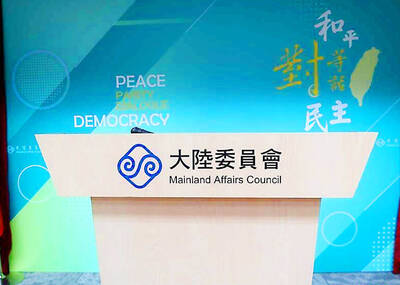
NO RECIPROCITY: Taipei has called for cross-strait group travel to resume fully, but Beijing is only allowing people from its Fujian Province to travel to Matsu, the MAC said The Mainland Affairs Council (MAC) yesterday criticized an announcement by the Chinese Ministry of Culture and Tourism that it would lift a travel ban to Taiwan only for residents of China’s Fujian Province, saying that the policy does not meet the principles of reciprocity and openness. Chinese Deputy Minister of Culture and Tourism Rao Quan (饒權) yesterday morning told a delegation of Chinese Nationalist Party (KMT) lawmakers in a meeting in Beijing that the ministry would first allow Fujian residents to visit Lienchiang County (Matsu), adding that they would be able to travel to Taiwan proper directly once express ferry

STUMPED: KMT and TPP lawmakers approved a resolution to suspend the rate hike, which the government said was unavoidable in view of rising global energy costs The Ministry of Economic Affairs yesterday said it has a mandate to raise electricity prices as planned after the legislature passed a non-binding resolution along partisan lines to freeze rates. Chinese Nationalist Party (KMT) lawmakers proposed the resolution to suspend the price hike, which passed by a 59-50 vote. The Taiwan People’s Party (TPP) voted with the KMT. Legislative Speaker Han Kuo-yu (韓國瑜) of the KMT said the resolution is a mandate for the “immediate suspension of electricity price hikes” and for the Executive Yuan to review its energy policy and propose supplementary measures. A government-organized electricity price evaluation board in March

FAST RELEASE: The council lauded the developer for completing model testing in only four days and releasing a commercial version for use by academia and industry The National Science and Technology Council (NSTC) yesterday released the latest artificial intelligence (AI) language model in traditional Chinese embedded with Taiwanese cultural values. The council launched the Trustworthy AI Dialogue Engine (TAIDE) program in April last year to develop and train traditional Chinese-language models based on LLaMA, the open-source AI language model released by Meta. The program aims to tackle the information bias that is often present in international large-scale language models and take Taiwanese culture and values into consideration, it said. Llama 3-TAIDE-LX-8B-Chat-Alpha1, released yesterday, is the latest large language model in traditional Chinese. It was trained based on Meta’s Llama-3-8B

NOVEL METHODS: The PLA has adopted new approaches and recently conducted three combat readiness drills at night which included aircraft and ships, an official said Taiwan is monitoring China’s People’s Liberation Army (PLA) exercises for changes in their size or pattern as the nation prepares for president-elect William Lai’s (賴清德) inauguration on May 20, National Security Bureau (NSB) Director-General Tsai Ming-yen (蔡明彥) said yesterday. Tsai made the comment at a meeting of the Legislative Yuan’s Foreign Affairs and National Defense Committee, in response to Democratic Progressive Party (DPP) Legislator Wang Ting-yu’s (王定宇) questions. China continues to employ a carrot-and-stick approach, in which it applies pressure with “gray zone” tactics, while attempting to entice Taiwanese with perks, Tsai said. These actions aim to help Beijing look like it has


 RSS
RSS