


The US-led administration in Iraq is to establish a major credit facility "within weeks" to lubricate overseas trade after last week's lifting of UN sanctions, its head Paul Bremer announced on Monday.
"It will be a substantial credit facility that first symbolically indicates to the world that Iraq is open for business and also provides a practical incentive to people who want to trade with Iraq," Bremer told a news conference.
The facility will be funded by a raft of private banks as well as the Central Bank of Iraq, he said.
He added that a further US$250 million of central bank reserves had been recovered undamaged from the bank's vaults after they had been drained of wartime flooding from the Tigris River by coalition troops over the past week.
"We are now nearing the end of the first stage of our task here and entering a new stage," said Bremer, noting that government ministries, most power and water supplies, and a new police force were all now up and running.
"The task now is to help the Iraqis rebuild their economy after decades of state control and mismanagement."
Bremer said the lifting of UN sanctions had been a "big step along this road."
"Oil revenues will now all be used for the Iraqi people as we work to establish the first free economy here in years," he said.
"Encouraging robust trade between Iraq and the rest of the world is a key part of our stra-tegy," he said, adding that a market economy was the "best protection for political freedom" in Iraq.
Bremer said the occupation had yet to work out any detailed economic policies, and was still looking at the closely related issues of trade tariffs, currency, and price deregulation.
"We are in the process now of trying to establish what the relationship should be and what the steps should be. I don't have a preconceived view on that," he said. "Because the economy was so tightly controlled and interlinked, you can't change any one part of it, without changing it all."
Bremer said that for the moment the ration system on which some 60 percent of Iraqis depended for basic goods under former president Saddam Hussein would be preserved.
"In the long term we would like to see market prices brought into the economy," he said.
"At this point it would be premature for me to lay down specific guidelines [for foreign investment] and it's a matter that, in the end, an Iraqi government would want to make a contribution to discussing," he said.

‘NO SECURITY RISK’: The Railway Bureau reassured the public that the technicians’ activities were limited to technical guidance and did not involve sensitive systems The Railway Bureau yesterday said it had invited eight Chinese technicians to assist with an airport MRT construction project. The bureau issued the confirmation after an Internet user said Chinese nationals had entered the construction zone of Taiwan Taoyuan International Airport’s Terminal 3 project. They asked why “individuals from an enemy state” were allowed access to such a major national infrastructure project, which raised serious concerns over Taiwan’s industrial safety, sensitive systems and information security. The bureau’s Northern Region Engineering Branch Office said subcontractor Taiwan Handle Industrial Co (台灣手把工業) of the Taoyuan airport MRT’s “Contract No. CU05 Project A14 Station Civil, MEP &

A US uncrewed surface vessel (USV) encountered multiple Chinese warships during an autonomous transit of the Taiwan Strait, US defense company Seasats said in a statement on Wednesday. Seasats announced that a Lightfish USV had completed the first autonomous transit of the Taiwan Strait. Over five days, the USV traversed the entire length of the Strait while constantly monitoring surface vessel traffic, the company said. The Lightfish encountered multiple Chinese warships, one of which was a Chinese People’s Liberation Army Navy (PLAN) Type 056 corvette, it said. The Chinese vessels were operating “well within Taiwan’s exclusive economic zone without transmitting their identity via the
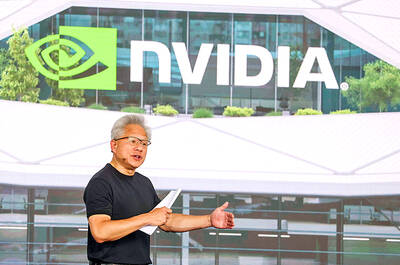
‘BOOMING’: ’ The number of partners we have here is incredible. You can see from their stock prices. They’re doing so well, they’re so happy,’ Jensen Huang said Nvidia Corp’s spending in Taiwan has ballooned to about US$150 billion a year, 10 times the US$10 billion to US$15 billion the company spent five years ago, Nvidia chief executive officer Jensen Huang (黃仁勳) said yesterday, suggesting Taiwan’s strategic importance in the global artificial intelligence (AI) supply chain. “Taiwan is the epicenter of the AI revolution. This is where the chips come, packaging comes. This is where the systems are made. This is where AI supercomputers were created,” Huang said at a meeting for the company’s employees in Beitou-Shilin Technology Park (北投士林科技園區) in Taipei, the planned site of Nvidia’s Taipei headquarters. “Taiwan
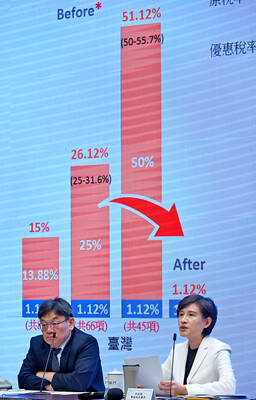
GREATER REACH? Auto parts and wood products would face tariffs of up to 15%, matching those targeting the EU, Japan and South Korea, Vice Premier said The US has announced that preferential tariff treatment for Taiwan’s non-semiconductor Section 232 goods would take effect retroactively from May 1, the Executive Yuan said yesterday. The US government yesterday posted a notice on the Federal Register’s public inspection Web site previewing tariff concessions for Taiwan under a memorandum of understanding (MOU) on Taiwan-US investment after two months of negotiations. The MOU signed on Jan. 15 stipulated three major preferential tariff arrangements: a 15 percent “reciprocal” tariff rate for Taiwan without stacking most-favored nation (MFN) rates; preferential Section 232 treatment for semiconductors and related products; and preferential Section 232 treatment for non-semiconductor


 RSS
RSS