


Slovaks yesterday voted in a general election, with the governing populists fighting for survival amid outrage over the 2018 gangland-style murder of a journalist whose stories exposed high-level corruption plaguing the eurozone country.
Allegedly a hit ordered by a businessman with connections to politicians, the killing of Jan Kuciak, which also took the life of his fiancee, Martina Kusnirova, has become a lightning rod for public outrage at graft in public life.
Hit hard by the fallout of the murder, most surveys suggested that former Slovak prime minister Robert Fico’s governing populist-left Smer-Social Democracy (Smer-SD) party was running neck-and-neck with OLaNO, a surging center-right opposition party focused on rooting out corruption.

Photo: AFP
OLaNO even outpaced Smer-SD by 3.5 percent in a last-minute AKO/Focus agency opinion survey published this week in the neighboring Czech Republic to bypass a pre-election polling ban in Slovakia.
“Change is much needed here,” said Daniela Jonasova, a 35-year-old office clerk, who told reporters that she voted for OLaNO at a Bratislava polling station shortly after it opened.
“I like the way [OLaNO leader Igor] Matovic points out what is wrong in Slovakia — I believe he’ll bring a real change,” she added, referring to OLaNO’s anti-graft focus.
“The election is primarily about the desire for decency in politics,” Bratislava-based political analyst Radoslav Stefancik said.
“Instead of protesting against the ruling Smer-SD party on the streets, people will do so in polling stations,” Stefancik said.
The double murder triggered the largest anti-government protests since communist times and toppled Fico as prime minister, with his party colleague Peter Pellegrini taking over the reins.
It also propelled Slovak President Zuzana Caputova, a liberal lawyer and anti-graft advocate, out of nowhere to win last year’s presidential race in the country of 5.4 million people.
The double murder “has reconfigured the entire political scene, as new liberal-democratic parties emerged and immediately gained support, political analyst Grigorij Meseznikov said.
“The most likely scenario is the creation of a center-right pro-democracy oriented government coalition of six or even seven parties,” he added.
Having vowed to immediately push through anti-corruption measures should he win office, OLaNO leader Matovic, a 46-year-old lawmaker, appeared to have galvanized voter outrage over the murders and the high-level corruption they exposed.
An eccentric self-made millionaire and former media boss, Matovic set up “Ordinary People and Independent Personalities — OLaNO” a decade ago.
Analysts suggested that the media savvy, but unpredictable politician could become prime minister if he manages to unify the splintered opposition.

The death of a former head of China’s one-child policy has been met not by tributes, but by castigation of the abandoned policy on social media this week. State media praised Peng Peiyun (彭珮雲), former head of China’s National Family Planning Commission from 1988 to 1998, as “an outstanding leader” in her work related to women and children. The reaction on Chinese social media to Peng’s death in Beijing on Sunday, just shy of her 96th birthday, was less positive. “Those children who were lost, naked, are waiting for you over there” in the afterlife, one person posted on China’s Sina Weibo platform. China’s
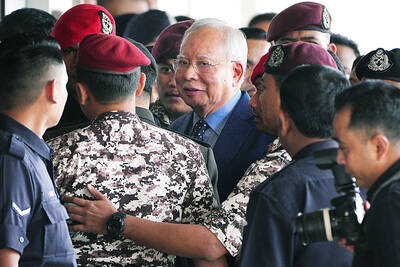
‘NO COUNTRY BUMPKIN’: The judge rejected arguments that former prime minister Najib Razak was an unwitting victim, saying Najib took steps to protect his position Imprisoned former Malaysian prime minister Najib Razak was yesterday convicted, following a corruption trial tied to multibillion-dollar looting of the 1Malaysia Development Berhad (1MDB) state investment fund. The nation’s high court found Najib, 72, guilty on four counts of abuse of power and 21 charges of money laundering related to more than US$700 million channeled into his personal bank accounts from the 1MDB fund. Najib denied any wrongdoing, and maintained the funds were a political donation from Saudi Arabia and that he had been misled by rogue financiers led by businessman Low Taek Jho. Low, thought to be the scandal’s mastermind, remains

Australian Prime Minister Anthony Albanese yesterday announced plans for a national bravery award to recognize civilians and first responders who confronted “the worst of evil” during an anti-Semitic terror attack that left 15 dead and has cast a heavy shadow over the nation’s holiday season. Albanese said he plans to establish a special honors system for those who placed themselves in harm’s way to help during the attack on a beachside Hanukkah celebration, like Ahmed al-Ahmed, a Syrian-Australian Muslim who disarmed one of the assailants before being wounded himself. Sajid Akram, who was killed by police during the Dec. 14 attack, and

VISHNU VANDALS: A Cambodian official accused Thailand of destroying a statue in a disputed border area, with video showing the Hindu structure being torn down The Thai military said ceasefire talks with Cambodia, set to begin yesterday, are expected to conclude with a meeting of the countries’ defense ministers on Saturday, as the two sides seek to end weeks of deadly clashes. The talks started at 4pm in Thailand’s Chanthaburi Province, which borders Cambodia. The Thai Ministry of Defense outlined several demands to be discussed ahead of the bilateral meeting of the General Border Committee (GBC) on Saturday. If secretariat-level discussions fail to reach agreement on key technical frameworks such as troop deployments, the Thai side would not proceed with the GBC meeting or sign any agreement on


 RSS
RSS