


It was not the way that Christian Redl’s latest deep-diving record attempt was meant to end: being hauled to the surface of Austria’s frozen Weissensee after losing consciousness in the icy waters.
Redl — dubbed the “Iceman” — experienced a blackout, something he sees as par for the course in his quest to break the record for the deepest dive under ice.
“For me, it’s not risky or dangerous. It just happened,” the 43-year-old said matter-of-factly after his unsuccessful record attempt on Friday last week.
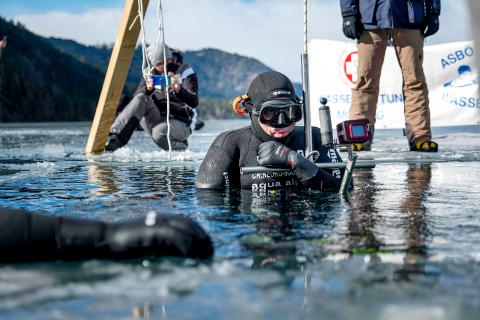
Photo: AFP
The Austrian, who has had similar blackouts before, is part of a small group of freedivers in the world specializing in diving under ice.
His aim was to dive 71m deep into the Weissensee — itself covered in 30cm of ice — braving the 2°C water in just a wetsuit and fins.
However, exerting himself excessively on the way up resulted in a lack of oxygen to the brain, which caused a blackout.
He was dragged up by one of his six safety divers and pulled onto the ice where a waiting medical team sprang into action with an oxygen mask.
It is the latest chapter in a life dominated by a passion for diving that began at the age of six when Redl’s uncle gave him fins and a mask as a present.
They were put to use snorkeling on a Vienna Lake, before he started scuba diving at the age of 10.
Seven years later, he saw The Big Blue — French director Luc Besson’s film about the friendship and rivalry between two freedivers.
“This movie changed my life completely because my biggest dream was to become like Jean Reno in this movie, a world record holder,” Redl said.
However, work commitments meant that he only had the winter months to attempt records, which led to him to specialize in ice diving, earning him his “Iceman” moniker.
At 30, he quit his job as an investment banker to become a professional freediver, supporting himself with teaching and occasional acting work.
His ability to hold his breath under water for up to six minutes has given him a somewhat macabre niche of drowned corpse roles.
His first record came in 2003, a 90m horizontal distance dive under ice.
In preparation for his latest attempt — perhaps surprisingly — Redl only did one practice dive on the Weissensee itself, otherwise sticking to an indoor pool on the outskirts of Vienna.
“I do everything with my mental strength, so I really don’t care about the cold,” he said before the attempt on Friday.
New Zealand freediver and rival Ant Williams, the holder of the record Redl wanted to clinch, understands the challenges only too well.
“The water is not only freezing cold, it is pitch black and foreboding,” he said by e-mail.
“It is far more intimidating and uncomfortable than normal diving,” Williams said, adding that he regards his Austrian rival as “talented” and “more than capable of pushing the record deeper.”
As for his hardest dive to date, Redl said that came on Nepal’s Gokyo Lake at an altitude of 5,160m, requiring him to undertake six months of training to deal with the lack of oxygen.
“The first 10 doctors said ‘it is impossible, you will die,’” Redl said. “The 11th one said: ‘Yes, you will die, but it’s a cool project.’ So I concentrated on the second part of this sentence.”
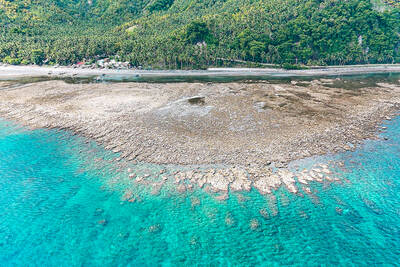
Arsenio Butil Jr fell to his knees and began to pray when last week’s deadly magnitude 7.8 earthquake began shaking his home on the coast of the southern Philippines. When he opened his eyes, he saw a once-familiar shoreline changing in real time, with swathes of previously submerged coral suddenly pushing above the waterline. The June 8 quake, driven by a shifting of the nearby Cotabato Trench, toppled buildings, triggered landslides and killed at least 76 people on the southern island of Mindanao. The tectonic forces at work also thrust chunks of the island’s coastline upward in a phenomenon known as “coastal uplift,”
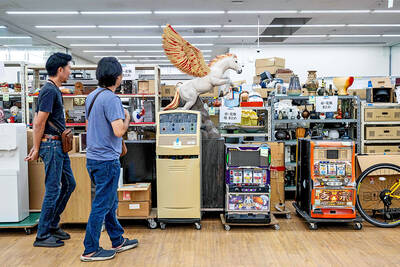
YUCK OR YUM? While it is difficult to sell second-hand goods that are more than seven years old in Japan, they are still popular in foreign markets, an executive said Under a scorching sun in a Bangkok suburb, a whistle blew, and shouts filled the air as dozens of shoppers rushed into a warehouse bearing the sign “Japanese Second-Hand Store.” From bags and bicycles to surfboards and suitcases, the Japanese second-hand market is booming, with quality-conscious buyers in other Asian countries increasingly tapping into the circular economy trend. “What is considered garbage for them can still be useful in Thailand,” said 36-year-old Lookpoo Sathitpanyapon, who runs an online store selling toy keychains. “That bag, that bag,” one shopper shouted while racing through the warehouse, filled with everything from colorful toys
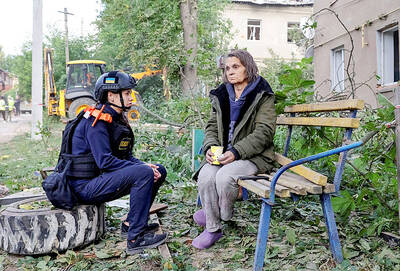
President Volodymyr Zelenskiy on Saturday said that Russian forces were preparing an impending massive attack on Ukraine and warned residents to take special care as Russian strikes in different regions killed at least six people. “Tonight and in the coming hours, it is especially important to pay close attention to air raid warnings,” Zelenskiy said in his nightly video address. “The Russians have prepared for a massive attack. Please take care of yourselves.” Russian forces have staged a series of heavy attacks on Kyiv in the past few weeks and in other major cities. Strikes on Monday last week killed
Growing up in Tahiti, Anna-Bella Failloux saw first-hand the threat posed by mosquitoes: Nearly one-third of adults on the picturesque island once had swollen limbs from elephantiasis caused by their bites. She has since dedicated her life to studying mosquitoes and the diseases they transmit — a concern that looms ever larger as climate change expands the area where the insects roam. “You have to accept being bitten by a mosquito from time to time,” the 63-year-old entomologist at France’s Pasteur Institute said. “But we have to avoid too many people getting sick and dying from the infections,” Failloux said, as she observed


 RSS
RSS