


April Reign remembered precisely where she was in January 2015, when she launched the #OscarsSoWhite movement with a simple, offhand tweet.
“I’d love to have a sexy story that I was sitting in a board room ideating and strategizing,” she said in an interview. “But no — I was half-dressed in my family room, to be very frank.
“I picked up my phone and wrote: ‘#OscarsSoWhite they asked to touch my hair.’ That was it.”
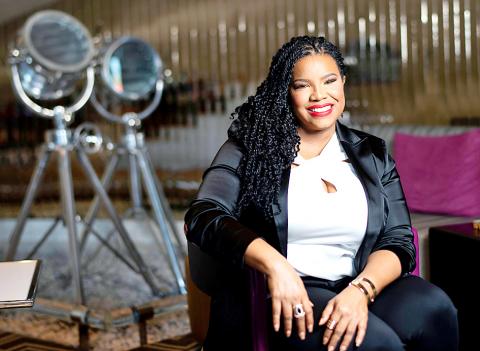
Photo: AFP
Within hours, the tweet — sent from Washington as Reign followed the Oscar nominations announcement over breakfast and realized that all 20 actors were white — had gone viral worldwide.
Five years later, the phrase has become a universal clarion call for more diversity at the Oscars, in Hollywood and the entertainment industry in general.
However, the hashtag made an unwelcome return to Twitter this month as the Oscar shortlists were announced by the Academy of Motion Picture Arts and Sciences.
Cynthia Erivo was the only actress of color to earn a nomination, for anti-slavery biopic Harriet. All of the male acting nominees were white.
Industry Web site Deadline Hollywood called the announcement “basically #OscarsSoWhite Part 2.”
For Reign, a former Washington campaign finance lawyer who quit her job in the US capital and now works on inclusion and representation issues full-time, it was no great surprise.
“We are now in year six, and every single year #OscarsSoWhite is mentioned again,” she said. “I would love to see an end point, but the end comes when we no longer have to talk about issues of inclusion and representation.”
Underlying Reign’s viral message about the Oscars is a much more expansive campaign to force Hollywood to boost diversity, broaden its horizons and stop relying on old habits and closed-shop networks.
Reign said this is something studios have shown themselves incapable, or unwilling, to do.
“Outside activists or advocates are incredibly important — to say, you know, we’re out here, we want to be represented,” she said. “I think that there is something interesting about speaking truth to power from the outside.”
Reign said that campaigners, such as singer Harry Belafonte and actress Rita Moreno, have been banging the diversity drum in entertainment for decades.
However, the “significant and undeniable power of social media” — particularly its high levels of engagement — make the message harder to ignore these days.
Beside the sheer weight of numbers a viral campaign can attract, advocates believe they can succeed by exposing the dirty secrets of the industry and its gatekeepers.
For Reign, spreading awareness about the Oscar-voting Academy is key.
Membership is 84 percent white, 68 percent male and voters are not required to watch every nominated movie.
“Why do regular audience members — who are much more diverse — care what older white men think is the best movie of the year?” she said, noting the Oscars’ falling viewership.
Progress so far is slow, but evident. Since 2015, the Academy has made concerted efforts to broaden its membership.
The annual intake of new members reached 50 percent female for the first time last year, while non-white membership has doubled in five years.
However, less than one-third admitted were people of color.
“The curtain has been pulled back, right? And we see what the Wizard of Oz looks like,” Reign said.
It is a method that has been emulated by other campaigners. New York-based advocate Tarana Burke began using the expression “Me Too” to confront sexual abuse in 2006, but the movement exploded when actress Alyssa Milano tweeted it after the Harvey Weinstein allegations a decade later.
More recently, a group of Hollywood writers and podcasters have coined the hashtag #PayUpHollywood in a bid for better treatment of put-upon assistants.
“By screwing the assistants, treating them badly, and not giving them enough money, we’re keeping them white and wealthy,” said cofounder Deirdre Mangan, pointing to skyrocketing rents in Los Angeles.
For the #PayUpHollywood campaigners, a survey showing dozens of assistants had experienced objects hurled at them by bosses created headlines — and a handful of agencies quickly upped wages.
The topic is now the focus of a new film, The Assistant, starring Emmy winner Julia Garner (Ozark).
Mangan, a TV producer and writer, said the industry’s elites worry about their reputations.
“Their identity and how they’re seen by other people is the most important ... thing to them, and this industry draws personality disorders like a magnet,” she said. “It’s going to be shame and reputation that’s going to be the real mover and shaker.”

A ship that appears to be taking on the identity of a scrapped gas carrier exited the Strait of Hormuz on Friday, showing how strategies to get through the waterway are evolving as the Middle East war progresses. The vessel identifying as liquefied natural gas (LNG) carrier Jamal left the Strait on Friday morning, ship-tracking data show. However, the same tanker was also recorded as having beached at an Indian demolition yard in October last year, where it is being broken up, according to market participants and port agent’s reports. The ship claiming to be Jamal is likely a zombie vessel that
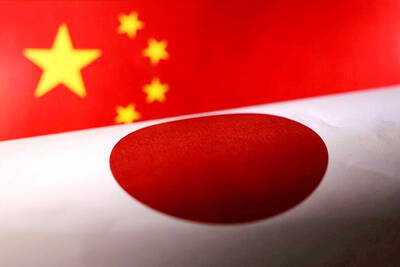
Japan is to downgrade its description of ties with China from “one of its most important” in an annual diplomatic report, according to a draft reviewed by Reuters, as relations with Beijing worsen. This year’s Diplomatic Bluebook, which Japanese Prime Minister Sanae Takaichi’s government is expected to approve next month, would instead describe China as an important neighbor and the relationship as “strategic” and “mutually beneficial.” The draft cites a series of confrontations with Beijing over the past year, including export controls on rare earths, radar lock-ons targeting Japanese military aircraft and increased pressure around Taiwan. The shift in tone underscores a deterioration

German Chancellor Friedrich Merz’s conservative Christian Democratic Union (CDU) yesterday faced a regional election battle in Rhineland-Palatinate, now held by the center-left Social Democratic Party (SPD). Merz’s CDU has enjoyed a narrow poll lead over the SPD — their coalition partners at the national level — who have ruled the mid-sized state for 35 years. Polling third is the far-right Alternative for Germany (AfD), which spells a greater threat to the two centrist parties in several state elections in September in the country’s ex-communist east. The picturesque state of Rhineland-Palatinate, bordering France, Belgium and Luxembourg and with a population of about 4 million,

LAW CONSTRAINTS: The US has been pressing allies to send warships to open the Strait, but Tokyo’s military actions are limited under its postwar pacifist constitution Japan could consider deploying its military for minesweeping in the Strait of Hormuz if a ceasefire is reached in the war on Iran, Japanese Minister of Foreign Affairs Toshimitsu Motegi said yesterday. “If there were to be a complete ceasefire, hypothetically speaking, then things like minesweeping could come up,” Motegi said. “This is purely hypothetical, but if a ceasefire were established and naval mines were creating an obstacle, then I think that would be something to consider.” Japan’s military actions are limited under its postwar pacifist constitution, but 2015 security legislation allows Tokyo to use its Self-Defense Forces overseas if an attack,


 RSS
RSS