


Shouts, glares and unprintable words: US Secretary of State Mike Pompeo lost his temper at a journalist after she questioned him on the administration’s stance on Ukraine, the country at the heart of US President Donald Trump’s impeachment trial.
It began when Pompeo gave an early morning interview to National Public Radio (NPR).
Much of the discussion dealt with Iran, but journalist Mary Louise Kelly closed by asking Pompeo about Ukraine.
Trump is accused of pressuring Kiev to investigate his potential election challenger, former US vice president Joe Biden, and of blocking congressional efforts to probe that abuse.
Pompeo has himself been criticized for failing to defend former US ambassador to Ukraine Marie Yovanovitch, who was abruptly called home last spring after being subjected to what she said was a “smear campaign” led by former New York City mayor Rudy Giuliani, Trump’s personal lawyer.
“Do you owe ambassador Marie Yovanovitch an apology?” Kelly asked Pompeo.
A tense exchange followed, wherein Pompeo said he had “defended every State Department official,” while Kelly asked, in vain, when he had publicly defended Yovanovitch.
“I’ve said all I’m going to say today. Thank you,” Pompeo said finally, ending the interview.
However, the story did not end there, and Kelly related the rest in an NPR broadcast on Friday evening, an account which Pompeo on Saturday disputed.
She said she thanked Pompeo, who did not reply, but leaned in and glared at her before leaving the room. A staffer then invited Kelly to Pompeo’s private living room, without her recorder.
There, Pompeo “was waiting and... he shouted at me for about the same amount of time as the interview itself lasted,” Kelly said.
“He was not happy to have been questioned about Ukraine,” Kelly said, adding that he asked her: “Do you think Americans care about Ukraine?” in an exchange peppered with profane words.
Pompeo then asked his advisers to bring out a map of the world without the countries labeled, to see whether Kelly knew where Ukraine was located.
“I pointed to Ukraine. He put the map away,” Kelly said.
“People will hear about this,” Pompeo said.
In a statement on Saturday, Pompeo accused Kelly of lying to him, twice. The first time, which he did not elaborate upon, was “in setting up our interview.”
He also alleged that the post-interview “conversation” was supposed to be off the record.
“It is shameful that this reporter chose to violate the basic rules of journalism and decency. This is another example of how unhinged the media has become in its quest to hurt President Trump and this administration,” Pompeo said.
He then implied that Kelly did not, in fact, identify Ukraine on the map.
“It is worth noting that Bangladesh is NOT Ukraine,” he said.
Kelly said she was not told the conversation would be off the record, nor would she have agreed to those terms if she were asked.
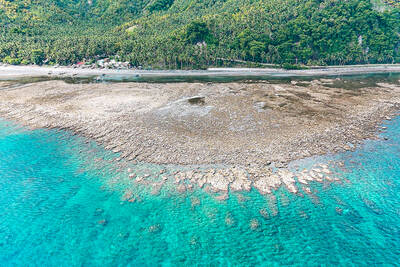
Arsenio Butil Jr fell to his knees and began to pray when last week’s deadly magnitude 7.8 earthquake began shaking his home on the coast of the southern Philippines. When he opened his eyes, he saw a once-familiar shoreline changing in real time, with swathes of previously submerged coral suddenly pushing above the waterline. The June 8 quake, driven by a shifting of the nearby Cotabato Trench, toppled buildings, triggered landslides and killed at least 76 people on the southern island of Mindanao. The tectonic forces at work also thrust chunks of the island’s coastline upward in a phenomenon known as “coastal uplift,”
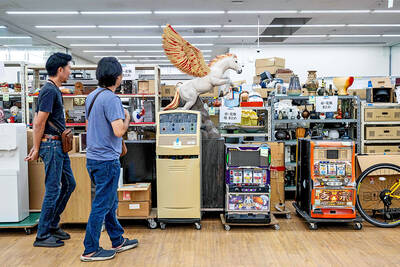
YUCK OR YUM? While it is difficult to sell second-hand goods that are more than seven years old in Japan, they are still popular in foreign markets, an executive said Under a scorching sun in a Bangkok suburb, a whistle blew, and shouts filled the air as dozens of shoppers rushed into a warehouse bearing the sign “Japanese Second-Hand Store.” From bags and bicycles to surfboards and suitcases, the Japanese second-hand market is booming, with quality-conscious buyers in other Asian countries increasingly tapping into the circular economy trend. “What is considered garbage for them can still be useful in Thailand,” said 36-year-old Lookpoo Sathitpanyapon, who runs an online store selling toy keychains. “That bag, that bag,” one shopper shouted while racing through the warehouse, filled with everything from colorful toys
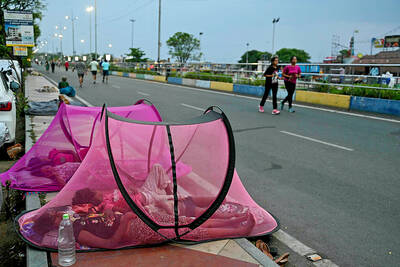
Growing up in Tahiti, Anna-Bella Failloux saw first-hand the threat posed by mosquitoes: Nearly one-third of adults on the picturesque island once had swollen limbs from elephantiasis caused by their bites. She has since dedicated her life to studying mosquitoes and the diseases they transmit — a concern that looms ever larger as climate change expands the area where the insects roam. “You have to accept being bitten by a mosquito from time to time,” the 63-year-old entomologist at France’s Pasteur Institute said. “But we have to avoid too many people getting sick and dying from the infections,” Failloux said, as she observed
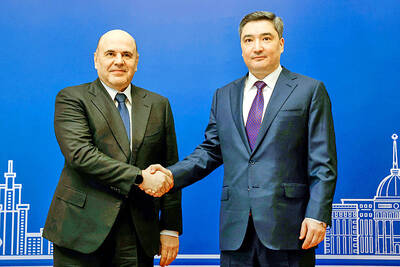
Kazakhstan signed accords with the start-up Firebird Inc on computing projects involving Nvidia Corp that could bring as much as US$10 billion in investment, as the Central Asian energy producer looks to position itself as an artificial intelligence (AI) hub. The pacts include a strategic cooperation agreement on developing AI infrastructure and terms for a planned large-scale project known as Data Center Valley in the country’s northeast, the Kazakh Ministry of Artificial Intelligence and Digital Development said in a statement. The plan envisages US$5 billion in investments in phase one — including US$1 billion provided by state-run Kazakhtelecom — with commercial operations


 RSS
RSS