


More than two months after being blinded in one eye by what she believes was a projectile fired by riot police, Indonesian video journalist Veby Mega Indah is still seeking answers.
On Sept. 29, Veby was among a group of reporters covering one of the hundreds of clashes between armed police and anti-government protesters that have broken out almost daily over the past six months.
“I am doing live-streaming that time. At one point, there are some protesters who showed up ... the police are aiming at them shooting. I heard somebody, a fellow journalist behind me, yelling: ‘Don’t shoot! Don’t shoot! We all journalists,’” Veby said.
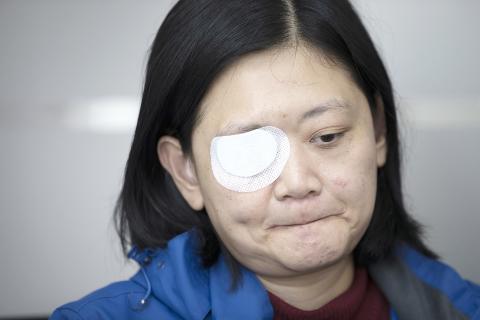
Photo: AP
“A second later, I heard the bang and I saw some smoke from the stairs, then the projectile is coming into my right eye,” she said.
Her case illustrates the risks media workers have been exposed to while covering the increasingly violent protests. An unknown number have been subjected to tear gas, pepper spray, projectiles thrown by both sides, and general mockery and verbal abuse.
Veby, 39, works full-time for Suara Hong Kong News, an Indonesian media outlet that serves the thousands of Indonesians working in Hong Kong, as well as their friends and families back home and around the world.
She said she intends to keep working in Hong Kong, her home since 2012.
“I still want to be a journalist, I still want to continue my job. I still don’t know how far I can do it. It’s a question that keeps me up at night,” she said.
While she waits, Veby, a member of Indonesia’s Christian minority, relies in part from assistance from her church.
According to Associated Press reporters on the scene when Veby was injured, police were retreating from a pedestrian bridge in the Wan Chai District. Journalists, including Veby, were standing away from the protesters in bright yellow vests to identify themselves, as well as helmets with stickers and press cards on lanyards around their necks.
Police say that they took action in response to protesters throwing objects from the bridge.
Veby has a lawyer who is pursuing her case against the Hong Kong police, but so far without result. She has filed a complaint and asked for the name of the officer who fired what was believed to have been a type of rubber bullet called a baton round, something that could allow her to sue him individually.
“And so far I don’t see any proper investigation done although I already filed a complaint,” she said.
“Justice is so important in my case because this case is not only about me; it’s also bringing justice for all the injured people in Hong Kong,” she said.
At a briefing on Friday last week, Hong Kong Police spokesman Kong Wing-cheung (江永祥) denied police were slow-walking Veby’s case.
The office responsible for handling complaints against police has been talking to her lawyer, but that “involves a lot of legal procedures,” Kong said.
“And in distributing different information, we all have to consider all the legal grounds whether to give or refuse to give the information,” he said.
Police use of force against protesters, the media and members of the public has been one of the main drivers keeping the protest movement alive.
Critics say the once widely respected force has employed increasingly brutal tactics with virtual impunity and have demanded an independent commission to investigate the allegations.
Hong Kong Legislator Claudia Mo (毛孟靜) on Wednesday brought up Veby’s case in a question to Hong Kong Secretary for Security John Lee (李家超), who switched the focus to police self-protection and rare cases of protesters impersonating journalists to facilitate their activities.
“Persons at the scene (including media practitioners) should pay attention to and follow the instructions given by police officers and maintain appropriate distance,” he said in his written reply.
“This will prevent obstruction of police enforcement operations, as well as avoid personal injury,” he said.

An American scientist convicted of lying to US authorities about payments from China while he was at Harvard University has rebuilt his research lab in Shenzhen, China, to pursue technology the Chinese government has identified as a national priority: embedding electronics into the human brain. Charles Lieber, 67, is among the world’s leading researchers in brain-computer interfaces. The technology has shown promise in treating conditions such as amyotrophic lateral sclerosis and restoring movement in paralyzed people. It also has potential military applications: Scientists at the Chinese People’s Liberation Army have investigated brain interfaces as a way to engineer super soldiers by boosting
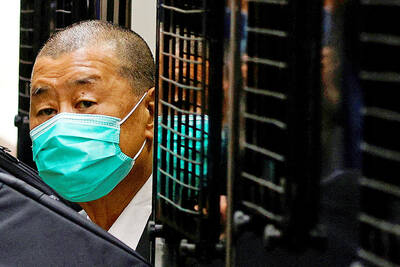
Jailed media entrepreneur Jimmy Lai (黎智英) has been awarded Deutsche Welle’s (DW) freedom of speech award for his contribution to Hong Kong’s pro-democracy movement. The German public broadcaster on Thursday said Lai would be presented in absentia with the 12th iteration of the award on June 23 at the DW Global Media Forum in Bonn. Deutsche Welle director-general Barbara Massing praised the 78-year-old founder of the now-shuttered news outlet Apple Daily for standing “unwaveringly for press freedom in Hong Kong at great personal risk.” “With Apple Daily, he gave journalists a platform for free reporting and a voice to the democracy movement in
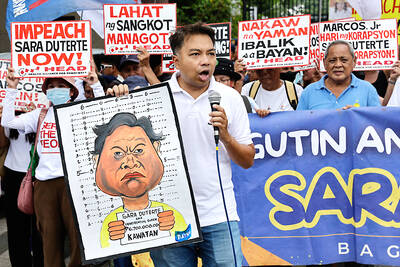
PHILIPPINE COMMITTEE: The head of the committee that made the decision said: ‘If there is nothing to hide, there is no reason to hide, there is no reason to obstruct’ A Philippine congressional committee on Wednesday ruled that there was “probable cause” to impeach Philippine Vice President Sara Duterte after hearing allegations of unexplained wealth, misuse of state funds and threats to have the president assassinated. The unanimous decision of the 53-member committee in the Philippine House of Representatives sends the two impeachment complaints to deliberations and voting by the entire lower chamber, which has more than 300 lawmakers. The complaints centered on Duterte’s alleged illegal use and mishandling of intelligence funds from the vice president’s office, and from her time as education secretary under Philippine President Ferdinand Marcos Jr. Duterte and the

As evening falls in Fiji’s capital, a steady stream of people approaches a makeshift clinic that is a first line of defense against one of the world’s fastest-growing HIV epidemics. In the South Pacific nation — a popular tourist destination of just under a million people — more than 2,000 new HIV cases were recorded last year, a 26 percent increase from 2024. The government has declared an HIV outbreak and described it as a national crisis. “It’s spreading like wildfire,” said Siteri Dinawai, 46, who came to be tested. The Moonlight Clinic, a converted minibus parked in a suburban cul-de-sac in Suva, is


 RSS
RSS