


Venetians woke yesterday to devastating scenes after the highest tide in 50 years washed through the historic Italian city, beaching gondolas, trashing hotels and sending tourists fleeing through rapidly rising waters.
Shopkeepers on the Grand Canal raged against those who have failed to protect the UNESCO city from the high tide, blaming corruption for the much-delayed barrier protection system which could have prevented the disaster.
“The city is on its knees,” Venice Mayor Luigi Brugnaro said in an interview with national broadcaster Radiotelevisione Italiana.

Photo: EPA-EFE
“There’s widespread devastation,” he said in the famed St Mark’s Square, which bore the brunt of the flooding.
Tourists lugging heavy suitcases waded in thigh-high galoshes or barefoot through the submerged alleys, as water taxi and gondola drivers baled sewage-tainted water out of their trashed vessels.
The exceptionally intense acqua alta (high waters) peaked at 1.87m. Only once since records began in 1923 has the water crept even higher, reaching 1.94m in the historic 1966 flood.
“It was unbelievable, the water rose so quickly,” said resident Tiziano Collarin, 59, as he surveyed the damage.
“Windows were blown out, there are those who have lost everything,” he said as the flood alarm rang out to warn those in the canal city that the tide, which had receded somewhat overnight, was coming in once again.
The fire brigade said it had carried out more than 250 operations as well as laying on extra boats as water ambulances.
About 150 fire fighters were deployed to rescue people stranded on jetties and to recover boats broken free from their moorings.
A 78-year old was killed by electric shock as the waters poured into his home, Italian media reported.
Veneto region President Luca Zaia said 80 percent of the city had been submerged, causing “unimaginable damage.”
German tourist Gabi Brueckner, 58, said the nighttime drama had been “horrifying”.
She echoed the mayor in blaming climate change and said she feared like many people that “it will get worse and at some point Venice will drown”.
A massive infrastructure project called MOSE has been underway since 2003 to protect the city, but it has been plagued by cost overruns, corruption scandals and delays.
The plan involves 78 gates that can be raised to protect Venice’s lagoon during high tides — but a recent attempt to test part of the barrier caused worrying vibrations and engineers discovered parts had rusted.
“They’ve done nothing, neglected it. It doesn’t work and they have stolen 6 billion euros [US$6.6 billion]. The politicians should all be put in jail,” said local Dino Perzolla, 62.
St Mark’s Square was particularly affected, its vestibule inundated with water.
“I’ve never seen anything like it in my life. There was a terrifying wind, it was a hurricane. It was horrible,” local Cristina said.

PARLIAMENT CHAOS: Police forcibly removed Brazilian Deputy Glauber Braga after he called the legislation part of a ‘coup offensive’ and occupied the speaker’s chair Brazil’s lower house of Congress early yesterday approved a bill that could slash former Brazilian president Jair Bolsonaro’s prison sentence for plotting a coup, after efforts by a lawmaker to disrupt the proceedings sparked chaos in parliament. Bolsonaro has been serving a 27-year term since last month after his conviction for a scheme to stop Brazilian President Luiz Inacio Lula da Silva from taking office after the 2022 election. Lawmakers had been discussing a bill that would significantly reduce sentences for several crimes, including attempting a coup d’etat — opening up the prospect that Bolsonaro, 70, could have his sentence cut to
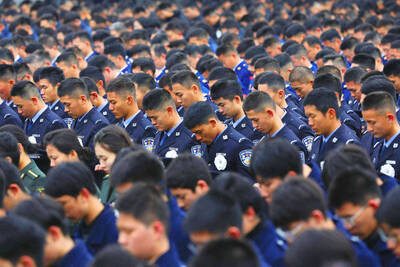
China yesterday held a low-key memorial ceremony for the 1937 Nanjing Massacre, with Chinese President Xi Jinping (習近平) not attending, despite a diplomatic crisis between Beijing and Tokyo over Taiwan. Beijing has raged at Tokyo since Japanese Prime Minister Sanae Takaichi last month said that a hypothetical Chinese attack on Taiwan could trigger a military response from Japan. China and Japan have long sparred over their painful history. China consistently reminds its people of the 1937 Nanjing Massacre, in which it says Japanese troops killed 300,000 people in what was then its capital. A post-World War II Allied tribunal put the death toll

A passerby could hear the cacophony from miles away in the Argentine capital, the unmistakable sound of 2,397 dogs barking — and breaking the unofficial world record for the largest-ever gathering of golden retrievers. Excitement pulsed through Bosques de Palermo, a sprawling park in Buenos Aires, as golden retriever-owners from all over Argentina transformed the park’s grassy expanse into a sea of bright yellow fur. Dog owners of all ages, their clothes covered in dog hair and stained with slobber, plopped down on picnic blankets with their beloved goldens to take in the surreal sight of so many other, exceptionally similar-looking ones.

‘UNWAVERING ALLIANCE’: The US Department of State said that China’s actions during military drills with Russia were not conducive to regional peace and stability The US on Tuesday criticized China over alleged radar deployments against Japanese military aircraft during a training exercise last week, while Tokyo and Seoul yesterday scrambled jets after Chinese and Russian military aircraft conducted joint patrols near the two countries. The incidents came after Japanese Prime Minister Sanae Takaichi triggered a dispute with Beijing last month with her remarks on how Tokyo might react to a hypothetical Chinese attack on Taiwan. “China’s actions are not conducive to regional peace and stability,” a US Department of State spokesperson said late on Tuesday, referring to the radar incident. “The US-Japan alliance is stronger and more


 RSS
RSS