


US diplomats told Ukrainian President Volodymyr Zelenskiy that a prestigious White House visit to meet US President Donald Trump was dependent on him making a public statement vowing to investigate Hunter Biden’s company, and a Ukrainian role in the 2016 US elections, texts released on Thursday night showed.
The texts, released by three congressional committees holding impeachment hearings, show that the diplomats made clear that any improvement in Kyiv’s relations with Washington would be dependent on Zelenskiy’s cooperation in Trump’s quest to find damaging material about the son of his leading political opponent, and on the Democrats in general.
The texts are exchanges between three US diplomats: US Ambassador to the EU Gordon Sondland, then-US special representative for Ukraine negotiations Kurt Volker, and Acting US Ambassador to Ukraine William Taylor.
Trump’s personal lawyer, Rudy Giuliani and a Zelenskiy aide, Andrey Yermak, also make brief appearances in the correspondence.
The early conversations came before a July 25 telephone call between Trump and Zelenskiy that was the trigger for the impeachment proceedings now consuming the US Congress.
They show that Sondland coached Zelenskiy on the call, making clear what would be required from him.
“I [spoke] to Zelensky and gave him a full briefing. He’s got it,” Sondland, a major donor to Trump and the Republican party, texted Volker.
“Most [important] is for Zelensky to say that he will help investigation,” Volker replied.
For their part, the Ukrainians were aware about what was happening and were uneasy about what they were being asked to do.
They made their concerns clear to Taylor, who had taken on the acting ambassador’s job in May.
“Gordon, one thing Kurt and I talked about yesterday was [Ukranian Minister of Finance] Sasha Danyliuk’s point that President Zelensky is sensitive about Ukraine being taken seriously, not merely as an instrument in Washington domestic, re-election politics,” Taylor wrote to Sondland on July 21.
Sondland brushed aside the concerns, arguing they had to move forward “irrespective of the pretext.”
On July 25, just before the Trump-Zelenskiy call, Volker texted Yermak, saying: “Heard from White House — assuming President Z convinces trump he will investigate/ ‘get to the bottom of what happened’ in 2016, we will nail down date for visit to Washington.”
Trump and his supporters have sought to create a counter-narrative to the US intelligence community finding that Russia intervened in the 2016 US election in Trump’s favor.
According to their narrative, the real interference came from Ukrainian oligarchs and was in Hillary Rodham Clinton’s favor.
There is no evidence for the theory, but the launch of an investigation by Kyiv would have given it credence.
After the July 25 presidential call, Yermak confirmed it “went well” and Trump told Zelenskiy to pick a date for his White House visit.
However, a final agreement was delayed.
By Aug. 9 Sondland told Volker the White House was ready to confirm the visit “as soon as Yermak confirms.”
“I think potus [Trump] really wants the deliverable,” he added.
Sondland suggested asking Yermak to forward a draft of what Zelenskiy was going to say.
On the same day, Volker checked in with Giuliani and told him about the statement the Ukrainian president was going to make.
“Can we all get on the phone to make sure I advise Z correctly as to what he should be saying? Want to make sure we get this done right,” Volker said.
Giuliani agreed.
However, the plan to exchange Zelenskiy’s statement for a White House visit was torpedoed when the Ukrainians read a report on the Politico news site, that Trump had blocked US$250 million in military aid to Ukraine, as well as state department funding.
The news made the Ukrainians even more skittish.
The last published text is dated Sept. 9 and is between a distressed Taylor and Sondland.
“The message to the Ukrainians [and Russians] we send with the decision on security assistance is key. With the hold, we have already shaken their faith in us. Thus my nightmare scenario,” Taylor said, adding: “As I said on the phone, I think it’s crazy to withhold security assistance for help with a political campaign.”
Sondland’s reply was startling. By that time, the White House had become aware that a complaint about the July 25 presidential phone call was in the pipeline, and that it was likely to cause a scandal.
“Bill, I believe you are incorrect about President Trump’s intentions. The President has been crystal clear no quid pro quo’s of any kind,” Sondland told Taylor.

ROCKY RELATIONS: The figures on residents come as Chinese tourist numbers drop following Beijing’s warnings to avoid traveling to Japan The number of Chinese residents in Japan has continued to rise, even as ties between the two countries have become increasingly fractious, data released on Friday showed. As of the end of December last year, the number of Chinese residents had increased by 6.5 percent from the previous year to 930,428. Chinese people accounted for 22.6 percent of all foreign residents in Japan, making them by far the largest group, Japanese Ministry of Justice data showed. Beijing has criticized Tokyo in increasingly strident terms since Japanese Prime Minister Sanae Takaichi last year suggested that a military conflict around Taiwan could

A retired US colonel behind a privately financed rocket launch site in the Dominican Republic sees the project as a response to China’s dominance of the space race in Latin America. Florida-based Launch on Demand is slated to begin building a US$600 million facility in a remote region near the border with Haiti late this year. The project is designed to meet surging demand for the heavy-lift rockets needed to put clusters of satellites into orbit. It is also an answer to China’s growing presence in the region, said CEO Burton Catledge, a former commander of the US Air Force’s 45th Operations

Germany is considering Australia’s Ghost Bat robot fighter as it looks to select a combat drone to modernize its air force, German Minister of Defense Boris Pistorius said yesterday. Germany has said it wants to field hundreds of uncrewed fighter jets by 2029, and would make a decision soon as it considers a range of German, European and US projects developing so-called “collaborative combat aircraft.” Australia has said it will integrate the Ghost Bat, jointly developed by Boeing Australia and the Royal Australian Air Force, into its military after a successful weapons test last year. After inspecting the Ghost Bat in Queensland yesterday,
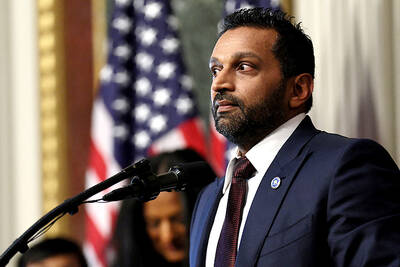
A pro-Iran hacking group claimed to breach FBI Director Kash Patel’s personal e-mail inbox and posted some of the contents online. The e-mails provided by the hacking group include travel details, correspondence with leasing agents in Washington and global entry, and loyalty account numbers. The e-mail address the hackers claim to have compromised has been previously tied to Patel’s personal details, and the leaked e-mails contain photos of Patel and others, in addition to correspondence with family members and colleagues. “The FBI is aware of malicious actors targeting Director Patel’s personal email information,” the agency said in a statement on


 RSS
RSS