


Syrian government forces on Friday surrounded a Turkish observation post in the northwest after overrunning nearby areas, a war monitor said, while Ankara vowed not to withdraw from its position.
“Regime forces have surrounded the Turkish observation post in Morek after capturing other towns and villages in this pocket,” the Syrian Observatory for Human Rights said.
Speaking at a news conference in the Lebanese capital, Turkish Minister of Foreign Affairs Mevlut Cavusoglu said that “our observation point there is not cut-off and nobody can isolate our forces and our soldiers.”
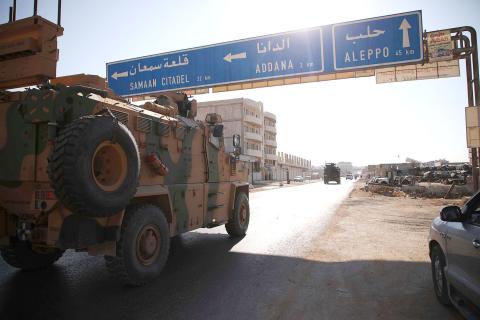
Photo: AFP
“We are there, not because we can’t leave, but because we don’t want to leave,” he said, adding that the issue was being discussed with Damascus’ allies Russia and Iran.
The Syrian regime has upped the stakes with Ankara in its months-long Russian-backed offensive against the militant-ruled Idlib region, which borders Turkey.
Moscow on Friday said that it had agreed with Ankara to “activate mutual efforts” to ease the situation in Syria’s last major opposition bastion.
Turkey later announced that Turkish President Recep Tayyip Erdogan would visit Moscow on Tuesday for talks with Russian President Vladimir Putin, a meeting confirmed by the Kremlin.
The town of Morek, where the Turkish troops have allegedly been cut off, lies in the north of Hama Province, part of the region centered on neighboring Idlib Province that has been under government assault — initially by air — since the end of April.
Government forces on Friday took control of Morek and nearby towns, including Kafr Zita, the Syrian Arab News Agency said.
Militants and allied rebels withdrew from the area ahead of the Syrian army’s entry into the strategic town of Khan Sheikhun on Wednesday and government forces took control without resistance, the Britain-based Observatory said.
The Morek observation post, established under a deal with Moscow, is one of 12 that the Turkish army set up along the front line — between Syrian government forces on one side and the militants and Ankara’s rebel allies on the other side — last year.
Cavusoglu on Tuesday vowed that the Turkish army “will do whatever is necessary” to defend these positions.
Erdogan has also said that Turkey would not abandon any of its observation posts in Syria.
The Turkish troops’ mission was to oversee the establishment of a buffer zone agreed on by Ankara and Moscow in September.
However, the militants failed to pull back from the zone as agreed and in April, government and Russian forces resumed an intense bombardment of the region.
The Kremlin on Friday said that Putin and Erdogan had agreed to “activate mutual efforts” to ease the situation in the Idlib region.
“They discussed the issues of Russian-Turkish cooperation in the context of stabilization of the de-escalation zone,” a statement said.
Next month, Erdogan is to host Putin and Iranian President Hassan Rouhani for a summit in Ankara to discuss the latest developments.
Erdogan on Friday said that regime attacks in Idlib have led to a “grave humanitarian crisis.”
“These attacks damage the efforts to regulate the Syrian conflict,” he added.

‘CROSSING THE LINE’: China’s embassy in Seoul criticized US Forces Korea Commander General Xavier Brunson, asking if his ‘hostile’ remarks were authorized by Washington South Korea and the US are in talks over recent public remarks by the commander of US Forces Korea, Seoul’s presidential office said yesterday, after the comments drew sharp criticism from China. In a recent podcast interview, US Forces Korea Commander General Xavier Brunson described South Korea as “the dagger in the heart of Asia” from China’s east coast, prompting the Chinese embassy in Seoul to say that he had “truly crossed the line.” The interview came amid growing speculation that Washington might seek to expand the role of US Forces Korea in countering the growing regional influence of China, a key

Through the noise of rushing papers and whirring belts at a print factory in Kyoto, two creators watch their photo essay come to life in broadsheet form — part of an effort to win new audiences in the age of artificial intelligence (AI). Despite the decline of the publishing industry, self-publication and handmade “zine” magazines are growing in popularity in Japan, reflecting the nation’s enduring love of paper in the digital era. While speaking to Agence France-Presse at the plant, his hands black with ink, one of the creators, Kazuma Obara, said: “I think [paper] is a medium that engages all five

Australian researchers have trained lab-grown brain cells on a silicon computer chip to play the 1990s shooter game Doom and said they are just scratching the surface of what the neurons could be capable of doing. It is the science-fiction work of biotech boffins at Cortical Labs, who researched and developed the technology that harnesses the workings of the brain’s networking system. Each so-called “biological computer” contains about 200,000 living human brain cells, grown from stem cells that were harvested from blood donations. Having mastered the simple computer game Pong, where a paddle is moved up and down to send a ball

France experienced its hottest spring on record, the French weather service said on Tuesday, after an exceptional early heat wave that also broke highs for the season in England and Wales. Meteo-France said the average nationwide temperature over March to May was 13.8°C — about 1.7°C above the norm, and surpassing records set in 2011 and 2020. “The warmest spring since records began in 1900,” it said in a bulletin. All three months were warmer than average, but the onset of an “unprecedented heatwave” late last month pushed the mercury to highs typically seen at the height of the summer. “Our country had never


 RSS
RSS