


Machetes in hand and wearing a straw hat against the sun, the participants of an “agro-bootcamp” in the farmlands of the west African nation of Benin harvest corn, cowpeas and rice.
“Cut at the base,” says Oluwafemi Kochoni, an organic farming teacher who runs the agricultural workshop to prepare young people for a future sustainably working the land. “Then leave the plants in place, we will bury them — they will decompose and fertilize the soil.”
It is beginners’ advice, but the program in Tori-Bossito, just outside Benin’s economic capital, Cotonou, aims to teach basic, traditional ways of agriculture to those who have forgotten or never known a life on the land.
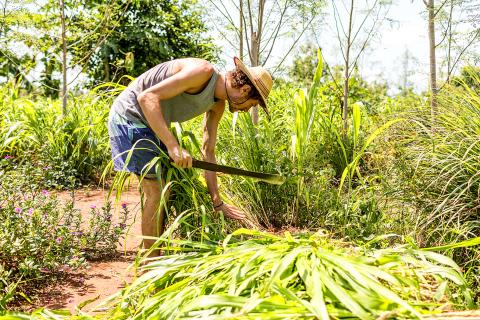
Photo: AFP
In Benin, a poor country next to oil giant Nigeria, about 80 percent of its 11 million people depend on agriculture, according to the UN Food and Agriculture Organization (FAO).
Most are subsistence farmers eking out a living growing crops on small plots where a lack of infrastructure and flooding that can wipe out harvests and seed stocks are key challenges, the FAO says.
However, the “agro-bootcamps” — the name is borrowed from the intensive training US army recruits go through — take place close to the suburbs of the city and are aimed at a different market.
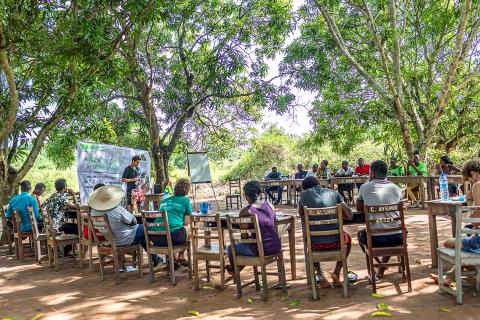
Photo: AFP
They are part of a wider movement to encourage self-sufficiency on the continent, which has about two-thirds of the world’s remaining uncultivated arable land, but spends US$64.5 billion a year importing food, according to the African Development Bank.
For 27,000 west African CFA francs (US$45) a week, agro-bootcampers learn agricultural techniques, follow marketing courses and can network with successful agro-entrepreneurs.
Like in traditional farming, the agro-bootcamp way of life is communal on the 3 hectare plot of land put at its disposal for the week by a family in exchange for baskets of vegetables.
On the edge of the fields, a border hedge of moringa plants and grasses are grown to help stabilize the soil.
There is also a fish farm in a pond and another area to grow mushrooms.
Behind the scheme is the Gardens of Hope, an organization promoting sustainable ways of farming.
“The advice usually received by farmers is based on the use of chemicals,” said participant Rachidi Idrissou, an agronomy student in Benin. “We think of quick yields and not sustainable production to preserve our land.”
Benin is a youthful country, with nearly two-thirds of the population aged under 25.
Camp organizers want to show young people struggling in the crowded cities looking for a job that working the land can offer an alternative and successful livelihood.
Originating from Africa and Europe, the 25 participants in this third agro-bootcamp are mostly men and of eight different nationalities, but they share a vision of an ecological and sustainable way of farming.
They sleep in tents and are kept busy from dawn until long after dusk.
“Our belief is that to solve the employment problem in our countries, young people must create their businesses with awareness of ecology of the climate,” coordinator Tanguy Gnikobou said.
Of the 85 people who have taken part in the past two bootcamps, 10 have already launched new agricultural activities, farms or enterprises, organizers say.
Social networks mean that participants and organizers can stay in touch for support as they develop their farms and small businesses.
Participants work in ways that farmers did before the massive movement of people to the cities.
“Initially, it was an alternative to conventional farming, to return to ancestral methods with the respect of the environment,” Kochoni said. “Then it became a way of life, and a philosophy.”
More camps are planned for later in the year in north Benin, then in Chad and Ivory Coast.
Cheikh Amadou Bass, 36, a civil servant in Nouakchott, capital of the desert nation of Mauritania, owns a large plot of land the size of five soccer fields in his home village. Bass dreams of showing his young compatriots that rather than crossing the sea in search of a new life abroad, there are opportunities on the land.
“With nature, you have everything at your fingertips,” Bass said, enthusing about how manure means chemical fertilizers are not needed.
“I have made a great discovery,” he said.

Through the noise of rushing papers and whirring belts at a print factory in Kyoto, two creators watch their photo essay come to life in broadsheet form — part of an effort to win new audiences in the age of artificial intelligence (AI). Despite the decline of the publishing industry, self-publication and handmade “zine” magazines are growing in popularity in Japan, reflecting the nation’s enduring love of paper in the digital era. While speaking to Agence France-Presse at the plant, his hands black with ink, one of the creators, Kazuma Obara, said: “I think [paper] is a medium that engages all five

‘CROSSING THE LINE’: China’s embassy in Seoul criticized US Forces Korea Commander General Xavier Brunson, asking if his ‘hostile’ remarks were authorized by Washington South Korea and the US are in talks over recent public remarks by the commander of US Forces Korea, Seoul’s presidential office said yesterday, after the comments drew sharp criticism from China. In a recent podcast interview, US Forces Korea Commander General Xavier Brunson described South Korea as “the dagger in the heart of Asia” from China’s east coast, prompting the Chinese embassy in Seoul to say that he had “truly crossed the line.” The interview came amid growing speculation that Washington might seek to expand the role of US Forces Korea in countering the growing regional influence of China, a key

Australian researchers have trained lab-grown brain cells on a silicon computer chip to play the 1990s shooter game Doom and said they are just scratching the surface of what the neurons could be capable of doing. It is the science-fiction work of biotech boffins at Cortical Labs, who researched and developed the technology that harnesses the workings of the brain’s networking system. Each so-called “biological computer” contains about 200,000 living human brain cells, grown from stem cells that were harvested from blood donations. Having mastered the simple computer game Pong, where a paddle is moved up and down to send a ball

France experienced its hottest spring on record, the French weather service said on Tuesday, after an exceptional early heat wave that also broke highs for the season in England and Wales. Meteo-France said the average nationwide temperature over March to May was 13.8°C — about 1.7°C above the norm, and surpassing records set in 2011 and 2020. “The warmest spring since records began in 1900,” it said in a bulletin. All three months were warmer than average, but the onset of an “unprecedented heatwave” late last month pushed the mercury to highs typically seen at the height of the summer. “Our country had never


 RSS
RSS