


Ukrainians yesterday began voting in a runoff election expected to thrust a comedian with no prior political experience into the presidency of a country at war and hungry for change.
At stake is the leadership of a country on the front line of the West’s standoff with Russia following the 2014 Maidan street protests and the annexation of Crimea.
Surveys made Volodymyr Zelenskiy, who plays a fictitious president in a TV series, the overwhelming favorite to defeat Ukrainian President Petro Poroshenko, whose popularity has been dragged down by patchy efforts to tackle corruption and sliding living standards.
Both men — who traded insults and accusations in a rowdy debate in a soccer stadium in Kiev on Friday — have pledged to keep Ukraine on a pro-Western course.
However, a victory for Zelenskiy in yesterday’s second-round runoff would nonetheless be a dramatic departure in a country where previous presidential elections since independence were won by experienced politicians, including three former prime ministers.
Investors are seeking reassurances that whoever wins will accelerate reforms needed to attract foreign investment and keep the country in an IMF program that has supported Ukraine through war, recession and a currency plunge.
Zelenskiy’s unorthodox campaign relied heavily on quirky social media posts and comedy gigs instead of traditional rallies and leafletting.
He has also promised to fight corruption, a message that has resonated with Ukrainians who are fed up with politics as usual in a country of 42 million people that remains one of Europe’s poorest nearly three decades after winning independence from the Soviet Union.
An opinion poll by the KIIS research firm on Tuesday showed Zelenskiy with 72 percent of the vote and Poroshenko with 25 percent. The week before, a different survey put them on 61 percent and 24 percent respectively.
Just 9 percent of Ukrainians have confidence in their national government, the lowest of any electorate in the world, according to a Gallup poll published last month.
Poroshenko has sought to portray his opponent as a buffoonish populist whose incompetence would leave Ukraine vulnerable to Russia.
“I’m just an ordinary person who has come to break the system. I’m the result of your mistakes and promises,” Zelenskiy said during the stadium debate.

ROCKY RELATIONS: The figures on residents come as Chinese tourist numbers drop following Beijing’s warnings to avoid traveling to Japan The number of Chinese residents in Japan has continued to rise, even as ties between the two countries have become increasingly fractious, data released on Friday showed. As of the end of December last year, the number of Chinese residents had increased by 6.5 percent from the previous year to 930,428. Chinese people accounted for 22.6 percent of all foreign residents in Japan, making them by far the largest group, Japanese Ministry of Justice data showed. Beijing has criticized Tokyo in increasingly strident terms since Japanese Prime Minister Sanae Takaichi last year suggested that a military conflict around Taiwan could

A retired US colonel behind a privately financed rocket launch site in the Dominican Republic sees the project as a response to China’s dominance of the space race in Latin America. Florida-based Launch on Demand is slated to begin building a US$600 million facility in a remote region near the border with Haiti late this year. The project is designed to meet surging demand for the heavy-lift rockets needed to put clusters of satellites into orbit. It is also an answer to China’s growing presence in the region, said CEO Burton Catledge, a former commander of the US Air Force’s 45th Operations

Germany is considering Australia’s Ghost Bat robot fighter as it looks to select a combat drone to modernize its air force, German Minister of Defense Boris Pistorius said yesterday. Germany has said it wants to field hundreds of uncrewed fighter jets by 2029, and would make a decision soon as it considers a range of German, European and US projects developing so-called “collaborative combat aircraft.” Australia has said it will integrate the Ghost Bat, jointly developed by Boeing Australia and the Royal Australian Air Force, into its military after a successful weapons test last year. After inspecting the Ghost Bat in Queensland yesterday,
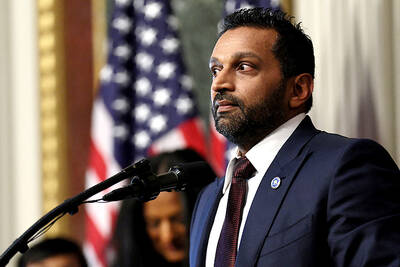
A pro-Iran hacking group claimed to breach FBI Director Kash Patel’s personal e-mail inbox and posted some of the contents online. The e-mails provided by the hacking group include travel details, correspondence with leasing agents in Washington and global entry, and loyalty account numbers. The e-mail address the hackers claim to have compromised has been previously tied to Patel’s personal details, and the leaked e-mails contain photos of Patel and others, in addition to correspondence with family members and colleagues. “The FBI is aware of malicious actors targeting Director Patel’s personal email information,” the agency said in a statement on


 RSS
RSS