


A comedian whose political experience is limited to playing the president on TV was likely to top the first round as Ukrainians voted for a president yesterday amid frustrations over living standards and corruption.
Actor Volodymyr Zelensky’s bid started as a long shot, but he has leapfrogged establishment politicians in the nation of 45 million that is fighting a Russia-backed separatist conflict in its east.
The 41-year-old star of the political comedy Servant of the People, which last week returned for its third season, had more than 25 percent support in final surveys, well ahead of his nearest rivals.

Photo: Reuters
Ukrainian President Petro Poroshenko was vying with former Ukrainian prime minister Yulia Tymoshenko to face Zelensky in a run-off this month, according to polls.
A recent survey put them neck and neck at about 17 percent, although another showed Poroshenko — who amassed a vast fortune in the chocolate business before being elected leader in 2014 — pulling ahead of ally-turned-foe Tymoshenko to make the second round.
In polling stations across Ukraine, voters expressed dissatisfaction with the candidates and many told reporters that they were opting for what they saw as the least of three evils.
“I’m voting for anyone apart from Poroshenko. I don’t believe him, he cheated us,” said 40-year-old housewife Olga, who had come to a polling station in the western city of Lviv with her young daughter.
“I’m just going to go into the booth and decide who to vote for. I just don’t know. Definitely not for Zelensky,” said Irina, a 35-year-old manicurist in the capital, Kiev.
There were a record 39 candidates on the ballot paper, but only the three frontrunners had a realistic chance of progressing to a run-off vote.
All three have said they would keep Ukraine on the European course it has charted since a 2014 revolution that forced pro-Russian then-Ukrainian president Viktor Yanukovych from office.
Poroshenko was elected on promises to tackle graft, align Ukraine with the West and shut down the separatist fighting.
However, the conflict is grinding on, corruption is rife and the country is struggling to recover from an economic crisis that began in 2014.
The 53-year-old president has positioned himself as the only person able to stand up to the Kremlin and has promised to return Crimea to Ukraine if he is re-elected.
The pledge has been widely dismissed as unrealistic.
Zelensky, meanwhile, has been criticized for the vagueness of his manifesto, the key pledges of which were chosen following a public vote on social media.
The entertainer has eschewed rallies and interviews in favor of playing gigs with his comedy troupe up to the final days of campaigning.
However, supporters said only a brand-new face can clean up the murky politics of one of the poorest nations in Europe.
Some accuse Zelensky of acting as a front for the interests of oligarch Igor Kolomoysky, who owns the channel that broadcasts the entertainer’s shows, but he denies any political links.
Tymoshenko — who was once known for her traditional plaited hairstyle, but now opts for a more conventional pony tail — has focused on the cost of living.
She has promised to cut consumer gas prices in half and boost pensions as she appealed to an older base during her third bid for the presidency.
“Today we have a chance to change everything,” Tymoshenko said as she cast her vote in Kiev.

ROCKY RELATIONS: The figures on residents come as Chinese tourist numbers drop following Beijing’s warnings to avoid traveling to Japan The number of Chinese residents in Japan has continued to rise, even as ties between the two countries have become increasingly fractious, data released on Friday showed. As of the end of December last year, the number of Chinese residents had increased by 6.5 percent from the previous year to 930,428. Chinese people accounted for 22.6 percent of all foreign residents in Japan, making them by far the largest group, Japanese Ministry of Justice data showed. Beijing has criticized Tokyo in increasingly strident terms since Japanese Prime Minister Sanae Takaichi last year suggested that a military conflict around Taiwan could

A retired US colonel behind a privately financed rocket launch site in the Dominican Republic sees the project as a response to China’s dominance of the space race in Latin America. Florida-based Launch on Demand is slated to begin building a US$600 million facility in a remote region near the border with Haiti late this year. The project is designed to meet surging demand for the heavy-lift rockets needed to put clusters of satellites into orbit. It is also an answer to China’s growing presence in the region, said CEO Burton Catledge, a former commander of the US Air Force’s 45th Operations

Germany is considering Australia’s Ghost Bat robot fighter as it looks to select a combat drone to modernize its air force, German Minister of Defense Boris Pistorius said yesterday. Germany has said it wants to field hundreds of uncrewed fighter jets by 2029, and would make a decision soon as it considers a range of German, European and US projects developing so-called “collaborative combat aircraft.” Australia has said it will integrate the Ghost Bat, jointly developed by Boeing Australia and the Royal Australian Air Force, into its military after a successful weapons test last year. After inspecting the Ghost Bat in Queensland yesterday,
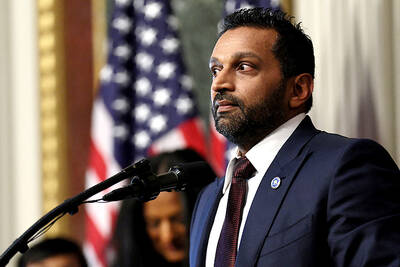
A pro-Iran hacking group claimed to breach FBI Director Kash Patel’s personal e-mail inbox and posted some of the contents online. The e-mails provided by the hacking group include travel details, correspondence with leasing agents in Washington and global entry, and loyalty account numbers. The e-mail address the hackers claim to have compromised has been previously tied to Patel’s personal details, and the leaked e-mails contain photos of Patel and others, in addition to correspondence with family members and colleagues. “The FBI is aware of malicious actors targeting Director Patel’s personal email information,” the agency said in a statement on


 RSS
RSS