


Last year, North Korea recorded its worst harvest in more than a decade, the UN said yesterday, as natural disasters combined with the nation’s lack of arable land and inefficient agriculture to hit production.
North Korea, which is under several sets of sanctions over its nuclear weapon and ballistic missile programs, has long struggled to feed itself and suffers chronic food shortages.
However, last year’s harvest was just 4.95 million tonnes, the UN said in its Needs and Priorities assessment for this year, down by 500,000 tonnes.
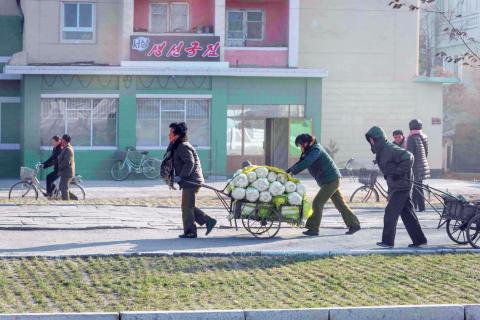
Photo: AFP
It was “the lowest production in more than a decade,” UN resident coordinator in North Korea Tapan Mishra said in a statement. “This has resulted in a significant food gap.”
As a result, 10.9 million North Koreans need humanitarian assistance — 600,000 more than last year — with the potential for increased malnutrition and illness.
It is equivalent to 43 percent of the population.
However, while the number of people needing help rose, the UN has had to cut its target for people to help — from 6 million to 3.8 million — as it seeks to prioritize those most in need.
Funding has fallen far short of what the UN says it needs.
Only 24 percent of last year’s appeal was met, with Mishra describing it as “one of the lowest-funded humanitarian plans in the world.”
Agencies have been forced to scale back their programs and some face closing projects, he said, appealing to donors to “not let political considerations get in the way of addressing humanitarian need.”
“The human cost of our inability to respond is unmeasurable,” he said, adding that sanctions have created unintended delays and challenges to humanitarian programs, even though they are exempt under UN Security Council resolutions.
Impoverished North Korea has frequently been condemned by the international community for decades of prioritizing the military and its nuclear weapons program over adequately providing for its people — an imbalance that some critics have said the UN’s aid program encourages.
Ahead of his Hanoi summit last week with North Korean leader Kim Jong-un, US President Donald Trump repeatedly dangled the prospect of North Korea becoming an economic powerhouse if it gave up its arsenal, but the two were unable to reach a deal.
The nation industrialized rapidly following the end of the Korean War and for a time was wealthier than South Korea. Funding from Moscow papered over the effects of chronic economic mismanagement, but that came to an end with the collapse of the Soviet Union, which was followed by a crippling famine.
That episode — known as the Arduous March, when hundreds of thousands of people died — is in the past, but North Korea does not have access to the latest agricultural technology or fertilizers, and its yields are well below global averages.
It is also a rugged, largely mountainous, nation with only about 20 percent of its land area suitable for cultivation. It was hit by a heatwave in July and August last year, followed by heavy rains and flash floods from Typhoon Soulik.
As a result, rice and wheat crops were down 12 to 14 percent, the UN said.
The figure is significantly larger than in South Korea, where rice production was down only 2.6 percent last year, according to Seoul’s statistics, even though it experiences similar weather and climate.
North Korea’s soybean output slumped 39 percent and production of potatoes — promoted by Kim as a way to increase supplies — was down 34 percent, the UN said.
Last month, Pyongyang told the UN that it was facing a shortfall of 1.4 million tonnes of food this year.
Humanitarian agencies were able to monitor their programs “rigorously” to make sure that help reached the most vulnerable people, Mishra said.
“We cannot just leave them behind,” he added.

Crowds in Bangladesh are flocking to snap photographs with an unlikely social media star — an albino buffalo with flowing blond hair nicknamed “Donald Trump” that is due to be sacrificed within days. Owner Zia Uddin Mridha, 38, said his brother named the 700kg bull over its flowing helmet of hair resembling the signature look of the US president. “My younger brother picked this name because of the buffalo’s extraordinary hair,” he said at his farm in Narayanganj, just outside the capital, Dhaka. Mridha said that a constant stream of curious visitors — social media fans, onlookers and children — have come throughout
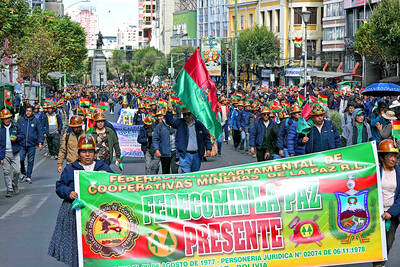
The Bolivian government on Friday struck a deal with protesting miners, but was still grappling with blockades and demonstrations by other workers across La Paz. Other groups are still blocking access roads into the city, which is also the seat of the government. Police on Thursday prevented the miners from entering the main square by using tear gas, while the demonstrators hurled stones and explosives with slingshots. Protests against the policies of Bolivian President Rodrigo Paz have convulsed the Andean nation since early this month, and roadblocks were choking routes into La Paz throughout Friday, the national road authority said. Miners demanded that Paz
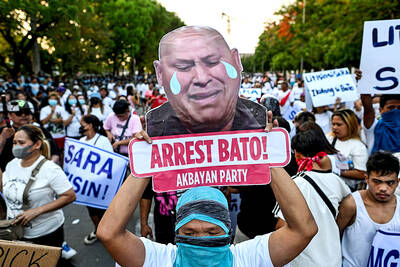
The Philippines said it has asked the country’s Supreme Court to allow it to arrest former Philippine president Rodrigo Duterte’s chief drug war enforcer to stand trial in an international tribunal. The International Criminal Court (ICC) last week unsealed an arrest warrant against Philippine Senator Ronald dela Rosa, accusing him along with Duterte and other “coperpetrators” of the “crime against humanity of murder.” Dela Rosa briefly sought refuge in the Philippine Senate last week while asking the Philippine Supreme Court to stop an ongoing attempt by government agents to arrest him. “By his own conduct, he has placed himself outside the protection of
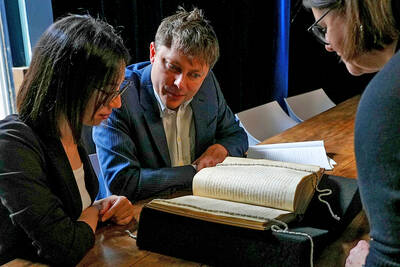
The researchers in Ireland looked at their computer screen, marveling at a medieval book tracked down in a Roman library. They flipped through its digitized pages and found their sought-after treasure: the oldest surviving English poem. “We were extremely surprised. We were speechless. We couldn’t believe our eyes when we first saw that,” said Elisabetta Magnanti, a visiting research fellow at Trinity College Dublin’s school of English. The poem was also within the main body of Latin text, she said, calling it “extraordinary.” Composed in Old English by a Northumbrian agricultural worker in the 7th century, Caedmon’s Hymn appears within some copies of


 RSS
RSS