


Ukraine on Wednesday said it would not take part in this year’s Eurovision Song Contest after the singer selected to represent the nation dropped out following a row over Russia.
Singer MARUV won a public vote, but said she would not participate because the Ukrainian national broadcaster had imposed conditions, including a ban on concerts in Russia.
Other performers who had competed to represent Kiev in the annual competition, to be hosted this year in Tel Aviv, Israel, also refused to accept the conditions.
“National Public Broadcasting Co of Ukraine [UA PBC] is declining to participate in the Eurovision Song Contest 2019,” the broadcaster said in a statement on Wednesday.
The broadcaster said the national selection process had revealed a “systemic problem” in Ukrainian music, that artists have business links to an “aggressor state.”
Russia and Ukraine are culturally close, but political ties between the nations have been in dire straits since Moscow annexed the Crimean Peninsula in 2014.
A conflict between Ukrainian troops and breakaway Moscow-backed rebels in the east of Ukraine has claimed about 13,000 lives since it broke out following the annexation.
National broadcaster UA PBC earlier accused MARUV, whose real name is Anna Korsun, of failing to understand her role as an ambassador who should represent Ukrainian public opinion.
“I’m a musician, not a tool in the political arena,” Korsun wrote on Instagram.
UA PBC made public some of the terms of the contract it requires the nation’s performer to sign, including a ban on “statements that may call into question the issue of territorial integrity and security of Ukraine.”
It also stipulated that the artist must not tour in Russia for three months after the contest.
“This is a crisis, to which there is no definite or correct answer, because society is divided,” Oleksandra Koltsova, a member of the board that oversees the Eurovision entry, told the Hromadske TV station.
Neither Freedom Jazz, the vocal trio who finished second in the national contest, nor KAZKA and Brunettes Shoot Blondes — the bands that came third and fourth — plan to go to Tel Aviv.
“We do not need a victory at any cost, our mission is to unite people with our music, not to sow discord,” KAZKA wrote on its Facebook page after talks with the national broadcaster.

ROCKY RELATIONS: The figures on residents come as Chinese tourist numbers drop following Beijing’s warnings to avoid traveling to Japan The number of Chinese residents in Japan has continued to rise, even as ties between the two countries have become increasingly fractious, data released on Friday showed. As of the end of December last year, the number of Chinese residents had increased by 6.5 percent from the previous year to 930,428. Chinese people accounted for 22.6 percent of all foreign residents in Japan, making them by far the largest group, Japanese Ministry of Justice data showed. Beijing has criticized Tokyo in increasingly strident terms since Japanese Prime Minister Sanae Takaichi last year suggested that a military conflict around Taiwan could

A retired US colonel behind a privately financed rocket launch site in the Dominican Republic sees the project as a response to China’s dominance of the space race in Latin America. Florida-based Launch on Demand is slated to begin building a US$600 million facility in a remote region near the border with Haiti late this year. The project is designed to meet surging demand for the heavy-lift rockets needed to put clusters of satellites into orbit. It is also an answer to China’s growing presence in the region, said CEO Burton Catledge, a former commander of the US Air Force’s 45th Operations

Germany is considering Australia’s Ghost Bat robot fighter as it looks to select a combat drone to modernize its air force, German Minister of Defense Boris Pistorius said yesterday. Germany has said it wants to field hundreds of uncrewed fighter jets by 2029, and would make a decision soon as it considers a range of German, European and US projects developing so-called “collaborative combat aircraft.” Australia has said it will integrate the Ghost Bat, jointly developed by Boeing Australia and the Royal Australian Air Force, into its military after a successful weapons test last year. After inspecting the Ghost Bat in Queensland yesterday,
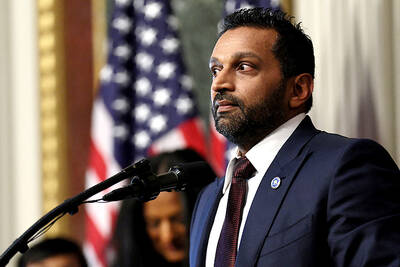
A pro-Iran hacking group claimed to breach FBI Director Kash Patel’s personal e-mail inbox and posted some of the contents online. The e-mails provided by the hacking group include travel details, correspondence with leasing agents in Washington and global entry, and loyalty account numbers. The e-mail address the hackers claim to have compromised has been previously tied to Patel’s personal details, and the leaked e-mails contain photos of Patel and others, in addition to correspondence with family members and colleagues. “The FBI is aware of malicious actors targeting Director Patel’s personal email information,” the agency said in a statement on


 RSS
RSS