


Crouching near a wooden shed in his snowy backyard, Prokopy Nogovitsyn lifts up a gray tarpaulin and takes out a vertebra the size of a saucer: part of a mammoth skeleton.
“Some friends found this in the north and wanted to sell it, but it lacks tusks, so nobody wanted it,” said Nogovitsyn, who lives in a village in the northern Siberian region of Yakutia.
Mammoth bones are widespread in Yakutia, an enormous region bordering the Arctic Ocean covered by permafrost, which acts as a giant freezer for prehistoric fauna, but over the past few years this part of the world has experienced something of a mammoth rush: After China banned the import and sale of elephant ivory, its traditional carvers turned to the tusks of the elephant’s long-extinct ancestor.
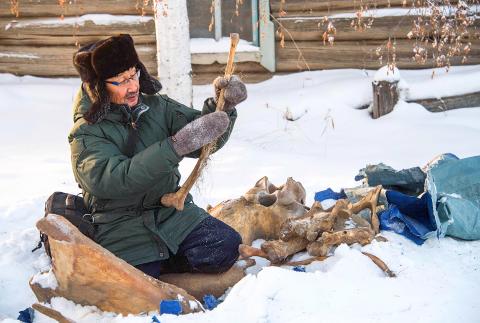
Photo: AFP
Russian exports amounted to 72 tonnes in 2017, with more than 80 percent going to China.
Some Chinese buyers travel to Yakutia to buy tusks directly, while some Russians also export them.
Thousands of woolly mammoths roamed the Pleistocene-era steppe tens of thousands of years ago and their remains are preserved in Yakutia’s permafrost.
Authorities estimate that 500,000 tonnes of mammoth tusks — known as “ice ivory” — are buried in the area.
Local hunters and fishers have long picked up mammoth bones along river banks and sea coasts, but prices dramatically increased over the past decade, leading fortune-seekers on arduous Arctic quests.
The industry has created a new source of revenue and led to an increase in paleontological discoveries.
While tusk hunters can obtain licenses, the trade is still not fully regulated, and some complain of pressure from the authorities and confiscation of their finds.
Collecting tusks is a complicated affair prepared months in advance. Equipment has to be shipped hundreds of kilometers to the north.
Yakutia covers 3 million square kilometers, an area five times the size of France, much of which has no roads. Collectors purchase licenses for particular areas. Some use powerful water jets to burrow prospecting tunnels into river banks, creating labyrinthine icy mines.
Good quality mammoth ivory can sell in China for more than US$1,000 per kilogram and locals see it as the only way to achieve financial security in northern Yakutia, where jobs are scarce and the climate makes agriculture impossible.
“There is a mammoth rush now,” said one collector, who has worked with a license for more than a decade, but requested anonymity due to the industry’s vague status.
A bill to fully regulate prospecting and the trade in tusks was introduced in the Russian parliament in 2013, but inexplicably has still not been voted on, he said.
Exporting tusks from Russia has lately become more difficult.
“Ordinary people should know that they can pick something up off the ground, sell it, pay a tax and live in peace,” he said.
Last year, collectors staged a protest in the region’s main city of Yakutsk, accusing authorities of confiscating their ivory haul even though they had the necessary permits.
They held up placards saying: “Return tusks back to the people.”
“The situation is at a dead-end” as long as Yakutia cannot persuade Moscow to pass the proposed bill, regional lawmaker Vladimir Prokopyev said.
He argued that while digging up the permafrost is harmful, 90 percent of collectors simply pick up tusks from the ground and Yakutia’s proposed bill forbids the damaging use of water jets.
Collectors are especially worried after a recent documentary on state television painted them as millionaire poachers.
The documentary called Island of Skeletons, shown on the Rossiya 24 channel, accused Yakutia authorities of turning a blind eye to prospectors’ “criminal” trade.
Prokopyev alleged the film was “ordered by [Russian] mammoth oligarchs who used to be monopolists” in buying up tusks from locals and reselling them to China, but have now lost out to Chinese dealers who come to buy them direct.
The film claims that prospectors “barbarically” destroy archeological sites, but Valery Plotnikov, a paleontologist at the Yakutia Academy of Sciences, said that the mammoth rush had been beneficial to science by providing specimens that the academy could not otherwise afford.
He was studying a rare prehistoric cave lion cub that a collector found last summer.
“We have a symbiosis with licensed collectors,” he said, adding that they provide researchers with valuable items for free, but remain owners of specimens and stand to profit when their finds are exhibited abroad.
He also receives tusks confiscated from collectors who operate illegally, without a license or in protected areas.
Those who have a license and pay a customs levy should be able to export, he said.
Yakutia Governor Aisen Nikolayev said he hoped the bill regulating tusk collectors would be finally passed this year, though he acknowledged “there is some resistance” to it.
Without a national law classifying mammoth ivory as a special natural resource, the trade remains in a “gray zone,” he said.
However, for some in Yakutia it is a source of pride that the region helps stop the hunting of elephants for tusks.
“Our dead bones are saving living elephants,” Nogovitsyn said. “Being able to gather them is important both for us and for Africa.”

Kouri Richins, a Utah mother who published a children’s book about grief after the death of her husband is to serve a life sentence for his murder without the possibility of parole, a judge ruled on Wednesday. Richins was convicted in March of aggravated murder for lacing a cocktail given to her husband, Eric Richins, with five times the lethal dose of fentanyl at their home near Park City in 2022. A jury also found her guilty of four other felonies, including insurance fraud, forgery and attempted murder for trying to poison her husband weeks earlier on Feb. 14, 2022, with a

DELA ROSA CASE: The whereabouts of the senator, who is wanted by the ICC, was unclear, while President Marcos faces a political test over the senate situation Philippine authorities yesterday were seeking confirmation of reports that a top politician wanted by the International Criminal Court (ICC) had fled, a day after gunfire rang out at the Philippine Senate where he had taken refuge fearing his arrest. Senator Ronald “Bato” dela Rosa, the former national police chief and top enforcer of former Philippine president Rodrigo Duterte’s “war on drugs,” has been under Senate protection and is wanted for crimes against humanity, the same charges Duterte is accused of. “Several sources confirmed that the senator, Senator Bato, is no longer in the Senate premises, but we are still getting confirmation,” Presidential

Nauru said it would hold a referendum to change its official name, described as a colonial relic from a time when “foreign tongues” mangled the native language. Nauru would change its name to Naoero to “more faithfully honor our nation’s heritage, our language and our identity,” Nauruan President David Adeang said in a statement on Tuesday. The Pacific island nation’s native language is Dorerin Naoero, which is spoken by the vast majority of its approximately 10,000 inhabitants. “Nauru emerged because Naoero could not be properly pronounced by foreign tongues, and was changed not by our choice, but for convenience,” the government said in

HELP DENIED? The US Department of State said that the Cuban leadership refuses to allow the US to provide aid to Cubans, ‘who are in desperate need of assistance’ US Secretary of State Marco Rubio on Wednesday said that Cuba’s leadership must change, as Washington renewed an offer of US$100 million in aid if the communist nation agrees to cooperate. Cuba has been suffering severe economic tumult led by an energy shortage that plunged 65 percent of the country into darkness on Tuesday. Cuba’s leaders have blamed US sanctions, but Rubio, a Cuban American and critic of the government established by Fidel Castro, said the system was to blame, including corruption by the military. “It’s a broken, nonfunctional economy, and it’s impossible to change it. I wish it were different,” he told


 RSS
RSS