


In a year of liberal challenges to US President Donald Trump, an avowed centrist scored the Democratic Party’s biggest coup — flipping a red state’s US Senate seat.
US Representative Kyrsten Sinema won the Arizona Senate seat being vacated by Republican Senator Jeff Flake. The race against Republican Representative Martha McSally was tight enough that a winner was not decided until Monday, after a slow count of mail-in ballots gave her an insurmountable lead.
Sinema’s win achieved a long-time Democratic goal of making Arizona, with its growing Latino population, a competitive state.
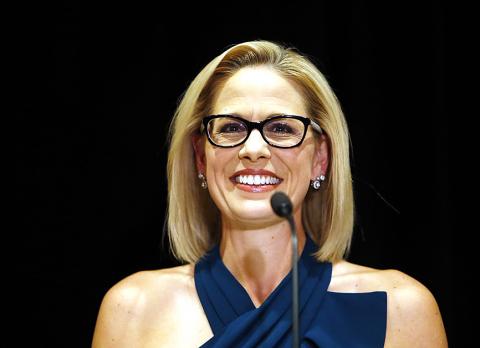
Photo: AP
She did it by pointedly not running against the US president, or even critiquing his hardline immigration stance.
“She didn’t put the progressive bit in her mouth and run with it,” said Chuck Coughlin, a Republican strategist in Phoenix. “She spit it out and did something else.”
Sinema targeted moderate Republican and independent women by painting herself as a nonpartisan problem-solver who voted to support Trump’s agenda 60 percent of the time.
Her nearly single-issue campaign talked about the importance of healthcare and protections for people with pre-existing conditions.
She knew McSally was vulnerable there, because she backed the Republicans’ failed attempt to repeal former US president Barack Obama’s healthcare law.
Sinema tailored her campaign for conservative-leaning Arizona rather than the national environment, but it might be a guide for Democrats who hope to expand the electoral map in 2020.
While some liberals won important races in California, Colorado and Kansas, the left’s highest-profile champions disappointed on election day.
US Representative Beto O’Rourke fell short in his challenge to US Senator Ted Cruz in Texas. Stacey Abrams trailed her Republican opponent in the still undecided bitter Georgia gubernatorial race, and Tallahassee Mayor Andrew Gillum, who once led in the polls in the race for Florida governor, was awaiting the results of a recount.
Sinema prevailed, while the Democratic candidate for governor, David Garcia, ran as an avowed progressive and got trounced by Republican incumbent Doug Ducey.
“Kyrsten was the perfect candidate for this race,” said Democratic strategist Chad Campbell, who previously served with Sinema in Arizona’s state legislature. “We saw that with Garcia.”
Sinema first came to prominence as an openly bisexual Green Party advocate in Phoenix, and McSally raked the Democrat over her protests against the Iraq and Afghanistan wars.
Sinema was elected as a Democrat to the state legislature in 2004 and carved out a reputation as a liberal who could work with her conservative colleagues.
By the time she was elected to US Congress representing a suburban Phoenix swing district in 2012, Sinema had completely remade herself into a centrist.
She voted against US Representative Nancy Pelosi as the Democratic leader, supported relaxed regulations on banks and a law to increase penalties on people illegally re-entering the country.
She supported a bill making it easier to deport immigrants identified by police as gang members.

ROCKY RELATIONS: The figures on residents come as Chinese tourist numbers drop following Beijing’s warnings to avoid traveling to Japan The number of Chinese residents in Japan has continued to rise, even as ties between the two countries have become increasingly fractious, data released on Friday showed. As of the end of December last year, the number of Chinese residents had increased by 6.5 percent from the previous year to 930,428. Chinese people accounted for 22.6 percent of all foreign residents in Japan, making them by far the largest group, Japanese Ministry of Justice data showed. Beijing has criticized Tokyo in increasingly strident terms since Japanese Prime Minister Sanae Takaichi last year suggested that a military conflict around Taiwan could

A retired US colonel behind a privately financed rocket launch site in the Dominican Republic sees the project as a response to China’s dominance of the space race in Latin America. Florida-based Launch on Demand is slated to begin building a US$600 million facility in a remote region near the border with Haiti late this year. The project is designed to meet surging demand for the heavy-lift rockets needed to put clusters of satellites into orbit. It is also an answer to China’s growing presence in the region, said CEO Burton Catledge, a former commander of the US Air Force’s 45th Operations

Germany is considering Australia’s Ghost Bat robot fighter as it looks to select a combat drone to modernize its air force, German Minister of Defense Boris Pistorius said yesterday. Germany has said it wants to field hundreds of uncrewed fighter jets by 2029, and would make a decision soon as it considers a range of German, European and US projects developing so-called “collaborative combat aircraft.” Australia has said it will integrate the Ghost Bat, jointly developed by Boeing Australia and the Royal Australian Air Force, into its military after a successful weapons test last year. After inspecting the Ghost Bat in Queensland yesterday,
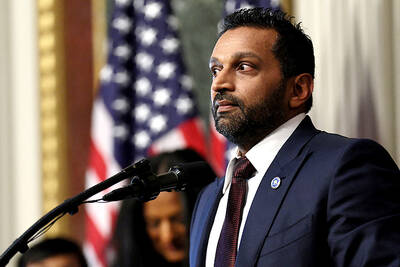
A pro-Iran hacking group claimed to breach FBI Director Kash Patel’s personal e-mail inbox and posted some of the contents online. The e-mails provided by the hacking group include travel details, correspondence with leasing agents in Washington and global entry, and loyalty account numbers. The e-mail address the hackers claim to have compromised has been previously tied to Patel’s personal details, and the leaked e-mails contain photos of Patel and others, in addition to correspondence with family members and colleagues. “The FBI is aware of malicious actors targeting Director Patel’s personal email information,” the agency said in a statement on


 RSS
RSS