


A team of Russian historians and archeologists have used a Nazi bomber pilot’s photograph to help them pinpoint the location of mass graves in Moscow containing the remains of thousands shot by Stalin’s secret police.
The existence of a mass grave in the Kommunarka district in southwestern Moscow first came to light in the dying days of the Soviet Union, when the KGB opened up its archives.
It was one of three killing fields in the city used by Stalin’s NKVD secret police in the 1930s.
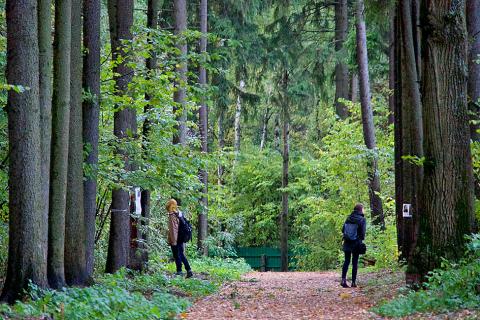
Photo: AFP
Historians believe at least 6,609 people were shot and thrown into mass graves in Kommunarka from 1937 to 1941.
The gated forested area was once used by NKVD boss Genrikh Yagoda, who had a holiday cottage there.
He fell foul of the regime and was removed from his post in 1936 and shot in 1938 — with his body most likely also disposed of in Kommunarka.
Until recently, the mass graves were believed to be located in one area of the forest, where victims’ relatives put up a memorial, but historians now believe the graves’ location was misidentified.
No serious archaeological work has been done before in Kommunarka, said Gulag History Museum director Roman Romanov, who co-led the investigation.
“There was nothing [in Kommunarka] before, people used to pick mushrooms there,” he said.
The area remains much less investigated than a larger Stalin-era killing field in Moscow’s Butovo district, Romanov said.
However, with a planned opening of a new memorial at Kommunarka, he said historians wanted to check exactly where the bodies were.
Romanov said they used ground-penetrating radar and historic photos to examine the area.
“We had volunteers working to clear the area and a geo-radar following us looking for anomalies in the ground,” he said.
An aerial shot of Kommunarka taken by a Nazi pilot flying over Moscow in 1942 — when the graves were “fresh” — was key to the investigation. Crucially, it showed the height of the trees in the area at the time.
Historians came to the conclusion that some of the trees had been planted over fresh graves — a tactic often used by the NKVD to cover up its executions.
The next step is to identify in which specific pits the bodies of victims were placed, Romanov said.
“In a small one there could be 30 people and in another there could be 100 — we want to know who is buried where,” he said.
Yan Rachinsky, a senior member of rights group Memorial that documents Stalinist crimes, estimates that about 30,000 people were shot in Moscow alone during Stalin’s Great Terror in 1937 and 1938.
During a brief period of openness during the Perestroika era in the 1980s, the KGB sent files on Stalin-era victims to journalists and Memorial, Rachinsky said.
In some, the NKVD gives the place of execution as Butovo or Moscow’s Donskoye cemetery. Others simply say that the victim’s body is “in a pit.”
“We believe those with no [marked] place of execution are in Kommunarka,” Rachinsky said.
High-ranking officials and scientists were among those shot and hastily buried in Kommunarka.
“Almost the entire Mongolian government is there,” Rachinsky said.
Mongolia was a Soviet satellite country.
Many officials from the Baltic states of Estonia, Lithuania and Latvia were also executed there after their countries were occupied by the USSR in 1940.
Rachinsky said that more than a thousand of those believed to be buried in Kommunarka remain unidentified after the Russian security services closed access to Soviet-era files.
“Suddenly, they stopped sending us the files,” he said. “Our country is still not ready to declassify the materials of another country: the USSR.”
“The state is responsible for what happened here and it struggles to define its position,” said historian Sergei Bondarenko, whose great-grandfather was shot in Kommunarka.
Romanov said he wants other regions to follow the “positive precedent” of Kommunarka to find the “exact borders” of their Stalin-era mass graves.
“These places are still secret. People don’t even know where [the bodies] are. Often all they know is that they are inside a huge forest,” he said.
The aim is to identify exactly “who is buried where in all Russian regions,” he said. “This might sound a bit Utopian. But it is necessary.”
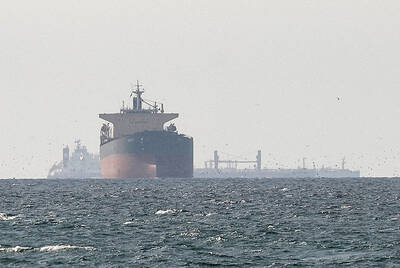
A ship that appears to be taking on the identity of a scrapped gas carrier exited the Strait of Hormuz on Friday, showing how strategies to get through the waterway are evolving as the Middle East war progresses. The vessel identifying as liquefied natural gas (LNG) carrier Jamal left the Strait on Friday morning, ship-tracking data show. However, the same tanker was also recorded as having beached at an Indian demolition yard in October last year, where it is being broken up, according to market participants and port agent’s reports. The ship claiming to be Jamal is likely a zombie vessel that

German Chancellor Friedrich Merz’s conservative Christian Democratic Union (CDU) yesterday faced a regional election battle in Rhineland-Palatinate, now held by the center-left Social Democratic Party (SPD). Merz’s CDU has enjoyed a narrow poll lead over the SPD — their coalition partners at the national level — who have ruled the mid-sized state for 35 years. Polling third is the far-right Alternative for Germany (AfD), which spells a greater threat to the two centrist parties in several state elections in September in the country’s ex-communist east. The picturesque state of Rhineland-Palatinate, bordering France, Belgium and Luxembourg and with a population of about 4 million,
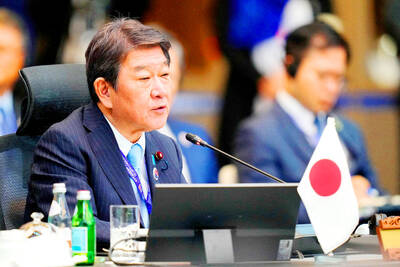
LAW CONSTRAINTS: The US has been pressing allies to send warships to open the Strait, but Tokyo’s military actions are limited under its postwar pacifist constitution Japan could consider deploying its military for minesweeping in the Strait of Hormuz if a ceasefire is reached in the war on Iran, Japanese Minister of Foreign Affairs Toshimitsu Motegi said yesterday. “If there were to be a complete ceasefire, hypothetically speaking, then things like minesweeping could come up,” Motegi said. “This is purely hypothetical, but if a ceasefire were established and naval mines were creating an obstacle, then I think that would be something to consider.” Japan’s military actions are limited under its postwar pacifist constitution, but 2015 security legislation allows Tokyo to use its Self-Defense Forces overseas if an attack,
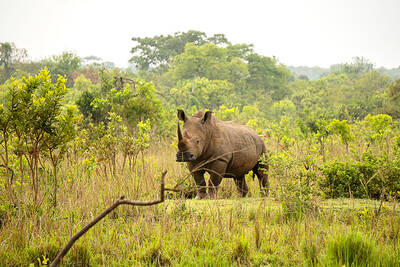
Ugandan wildlife authorities have reintroduced rhinos into a remote protected area where they were once poached into extinction, an event seen by conservationists as a milestone in efforts to support the recovery of a species threatened by poaching. On Tuesday, two southern white rhinos from a private ranch in the East African country were reintroduced into Kidepo Valley National Park in the country’s northeast. Two more rhinos in metallic crates arrived on Thursday. There have been no rhinos in the park since 1983, the result of poaching. However, a private ranch in central Uganda — the Ziwa Rhino Sanctuary — has been


 RSS
RSS