


The remote Brazilian town of Pacaraima is used to outsiders — tourists curious about spectacular nearby mountains — but a sea of Venezuelan refugees is pushing locals’ hospitality to breaking point.
Before, Pacaraima’s main attraction was its location near Monte Roraima in Venezuela, believed to have inspired Arthur Conan Doyle’s Lost World fantasy adventure, but now the town has become a focal point for the exodus from economic collapse and political violence just across the border.
Every day, between 500 and 1,200 impoverished Venezuelans come over the frontier into Pacaraima, swamping the sleepy community.
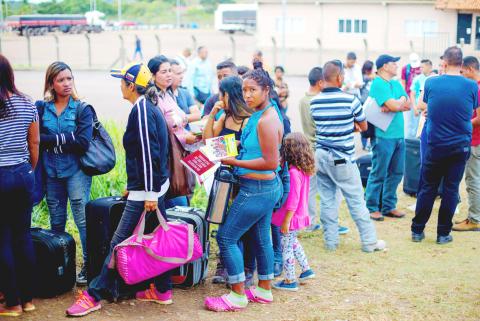
Photo: AFP
The arrivals — designated refugees by the UN — sleep in the streets, cram into inadequate shelters and are blamed by some for problems such as increased prostitution.
“It’s out of control,” said Catholic priest Father Jesus Lopez, who runs a soup kitchen for the Venezuelans in Pacaraima.
Refugees are estimated to have swelled Pacaraima’s population of 12,000 by a third, but despite the increased traffic, the local economy is suffering.
“There’s a lot of movement and little money. My sales have fallen because there are fewer tourists and they were the ones who brought in money,” said Zilma Rocha, who has a kitchen serving breakfasts.
About the only people seeing an uptick in trade are the currency dealers, who sell the Brazilian real to their neighbors.
Some supermarkets are also seeing new business, with Venezuelans crossing the border just to buy food they cannot afford or find back home.
“Everything is cheaper here. Over there, 80 reais [US$25] won’t buy you anything, but with that amount here you can get rice, sugar, flour, butter, soap, biscuits, juice and hygiene products,” said Jonathan do Santos, who frequently makes the trip.
“The lack of food in Venezuela has created opportunities here and our businesses are taking advantage of that,” said Ruan Silva, whose supermarket in Pacaraima is one of the few accepting the nearly worthless Venezuelan currency, the bolivar.
Lopez said Brazil’s government has not done enough to help communities like this prepare for the influx, but he understood the desperation driving the fugitives.
“These people are running from hunger, from death,” he said.
Most Venezuelans arriving in Pacaraima try to move straight on to the nearest sizeable city in Brazil’s Roraima state, Boa Vista, where much of the refugee aid is centered, but for some, that 215km trip — and the US$16 taxi ride — is a step too far.
“We had planned to go to Boa Vista, but things sound terrible there,” said Jose Pena, 22, who had traveled more than 1,500km with his family from Carabobo in Venezuela.
“We prefer to stay here,” he said, while tending a cooking fire. “At least here we can eat.”
Abilio Mendez, 46, who traveled all the way from Puerto La Cruz on Venezuela’s Caribbean coast, simply could not afford to go any further than Pacaraima.
“It’s everything left in my life,” he said, pointing to his two suitcases.
His solution for getting to Boa Vista? To set off under the punishing sun and try to walk.

‘CROSSING THE LINE’: China’s embassy in Seoul criticized US Forces Korea Commander General Xavier Brunson, asking if his ‘hostile’ remarks were authorized by Washington South Korea and the US are in talks over recent public remarks by the commander of US Forces Korea, Seoul’s presidential office said yesterday, after the comments drew sharp criticism from China. In a recent podcast interview, US Forces Korea Commander General Xavier Brunson described South Korea as “the dagger in the heart of Asia” from China’s east coast, prompting the Chinese embassy in Seoul to say that he had “truly crossed the line.” The interview came amid growing speculation that Washington might seek to expand the role of US Forces Korea in countering the growing regional influence of China, a key

Through the noise of rushing papers and whirring belts at a print factory in Kyoto, two creators watch their photo essay come to life in broadsheet form — part of an effort to win new audiences in the age of artificial intelligence (AI). Despite the decline of the publishing industry, self-publication and handmade “zine” magazines are growing in popularity in Japan, reflecting the nation’s enduring love of paper in the digital era. While speaking to Agence France-Presse at the plant, his hands black with ink, one of the creators, Kazuma Obara, said: “I think [paper] is a medium that engages all five

Australian researchers have trained lab-grown brain cells on a silicon computer chip to play the 1990s shooter game Doom and said they are just scratching the surface of what the neurons could be capable of doing. It is the science-fiction work of biotech boffins at Cortical Labs, who researched and developed the technology that harnesses the workings of the brain’s networking system. Each so-called “biological computer” contains about 200,000 living human brain cells, grown from stem cells that were harvested from blood donations. Having mastered the simple computer game Pong, where a paddle is moved up and down to send a ball

France experienced its hottest spring on record, the French weather service said on Tuesday, after an exceptional early heat wave that also broke highs for the season in England and Wales. Meteo-France said the average nationwide temperature over March to May was 13.8°C — about 1.7°C above the norm, and surpassing records set in 2011 and 2020. “The warmest spring since records began in 1900,” it said in a bulletin. All three months were warmer than average, but the onset of an “unprecedented heatwave” late last month pushed the mercury to highs typically seen at the height of the summer. “Our country had never


 RSS
RSS