


Global warming is making the world’s oceans sicker, depleting them of oxygen and harming delicate coral reefs more often, two studies show.
The lower oxygen levels are making marine life far more vulnerable, the researchers said. Oxygen is crucial for nearly all life in the oceans, except for a few microbes.
“If you can’t breathe, nothing else matters. That pretty much describes it,” said study lead author Denise Breitburg, a marine ecologist at the Smithsonian Environmental Research Center. “As seas are losing oxygen, those areas are no longer habitable by many organisms.”
She was on a team of scientists, convened by the UN, who reported that the drop in oxygen levels is getting worse, choking large areas, and is more of a complex problem than previously thought.
A second study found that severe bleaching caused by warmer waters is hitting once-colorful coral reefs four times more often than it used to a few decades ago.
Both studies were in Thursday’s edition of the journal Science.
When put all together, there are more than 32 million square kilometers of ocean with low oxygen levels at a depth of 200m, according to scientists with the Global Ocean Oxygen Network.
That amounts to an area bigger than the continents of Africa or North America, an increase of about 16 percent since 1950.
Their report is the most comprehensive look at oxygen deprivation in the world’s seas.
“The low oxygen problem is the biggest unknown climate change consequence out there,” said Lisa Levin, a study coauthor and professor of biological oceanography at the Scripps Institution of Oceanography.
Levin said researchers have seen coastal “dead zones” from fertilizer pollution from farms before, as well as areas of low oxygen in open ocean blamed on warmer waters, but this study shows how the two problems are interconnected with common causes and potential solutions.
“Just off southern California, we’ve lost 20 to 30 percent of our oxygen off the outer shelf,” Levin said. “That’s a huge loss.”
Some low oxygen levels in the world’s ocean are natural, but not this much, Breitburg said.
A combination of changes in winds and currents — likely from climate change — is leaving oxygen on the surface and not bringing it down lower as usual. On top of that, warmer water simply does not hold as much oxygen, and less oxygen dissolves and gets into the water, she said.
“Oxygen loss is a real and significant problem in the oceans,” said University of Georgia marine scientist Samantha Joye, who was not part of the study, but praised it.
Levels of ocean oxygen are “changing potentially faster than higher organisms can cope,” she said.
In a separate study, a team of experts looked at 100 coral reefs around the globe and how often they have had severe bleaching since 1980.
Bleaching is caused purely by warmer waters, when it is nearly 1?C above the normal highest temperatures for an area.
In the early 1980s, bleaching episodes would happen at a rate of once every 25 to 30 years. As of 2016, they were happening just under once every six years, the study found.
Bleaching is not quite killing the delicate corals, but making them extremely sick by breaking down the crucial microscopic algae living inside them.
Bleaching is like “ripping out your guts” for coral, said study coauthor Mark Eakin, coordinator of the Coral Reef Watch program for the US National Oceanic and Atmospheric Administration.
Guam has been one of the hardest hit places with eight severe bleaching outbreaks since 1994, four of them in the past five years, Eakin said.
The Florida Keys, Puerto Rico and Cuba have been hit seven times.
It takes time to recover from bleaching and the increased frequency means coral does not get the chance to recover before the next outbreak, Eakin said.
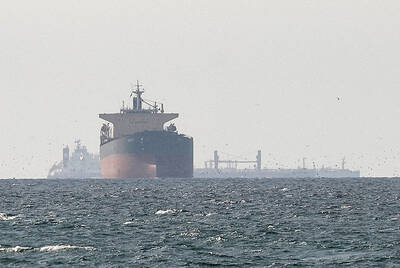
A ship that appears to be taking on the identity of a scrapped gas carrier exited the Strait of Hormuz on Friday, showing how strategies to get through the waterway are evolving as the Middle East war progresses. The vessel identifying as liquefied natural gas (LNG) carrier Jamal left the Strait on Friday morning, ship-tracking data show. However, the same tanker was also recorded as having beached at an Indian demolition yard in October last year, where it is being broken up, according to market participants and port agent’s reports. The ship claiming to be Jamal is likely a zombie vessel that

Japan is to downgrade its description of ties with China from “one of its most important” in an annual diplomatic report, according to a draft reviewed by Reuters, as relations with Beijing worsen. This year’s Diplomatic Bluebook, which Japanese Prime Minister Sanae Takaichi’s government is expected to approve next month, would instead describe China as an important neighbor and the relationship as “strategic” and “mutually beneficial.” The draft cites a series of confrontations with Beijing over the past year, including export controls on rare earths, radar lock-ons targeting Japanese military aircraft and increased pressure around Taiwan. The shift in tone underscores a deterioration

LAW CONSTRAINTS: The US has been pressing allies to send warships to open the Strait, but Tokyo’s military actions are limited under its postwar pacifist constitution Japan could consider deploying its military for minesweeping in the Strait of Hormuz if a ceasefire is reached in the war on Iran, Japanese Minister of Foreign Affairs Toshimitsu Motegi said yesterday. “If there were to be a complete ceasefire, hypothetically speaking, then things like minesweeping could come up,” Motegi said. “This is purely hypothetical, but if a ceasefire were established and naval mines were creating an obstacle, then I think that would be something to consider.” Japan’s military actions are limited under its postwar pacifist constitution, but 2015 security legislation allows Tokyo to use its Self-Defense Forces overseas if an attack,

German Chancellor Friedrich Merz’s conservative Christian Democratic Union (CDU) yesterday faced a regional election battle in Rhineland-Palatinate, now held by the center-left Social Democratic Party (SPD). Merz’s CDU has enjoyed a narrow poll lead over the SPD — their coalition partners at the national level — who have ruled the mid-sized state for 35 years. Polling third is the far-right Alternative for Germany (AfD), which spells a greater threat to the two centrist parties in several state elections in September in the country’s ex-communist east. The picturesque state of Rhineland-Palatinate, bordering France, Belgium and Luxembourg and with a population of about 4 million,


 RSS
RSS