


Coral bred in one part of the Great Barrier Reef was successfully transplanted into another area, Australian scientists said yesterday, in a project they hope could restore damaged ecosystems around the world.
In a trial at the reef’s Heron Island off Australia’s east coast, the researchers late last year collected large amount of coral spawn and eggs, grew them into larvae and then transplanted them into areas of damaged reef.
When they returned eight months later, they found juvenile coral that had survived and grown, aided by underwater mesh tanks.
“The success of this new research not only applies to the Great Barrier Reef, but has potential global significance,” lead researcher Peter Harrison of Southern Cross University said. “It shows we can start to restore and repair damaged coral populations where the natural supply of coral larvae has been compromised.”
Harrison said his mass larval-restoration approach contrasts with the “coral gardening” method of breaking up healthy coral and sticking healthy branches on reefs in the hope they will regrow, or growing coral in nurseries before transplantation.
He was optimistic his approach, which was successfully trialed earlier in the Philippines in an area of reef highly degraded by blast fishing, could help reefs recover on a larger scale.
“The results are very promising and our work shows that adding higher densities of coral larvae leads to higher numbers of successful coral recruits,” he said.
The Great Barrier Reef, the largest living structure on Earth, is reeling from an unprecedented second-straight year of coral bleaching, because of warming sea temperatures linked to climate change.
David Wachenfeld, chief scientist of the Great Barrier Reef Marine Park Authority that manages the area, said there was a need for such efforts amid the accelerating effects of climate change.
“The success of these first trials is encouraging — the next challenge is to build this into broader scale technology that is going to make a difference to the reef as a whole,” Wachenfeld said.
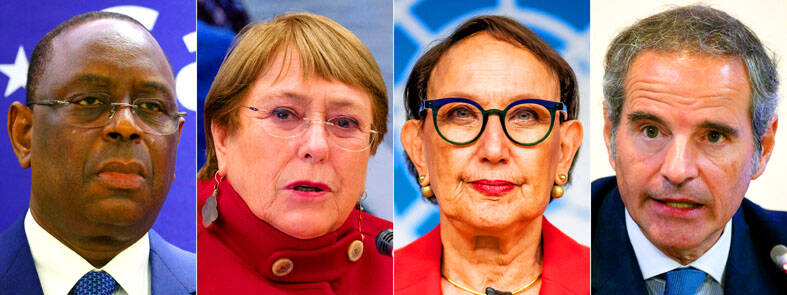
Four contenders are squaring up to succeed Antonio Guterres as secretary-general of the UN, which faces unprecedented global instability, wars and its own crushing budget crisis. Chile’s Michelle Bachelet, Argentina’s Rafael Grossi, Costa Rica’s Rebeca Grynspan and Senegal’s Macky Sall are each to face grillings by 193 member states and non-governmental organizations for three hours today and tomorrow. It is only the second time the UN has held a public question-and-answer, a format created in 2016 to boost transparency. Ultimately the five permanent members of the UN’s top body, the Security Council, hold the power, wielding vetoes over who leads the

South Korea’s air force yesterday apologized for a 2021 midair collision involving two fighter jets, a day after auditors said the pilots were taking selfies and filming during the flight and held them responsible for the accident. “We sincerely apologize to the public for the concern caused by the accident that occurred in 2021,” an air force spokesman told a news conference, adding that one of the pilots involved had been suspended from flying duties, received severe disciplinary action and has since left the military. The apology followed a report released on Wednesday by the South Korean Board of Audit and Inspection,

An earthquake registering a preliminary magnitude of 7.7 off northern Japan on Monday prompted a short-lived tsunami alert and the advisory of a higher risk of a possible mega-quake for coastal areas there. The Cabinet Office and the Japan Meteorological Agency said there was a 1% chance for a mega-quake, compared to a 0.1% chance during normal times, in the next week or so following the powerful quake near the Chishima and Japan trenches. Officials said the advisory was not a quake prediction but urged residents in 182 towns along the northeastern coasts to raise their preparedness while continuing their daily lives. Prime

About 240 Indians claiming descent from a Biblical tribe landed at Tel Aviv airport on Thursday as part of a government operation to relocate them to Israel. The newcomers passed under a balloon arch in blue and white, the colors of the Israeli flag, as dozens of well-wishers welcomed them with a traditional Jewish song. They were the first “bnei Menashe” (“sons of Manasseh”) to arrive in Israel since the government in November last year announced funding for the immigration of about 6,000 members of the community from the states of Manipur and Mizoram in northeast India. The community claims to descend from


 RSS
RSS