


Felix Salcedo lost an arm fighting during Colombia’s half-century civil war that ended in August. Today, he uses his remaining arm to grow pineapples.
Like dozens of other former Revolutionary Armed Forces of Colombia (FARC) guerrillas in his village, Salcedo is trying to earn a living legally after his rebel movement disarmed under a peace deal in December last year with the government.
Salcedo, 38, thinks back on the half of his life he spent with Colombia’s largest rebel force, which last month transformed into a political party.
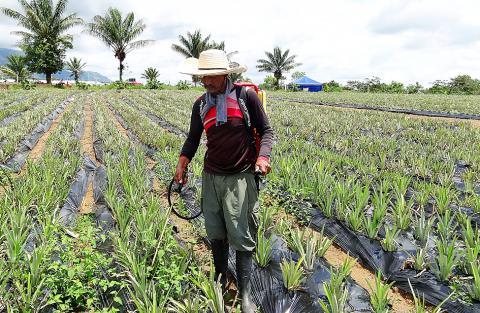
Photo: Reuters
An anti-personnel mine tore off Salcedo’s left arm, he says as he sprays pesticides at the plantation of 20,000 young pineapple plants.
Peace has not come easily to the nation where for decades the FARC controlled areas where coca leaf and cocaine production flourished.
Not only have there been delays in implementing the peace accord, but the ex-combatants face strong temptations to join dissident rebels, keep their weapons and traffic drugs.
Last week, UN Assistant Secretary-General for Human Rights Andrew Gilmour said “reintegration is not going so well,” because “there is nothing” for returning FARC fighters.
La Montanita village, with its houses of metal sheeting and zinc roofs surrounded by emerald green plantations, is considered a success for the peace plan.
In the nation’s south, it is one of 26 demobilization zones for the 7,000 ex-FARC members.
His fighting days are over, but Salcedo has found renewed motivation from the esprit de corps that kept FARC going for 53 years.
“To be united, that’s what it takes to work, to carry out future projects,” he says of the pineapples, planted thanks to a fund created by 150 former rebels assisted by a public subsidy.
In this jungle zone that was a historic bastion of FARC, about 250 ex-rebels came together to start their lives anew in agriculture, fish farming or as cobblers.
Some have opened bookstores or bakeries.
The aim is to transform the demobilization zones into villages for former FARC members and their families, so they can put into practice the socialist ideals on which their movement was founded.
FARC and another rebel group were formed in 1964 to fight for land rights and protect poor rural communities.
Over subsequent decades, the conflict drew in paramilitary groups and state forces in what became a many-sided war fueled by drug trafficking.
It left about 260,000 people dead, 60,000 unaccounted for and 7 million displaced in Latin America’s longest conflict.
“This process we are going through is harder than the war itself... We have to invent [these projects] and a whole lot more,” said Danilo Ortiz, who spent 20 of his 34 years in FARC.
Now he repairs shoes.
“What we see here is a good example of how the reintegration process should be carried out,” said Jean Arnault, a Frenchman who heads the UN mission in Colombia.
The UN was tasked with supervising the guerrillas’ disarmament and return to civilian life.
However, elsewhere in the nation, ex-guerrillas have quit the reintegration program, deciding to find their own ways of making a living or to join dissident rebels.
Between 500 and 800 have turned to the dissidents, State Ombudsman Carlos Negret said.
“If people in the countryside don’t see state aid arriving, it’s going to be very difficult to have the conditions needed for the peace process,” he said.
FARC’s former commanders criticize the government of Columbian President Juan Manuel Santos for not respecting what was negotiated. The government attributes delays in implementing the accord to bureaucratic and logistical problems.
“The state must be reintegrated in all the regions that were left aside,” former commander Pastor Alape said.
Salcedo and Ortiz share Alape’s frustration, but want to be more hopeful.
They smile as they consider the “collective effort” that will produce the income from the village’s first peacetime harvest of pineapples.
“United, we will never be defeated,” Ortiz says, in an old revolutionary refrain.


Through the noise of rushing papers and whirring belts at a print factory in Kyoto, two creators watch their photo essay come to life in broadsheet form — part of an effort to win new audiences in the age of artificial intelligence (AI). Despite the decline of the publishing industry, self-publication and handmade “zine” magazines are growing in popularity in Japan, reflecting the nation’s enduring love of paper in the digital era. While speaking to Agence France-Presse at the plant, his hands black with ink, one of the creators, Kazuma Obara, said: “I think [paper] is a medium that engages all five
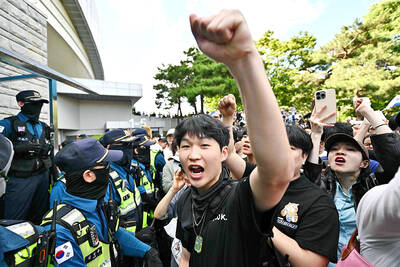
‘ABSURD MISTAKE’: The election commission said that there had been a failure to anticipate turnout after 14 polling stations ran short of ballot papers South Korean riot police yesterday cleared protesters from a Seoul polling station after a 35-hour blockade sparked by a shortage of ballot papers during local elections earlier this week. Wednesday’s election was the first nationwide vote since South Korean President Lee Jae-myung took office following the ouster of Yoon Suk-yeol over his short-lived martial law declaration. Lee’s ruling Democratic Party swept most races, but failed to flip the crucial Seoul mayoral seat. The South Korean National Election Commission apologized, blaming a failure to anticipate turnout after 14 polling stations in Seoul ran short of ballot papers. Some polling stations stayed open until 10pm to

France experienced its hottest spring on record, the French weather service said on Tuesday, after an exceptional early heat wave that also broke highs for the season in England and Wales. Meteo-France said the average nationwide temperature over March to May was 13.8°C — about 1.7°C above the norm, and surpassing records set in 2011 and 2020. “The warmest spring since records began in 1900,” it said in a bulletin. All three months were warmer than average, but the onset of an “unprecedented heatwave” late last month pushed the mercury to highs typically seen at the height of the summer. “Our country had never

A Sherpa guide was found crawling to base camp on Mount Everest a week after he went missing and was reunited with his family, who had given up hope he would return. Dawa Sherpa was last seen on Friday last week descending the mountain, but he did not reach base camp even though his client did. The pair were among the last climbers on the mountain as the climbing season came to an end and the route was dismantled. Dawa was located by a cleaning crew on Thursday morning as he was crawling down the snowy slopes around the Khumbu Icefall, just above


 RSS
RSS