


Relief agencies struggling to reach hundreds of thousands of Rohingya Muslims displaced by strife in northwestern Myanmar are facing rising hostility from ethnic Rakhine Buddhists, who accuse the UN and foreign aid groups of only helping Muslims.
So far, the Myanmar government has only granted Red Cross organizations access to the area. The UN suspended its activities and evacuated non-critical staff after the government suggested it had supported Rohingya insurgents.
Already battling against bad weather, tough terrain and obstructive bureaucracy, the Red Cross also ran into an angry mob, who believed the foreign aid agencies have ignored the suffering of Rakhine Buddhists in Myanmar’s poorest state.
On Wednesday, a mob in Sittwe, the capital of Rakhine State, tried to block a boat carrying International Committee of the Red Cross (ICRC) aid to the north, where attacks by Rohingya militants on Aug. 25 prompted Myanmar’s generals to order a sweeping counter-insurgency offensive.
The mob was armed with sticks, knives and firebombs, and only dispersed after police fired rubber bullets.
Four days earlier, a Myanmar Red Cross truck was stopped and searched by Rakhine residents in Sittwe.
“With heightened tensions in Rakhine State, humanitarian staff and private contractors are facing serious challenges in implementing life-saving activities,” said Pierre Peron, spokesman for the UN Office for the Coordination of Humanitarian Affairs in Myanmar.
“Many ongoing humanitarian activities that existed before August 25th have still not resumed,” Peron said. “For the sake of vulnerable people in all communities in Rakhine State, urgent measures must be taken to allow vital humanitarian activities to resume.”
In northern Rakhine, tens of thousands of people, most of them Rohingya, are displaced, but have not crossed into Bangladesh.
Closer to Sittwe, 140,000 Rohingya displaced by previous religious unrest are confined to squalid camps. They depend on foreign aid that has been severely restricted since Aug. 25.
About 6,000 Buddhists have also fled to Sittwe, where they are cared for at monasteries by the government and Rakhine volunteers.
Ethnic Rakhine have long complained that foreign aid agencies have given generously to Muslims while ignoring other equally needy people.
“All people in Rakhine are suffering, but only Muslims get help,” Arakan National Party Secretary-General Htun Aung Kyaw said.
Rakhine residents of Sittwe told reporters they believed that UN estimates of refugee numbers were exaggerated and that Rohingya camps near the city faced no shortages.
“They have more than enough,” said Kyaw Sein of Rakhine Alin Dagar, a Rakhine advocacy group in Sittwe.
She had not visited the camps, but in the past she had seen Muslims selling oil, rice and other aid in local markets, Kyaw Sein said, adding that relations between foreign aid groups and the Rakhine people had been poisoned by years of neglect and favoritism.
“It is difficult to say what they can do to win back our trust,” she said.

A humanoid robot that won a half-marathon race for robots in Beijing on Sunday ran faster than the human world record in a show of China’s technological leaps. The winner from Honor, a Chinese smartphone maker, completed the 21km race in 50 minutes and 26 seconds, said a WeChat post by the Beijing Economic-Technological Development Area, also known as Beijing E-Town, where the race began. That was faster than the human world record holder, Ugandan Jacob Kiplimo, who finished the same distance in about 57 minutes in March at the Lisbon road race. The performance by the robot marked a significant step forward
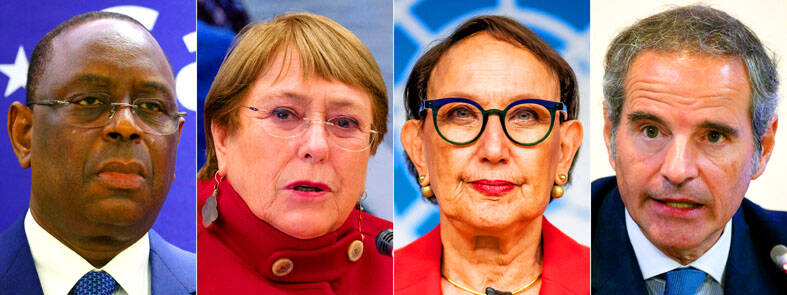
Four contenders are squaring up to succeed Antonio Guterres as secretary-general of the UN, which faces unprecedented global instability, wars and its own crushing budget crisis. Chile’s Michelle Bachelet, Argentina’s Rafael Grossi, Costa Rica’s Rebeca Grynspan and Senegal’s Macky Sall are each to face grillings by 193 member states and non-governmental organizations for three hours today and tomorrow. It is only the second time the UN has held a public question-and-answer, a format created in 2016 to boost transparency. Ultimately the five permanent members of the UN’s top body, the Security Council, hold the power, wielding vetoes over who leads the
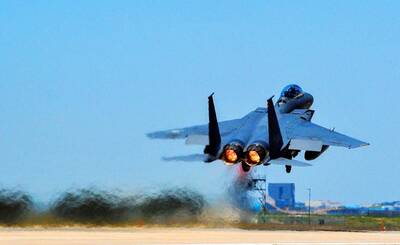
South Korea’s air force yesterday apologized for a 2021 midair collision involving two fighter jets, a day after auditors said the pilots were taking selfies and filming during the flight and held them responsible for the accident. “We sincerely apologize to the public for the concern caused by the accident that occurred in 2021,” an air force spokesman told a news conference, adding that one of the pilots involved had been suspended from flying duties, received severe disciplinary action and has since left the military. The apology followed a report released on Wednesday by the South Korean Board of Audit and Inspection,
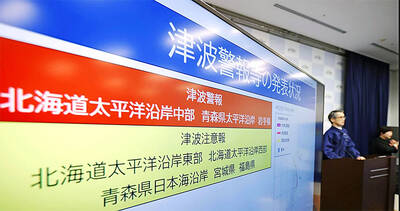
An earthquake registering a preliminary magnitude of 7.7 off northern Japan on Monday prompted a short-lived tsunami alert and the advisory of a higher risk of a possible mega-quake for coastal areas there. The Cabinet Office and the Japan Meteorological Agency said there was a 1% chance for a mega-quake, compared to a 0.1% chance during normal times, in the next week or so following the powerful quake near the Chishima and Japan trenches. Officials said the advisory was not a quake prediction but urged residents in 182 towns along the northeastern coasts to raise their preparedness while continuing their daily lives. Prime


 RSS
RSS