


Confederate Army General Robert E. Lee was vilified during the US Civil War only to become a heroic symbol of the South’s “Lost Cause” — and eventually a racist icon.
His transformation, at the center of the recent violence in Charlottesville, Virginia, reflects the changing moods in the US around race, mythology and national reconciliation, historians say.
The monuments, memorials and schools in Lee’s name erected at the turn of the 20th century are now facing scrutiny amid a demographically changing nation.
However, who was Lee beyond the myth? Why are there memorials in his honor in the first place?
THE SOLDIER
A son of US Revolutionary War hero Henry “Light-Horse Harry” Lee, Robert E. Lee graduated second in his class at West Point and distinguished himself in various battles during the US-Mexico War.
As tensions heated around southern secession, Lee’s former mentor, US General Winfield Scott, offered him a post to lead the Union’s forces against the South.
Lee declined, citing his reservations about fighting against his home state of Virginia.
Lee accepted a leadership role in the Confederate forces although he had little experience leading troops. He struggled, but eventually became a general in the Confederate Army, winning battles largely because of incompetent Union General George McClellan.
He would win other important battles against other Union generals, but he was often stalled. He was famously defeated at Gettysburg by Union Major General George Meade.
Historians say Lee’s massed infantry assault across a wide plain was a gross miscalculation in the era of the rifle.
A few weeks after becoming the general-in-chief of the armies of the Confederate states, Lee surrendered to Union General Ulysses S. Grant at Appomattox Court House in Virginia on April 9, 1865.
THE SLAVE OWNER
A career US army officer, Lee did not have much wealth, but he inherited a few slaves from his mother.
Still, he married into one of the wealthiest slave-holding families in Virginia — the Custis family of Arlington and descendants of Martha Washington.
When Lee’s father-in-law died, he took leave from the US Army to run the struggling estate and met resistance from slaves expecting to be freed.
Documents show Lee was a cruel figure with his slaves and encouraged his overseers to severely beat slaves captured after trying to escape.
One slave said Lee was one of the meanest men she had ever met.
In a 1856 letter, Lee wrote that slavery is “a moral & political evil.”
However, Lee also wrote in the same letter that God would be the one responsible for emancipation and blacks were better off in the US than Africa.
THE LOST CAUSE ICON
After the US Civil War, Lee resisted efforts to build Confederate monuments in his honor and instead wanted the nation to move on from the war.
After his death, Southerners adopted “The Lost Cause” revisionist narrative about the war and placed Lee as its central figure.
The Lost Cause argued the South knew it was fighting a losing war and decided to fight it anyway on principle.
It also tried to argue that the war was not about slavery, but high constitutional ideals.
As The Lost Cause narrative grew in popularity, proponents pushed to memorialize Lee, ignoring his deficiencies as a general and his role as a slave owner. Lee monuments went up in the 1920s just as the Ku Klux Klan was experiencing a resurgence and new Jim Crow segregation laws were adopted.
The Lee statue in Charlottesville, Virginia, went up in 1924. A year later, the US Congress voted to use federal funds to restore the Lee mansion in the Arlington National Cemetery.
The US Mint issued a coin in his honor and Lee has been on five postage stamps. No other Union figure besides former US president Abraham Lincoln has similar honors.
A NEW MEMORY
A generation after the civil rights movement, black and Latino residents began pressuring elected officials to dismantle Lee and other Confederate memorials in places like New Orleans, Houston and South Carolina.
The removals partly were based on violent acts committed by white supremacists using Confederate imagery and historians questioning the legitimacy of The Lost Cause.
A Lee statue was removed from Lee Circle in New Orleans as the last of four monuments to Confederate-era figures to be removed under a 2015 City Council vote.
The Houston Independent School District last year voted to rename Robert E. Lee High School, a school with a large Latino population, as Margaret Long Wisdom High School.
Earlier this year, the Charlottesville City Council voted to remove its Lee statue from a city park, sparking a lawsuit from opponents of the move.
The debate also drew opposition from white supremacists and neo-Nazis who revered Lee and the Confederacy. The opposition resulted in rallies to defend Lee statues this weekend that resulted in at least three deaths.

An American scientist convicted of lying to US authorities about payments from China while he was at Harvard University has rebuilt his research lab in Shenzhen, China, to pursue technology the Chinese government has identified as a national priority: embedding electronics into the human brain. Charles Lieber, 67, is among the world’s leading researchers in brain-computer interfaces. The technology has shown promise in treating conditions such as amyotrophic lateral sclerosis and restoring movement in paralyzed people. It also has potential military applications: Scientists at the Chinese People’s Liberation Army have investigated brain interfaces as a way to engineer super soldiers by boosting
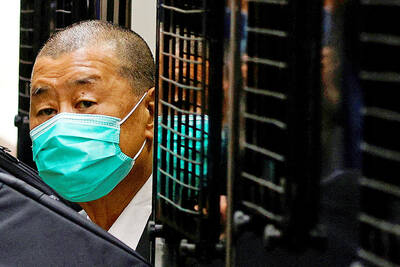
Jailed media entrepreneur Jimmy Lai (黎智英) has been awarded Deutsche Welle’s (DW) freedom of speech award for his contribution to Hong Kong’s pro-democracy movement. The German public broadcaster on Thursday said Lai would be presented in absentia with the 12th iteration of the award on June 23 at the DW Global Media Forum in Bonn. Deutsche Welle director-general Barbara Massing praised the 78-year-old founder of the now-shuttered news outlet Apple Daily for standing “unwaveringly for press freedom in Hong Kong at great personal risk.” “With Apple Daily, he gave journalists a platform for free reporting and a voice to the democracy movement in
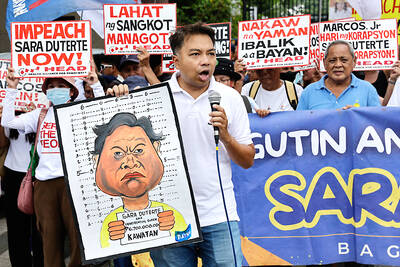
PHILIPPINE COMMITTEE: The head of the committee that made the decision said: ‘If there is nothing to hide, there is no reason to hide, there is no reason to obstruct’ A Philippine congressional committee on Wednesday ruled that there was “probable cause” to impeach Philippine Vice President Sara Duterte after hearing allegations of unexplained wealth, misuse of state funds and threats to have the president assassinated. The unanimous decision of the 53-member committee in the Philippine House of Representatives sends the two impeachment complaints to deliberations and voting by the entire lower chamber, which has more than 300 lawmakers. The complaints centered on Duterte’s alleged illegal use and mishandling of intelligence funds from the vice president’s office, and from her time as education secretary under Philippine President Ferdinand Marcos Jr. Duterte and the

As evening falls in Fiji’s capital, a steady stream of people approaches a makeshift clinic that is a first line of defense against one of the world’s fastest-growing HIV epidemics. In the South Pacific nation — a popular tourist destination of just under a million people — more than 2,000 new HIV cases were recorded last year, a 26 percent increase from 2024. The government has declared an HIV outbreak and described it as a national crisis. “It’s spreading like wildfire,” said Siteri Dinawai, 46, who came to be tested. The Moonlight Clinic, a converted minibus parked in a suburban cul-de-sac in Suva, is


 RSS
RSS