


Firefighters on Saturday managed to contain huge wildfires in Portugal and the French island of Corsica, although hot weather meant the risk of them spreading again remained high.
Nearly 1,000 people were evacuated in Corsica overnight, mostly tourists staying at campsites, as 2,000 hectares of scrubland was destroyed, although no casualties were reported.
At Cap Corse, the most northerly point of the Mediterranean island where the fire had spread, the blaze was “contained but not controlled,” local authorities said.
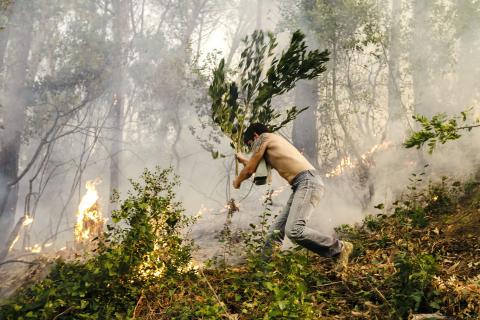
Photo: EPA
“It’s hell,” said Christian Burchi, a 50-year-old Sisco resident. “We tried to extinguish the flames with two buckets of water and a ridiculous hose. Everywhere is burning.”
About 180 firefighters, bolstered by reinforcements from the mainland, were battling the flames aided by three fire-bombing aircraft.
French Minister of the Interior Gerard Collomb praised the “admirable work” of the hundreds of emergency services.
In Portugal, firefighters managed to bring two of the major blazes under control in the center of the country by Saturday afternoon, the civil protection authority announced, while warning that the heatwave could reignite the fires.
Firefighters have stopped the spreading of the flames from the forest fire that raged in the region of Abrantes since Wednesday, authorities said.
However, more than 500 firefighters, nearly 200 vehicles and three water-bombing helicopters remain on standby should the fires flare up again, they added.
A record 220 fires had started on Friday alone, civil protection agency spokeswoman Patricia Gaspar said.
Some residents have voiced anger at authorities after a season of repeated wildfires which have stretched resources.
“Firefighters can’t perform miracles, they are exhausted,” Bracal resident Lucia Ricardo said.
After an uncommonly dry winter and spring, nearly 79 percent of the Portuguese mainland was enduring extreme or severe drought at the end of last month, the national weather office said.

‘CROSSING THE LINE’: China’s embassy in Seoul criticized US Forces Korea Commander General Xavier Brunson, asking if his ‘hostile’ remarks were authorized by Washington South Korea and the US are in talks over recent public remarks by the commander of US Forces Korea, Seoul’s presidential office said yesterday, after the comments drew sharp criticism from China. In a recent podcast interview, US Forces Korea Commander General Xavier Brunson described South Korea as “the dagger in the heart of Asia” from China’s east coast, prompting the Chinese embassy in Seoul to say that he had “truly crossed the line.” The interview came amid growing speculation that Washington might seek to expand the role of US Forces Korea in countering the growing regional influence of China, a key

Through the noise of rushing papers and whirring belts at a print factory in Kyoto, two creators watch their photo essay come to life in broadsheet form — part of an effort to win new audiences in the age of artificial intelligence (AI). Despite the decline of the publishing industry, self-publication and handmade “zine” magazines are growing in popularity in Japan, reflecting the nation’s enduring love of paper in the digital era. While speaking to Agence France-Presse at the plant, his hands black with ink, one of the creators, Kazuma Obara, said: “I think [paper] is a medium that engages all five

Australian researchers have trained lab-grown brain cells on a silicon computer chip to play the 1990s shooter game Doom and said they are just scratching the surface of what the neurons could be capable of doing. It is the science-fiction work of biotech boffins at Cortical Labs, who researched and developed the technology that harnesses the workings of the brain’s networking system. Each so-called “biological computer” contains about 200,000 living human brain cells, grown from stem cells that were harvested from blood donations. Having mastered the simple computer game Pong, where a paddle is moved up and down to send a ball

France experienced its hottest spring on record, the French weather service said on Tuesday, after an exceptional early heat wave that also broke highs for the season in England and Wales. Meteo-France said the average nationwide temperature over March to May was 13.8°C — about 1.7°C above the norm, and surpassing records set in 2011 and 2020. “The warmest spring since records began in 1900,” it said in a bulletin. All three months were warmer than average, but the onset of an “unprecedented heatwave” late last month pushed the mercury to highs typically seen at the height of the summer. “Our country had never


 RSS
RSS