


US Senator John McCain, the 2008 Republican presidential nominee known for political independence during more than three decades in the Senate, has been diagnosed with an aggressive form of brain cancer, his office said on Wednesday.
The 80-year-old lawmaker and former US Navy pilot, who was re-elected to a sixth Senate term in November last year, has been recovering at home in Arizona since undergoing surgery at the Mayo Clinic in Phoenix on Friday last week to remove a blood clot above his left eye.
Tissue analysis since that procedure revealed that a brain tumor known as a glioblastoma was associated with the clot, his office said.
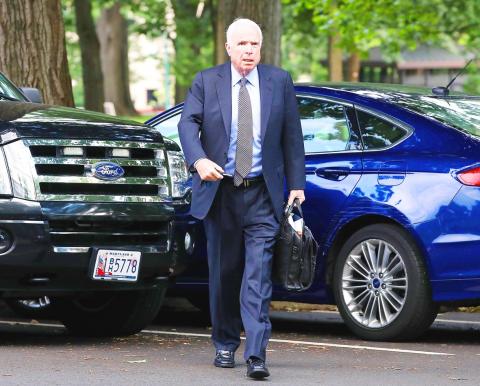
Photo: AFP
McCain’s doctors said he was recovering from surgery “amazingly well” and that his underlying health was excellent. Treatment options include a combination of chemotherapy and radiation.
However, glioblastoma is considered a grade IV tumor, the most malignant of gliomas. Medical experts said it can be very aggressive and spread into other parts of the brain quickly.
“It takes people’s lives almost uniformly... The tumor cells are very resistant to conventional therapy, such as radiation and chemotherapy. It’s a poor prognosis,” said Richard Ellenbogen, who chairs the Department of Neurological Surgery at the University of Washington.
McCain’s daughter, Meghan, said the family was shocked by the diagnosis, but that her father was the “most confident and calm” of them all as he prepared for a new battle against cancer.
McCain has had non-invasive melanomas removed at least three times. He also overcame injuries suffered as a prisoner of war in Vietnam, where he endured beatings and torture by his North Vietnamese captors.
Questions about McCain’s health arose during a recent Senate hearing when the lawmaker, normally a keen interrogator of witnesses, rambled during questioning of former FBI director James Comey.
However, his doctors told CNN that he had no sign of neurological impairment before or during his surgery.
His congressional colleagues rushed to offer tributes to McCain and wishes for his quick recovery. Known for an independent political streak, ready wit and strong opinions, McCain is one of the best-known and most popular US lawmakers among his peers and the media.
US Senator Lindsey Graham, a long-time friend, said McCain was “resolved and determined” when they spoke by telephone.
“This disease has never had a more worthy opponent,” he said.
While known as a fierce advocate for strong US military action overseas, McCain also has a reputation for working with Democrats on issues from clamping down on campaign finance abuses to immigration reform.
This week, McCain called for a bipartisan approach to overhauling the US healthcare system.
“Senator John McCain has always been a fighter,” US President Donald Trump said. “Get well soon.”
Former US president Barack Obama, who defeated McCain for the White House in 2008, called McCain “an American hero and one of the bravest fighters I’ve ever known. Cancer doesn’t know what it’s up against. Give it hell, John.”
McCain was one of Congress’ most vocal critics of Obama’s foreign policy, but he has also raised questions about Trump, a fellow Republican.
McCain found himself to be a brief side issue in the race for the 2016 Republican presidential nomination when he criticized Trump, who responded by saying McCain was not a war hero because he had been captured by the Vietnamese.
US Senate Majority Leader Mitch McConnell called McCain, the chairman of the Armed Services Committee, a hero and said he looked forward to having him back in Washington.


Showcasing phallus-shaped portable shrines and pink penis candies, Japan’s annual fertility festival yesterday teemed with tourists, couples and families elated by its open display of sex. The spring Kanamara Matsuri near Tokyo features colorfully dressed worshipers carrying a trio of giant phallic-shaped objects as they parade through the street with glee. The festival, as legend has it, honors a local blacksmith in the Edo Period (1603-1868) who forged an iron dildo to break the teeth of a sharp-toothed demon inhabiting a woman’s vagina that had been castrating young men on their wedding nights. A 1m black steel phallus sits in the courtyard of

JAN. 1 CLAUSE: As military service is voluntary, applications for permission to stay abroad for over three months for men up to age 45 must, in principle, be granted A little-noticed clause in sweeping changes to Germany’s military service policy has triggered an uproar after it emerged that the law requires men aged up to 45 to get permission from the armed forces before any significant stay abroad, even in peacetime. The legislation, which went into effect on Jan. 1 aims to bolster the military and demands all 18-year-old men fill out a questionnaire to gauge their suitability to serve in the armed forces, but stops short of conscription. If the “modernized” model fails to pull in enough recruits, parliament will be compelled to discuss the reintroduction of compulsory service, German
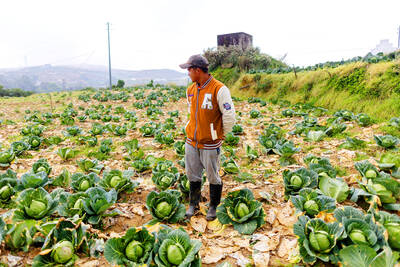
Filipino farmers like Romeo Wagayan have been left with little choice but to let their vegetables rot in the field rather than sell them at a loss, as rising oil prices linked to the Iran war drive up the cost of harvesting, labor and transport. “There’s nothing we can do,” said Wagayan, a 57-year old vegetable farmer in the northern Philippine province of Benguet. “If we harvest it, our losses only increase because of labor, transportation and packing costs. We don’t earn anything from it. That’s why we decided not to harvest at all,” he said. Soaring costs caused by the Middle East

Hungarian Prime Minister Viktor Orban’s officially declared wealth is fairly modest: some savings and a jointly owned villa in Budapest. However, voters in what Transparency International deems the EU’s most corrupt country believe otherwise — and they might make Orban pay in a general election this Sunday that could spell an end to his 16-year rule. The wealth amassed by Orban’s inner circle is fueling the increasingly palpable frustration of a population grappling with sluggish growth, high inflation and worsening public services. “The government’s communication machine worked well as long as our economic situation remained relatively good,” said Zoltan Ranschburg, a political analyst


 RSS
RSS