


Business owners shuttered shops, a burned police station stood charred and a state officer in western Venezuela was under arrest on Tuesday following a spasm of violence that resulted in at least four deaths in anti-government protests.
An especially grisly 24 hours of turmoil coming after nearly two months of political unrest had nervous residents staying indoors in restive cities such as San Cristobal near the border with Colombia.
Authorities announced on Tuesday that four men ranging in age from 17 to 33 had died from gunshot wounds at separate protests over the preceding day.
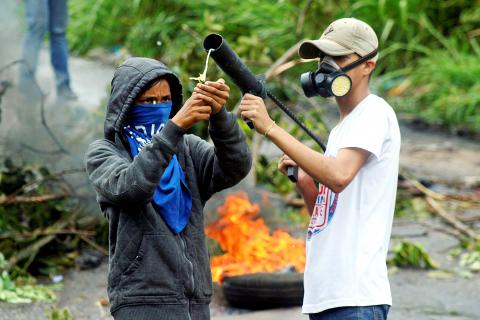
Photo: Reuters
Diego Hernandez, 33, and Luis Alviarez, 18, were killed in Tachira, while Yeison Mora Castillo, 17, died near a protest farther east in the state of Barinas on Monday. Diego Arellano, 31, died during surgery on Tuesday after being shot at a demonstration south of Caracas.
Friends and relatives of Arellano gathered outside the clinic where he died and sang the national anthem as his body was removed from the facility.
The nation’s chief prosecutor said it was charging a 27-year-old state police officer in Hernandez’s death, whose final moments were purportedly captured in a video circulating on social media.
The footage showed a bystander ripping open Hernandez’s blue T-shirt as he lay lifeless on the pavement, his eyes open and fixed, revealing a bloody wound underneath.
“They killed him,” someone screams in the video.
The weeks of protests were set off by the government’s move to nullify the opposition-controlled Congress in late March, but demonstrations have escalated into a vehicle for airing grievances against the government for triple-digit inflation, food shortages and a rise in crime.
The flare-up of violence outside Venezuela’s capital this week added to a grim and growing list of casualties from the unrest.
More than three dozen people have died, most of them young men shot at protests or killed during looting. Hundreds more have been injured in near-daily demonstrations by the opposition that frequently end with state security forces unleashing tear gas, water cannon and rubber bullets at protesters.
Arrests have been made in seven homicides. In four of those cases, state or national police officers have been charged.
Civilians were charged in three other cases, but no details released on their motives.
The opposition blames the bloodshed on state security forces using excessive force and on groups of armed, pro-government civilians known as colectivos.
Venezuelan President Nicolas Maduro says far-right extremists are working with criminal gangs to foment the violence.

‘CROSSING THE LINE’: China’s embassy in Seoul criticized US Forces Korea Commander General Xavier Brunson, asking if his ‘hostile’ remarks were authorized by Washington South Korea and the US are in talks over recent public remarks by the commander of US Forces Korea, Seoul’s presidential office said yesterday, after the comments drew sharp criticism from China. In a recent podcast interview, US Forces Korea Commander General Xavier Brunson described South Korea as “the dagger in the heart of Asia” from China’s east coast, prompting the Chinese embassy in Seoul to say that he had “truly crossed the line.” The interview came amid growing speculation that Washington might seek to expand the role of US Forces Korea in countering the growing regional influence of China, a key

SEEKING ORDER: Rodrigo Paz said that ‘anyone who wants to destroy the nation will have to deal with this president and the full force of the constitution’ Bolivian President Rodrigo Paz on Wednesday said that the nation was at a “breaking point” after nearly a month of protests that have caused shortages of food, fuel and medicine. Paz, who took office six months ago amid the worst economic crisis there in four decades, is battling a groundswell of fury over his policies. The political capital, La Paz, has been besieged by low-income workers and members of the indigenous majority calling for his resignation. “The country needs order and is reaching breaking point,” the 58-year-old said at a public event in La Paz, renewing his appeal for dialogue. On Tuesday, the Bolivian

Australian researchers have trained lab-grown brain cells on a silicon computer chip to play the 1990s shooter game Doom and said they are just scratching the surface of what the neurons could be capable of doing. It is the science-fiction work of biotech boffins at Cortical Labs, who researched and developed the technology that harnesses the workings of the brain’s networking system. Each so-called “biological computer” contains about 200,000 living human brain cells, grown from stem cells that were harvested from blood donations. Having mastered the simple computer game Pong, where a paddle is moved up and down to send a ball

Through the noise of rushing papers and whirring belts at a print factory in Kyoto, two creators watch their photo essay come to life in broadsheet form — part of an effort to win new audiences in the age of artificial intelligence (AI). Despite the decline of the publishing industry, self-publication and handmade “zine” magazines are growing in popularity in Japan, reflecting the nation’s enduring love of paper in the digital era. While speaking to Agence France-Presse at the plant, his hands black with ink, one of the creators, Kazuma Obara, said: “I think [paper] is a medium that engages all five


 RSS
RSS