


US President Donald Trump and Turkish President Recep Tayyip Erdogan stood side by side at the White House on Tuesday and promised to strengthen strained ties, despite the Turkish leader’s stern warning about Washington’s arming of a Kurdish militia.
Fresh from securing his grip on Turkey with a referendum to enhance his powers, Erdogan visited the Oval Office with complaints about US support for Kurdish fighters and what Ankara says is Washington’s harboring of the mastermind of a failed coup, but both leaders also tried gamely to put a brave face on their differences and to renew a key alliance between NATO’s leading power and its biggest Muslim member, partners in the fight against the Islamic State group in Syria and Iraq.
“It is absolutely unacceptable to take the YPG-PYD into consideration as partners in the region and it’s going against a global agreement we reached,” Erdogan said, referring to the Kurdish Peoples’ Protection Units in Syria.
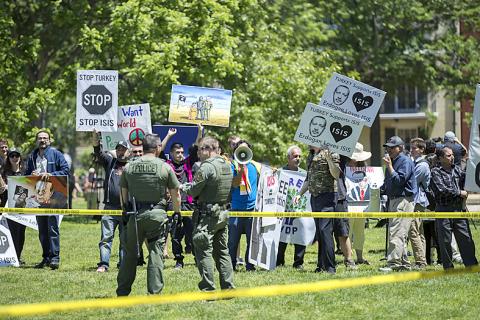
Photo: EPA
“In the same way, we should never allow those groups who want to change the ethnic or religious structures in the region to use terrorism as a pretext,” he added, suggesting that the Kurds are using the fight against the Islamic State group as cover for separatist nationalism.
Trump was one of the first leaders to congratulate Erdogan on winning the April 16 vote to strengthen his office and his Turkish counterpart repaid the compliment on Tuesday by hailing his host’s “legendary triumph” in last year’s US presidential race.
“Of course, Mr Trump’s victory has led to an awakening of new expectations for Turkey and the region it is in. We know the new US administration will not let these hopes be in vain,” Erdogan said.
The US president paid tribute to Turkey’s historical contributions to the Western alliance’s Cold War battles and promised: “Today, we face a new enemy in the fight against terrorism and again we seek to face this threat together.”
Washington and Ankara are bitterly at odds over US support for the YPG, a Syrian armed faction that acts as the main ground force in the Pentagon’s plan to defeat the Islamic State group, but that Turkey deems a front for the banned Kurdistan Workers’ Party (PKK).
Erdogan is also angry that the US continues to host Islamic preacher Fethullah Gulen, a former ally who chose exile in Pennsylvania and who has now been accused of masterminding last year’s attempted coup in his homeland.
While the pair shared warm words at their joint public appearance, Erdogan again made it clear that he would never accept an autonomous YPG-led Kurdish area in Syria and that he had “frankly communicated” his expectation that Washington hand over Gulen.
After their meeting, Trump and Erdogan exchanged friendly tweets.
The US leader said it was a “great honor” to welcome his guest, and Erdogan responded by thanking him and declared: “I believe today’s meeting will strengthen our longstanding alliance and strategic partnership.”
Trump hoped to secure at least grudging Turkish agreement not to oppose the US-led drive by YPG fighters to oust the Islamic State group from their Syrian stronghold of Raqa.
In return, Trump might have had to give Erdogan assurances that Gulen would be closely monitored while the US courts examine an extradition request and pledge that Washington would eventually endorse a Turkish offensive against PKK bases in Sinjar, Iraq.
“That’s the main ask,” said Soner Cagaptay, director of the Turkish research program at the Washington Institute of Near East Policy. “He’s going to want US support for a Turkish operation against Sinjar.”
After Erdogan left the White House, tensions over the Kurdish issue spilled out onto the streets of Washington.
According to witnesses, a brawl erupted when the Turkish president’s security detail attacked protesters carrying the PYD flag outside the ambassador’s residence.
Police restored order, but emergency services said nine people were injured and taken to hospital, one of them in critical condition.
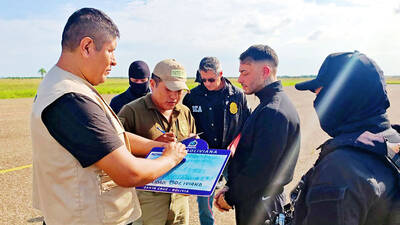
KINGPIN: Marset allegedly laundered the proceeds of his drug enterprise by purchasing and sponsoring professional soccer teams and even put himself in the starting lineups Notorious Latin American narco trafficker Sebastian Marset, who eluded police for years, was handed over to US authorities after his arrest on Friday in Bolivia. Marset, a Uruguayan national who was on the US most-wanted list, was passed to agents of the US Drug Enforcement Administration at Santa Cruz airport in Bolivia, then put on a US airplane, Bolivian state television showed. “The arrest and deportation were carried out pursuant to a court order issued by the US justice system,” Bolivian Minister of Government Marco Antonio Oviedo told reporters. The alleged kingpin was arrested in an upscale neighborhood of Santa
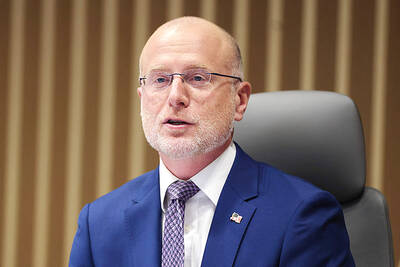
FAKE NEWS? ‘When the government demands the press become a state mouthpiece under the threat of punishment, something has gone very wrong,’ a civic group said The top US broadcast regulator on Saturday threatened media outlets over negative coverage of the Middle East war, after US President Donald Trump slammed critical headlines from the “Fake News Media.” The US president since his first term has derided mainstream media as “fake news” and has sued major outlets over what he sees as unfair coverage. Brendan Carr, head of the US Federal Communications Commission — which oversees the nation’s radio, television and Internet media — said broadcasters risked losing their licenses over news coverage. “The law is clear. Broadcasters must operate in the public interest, and they will
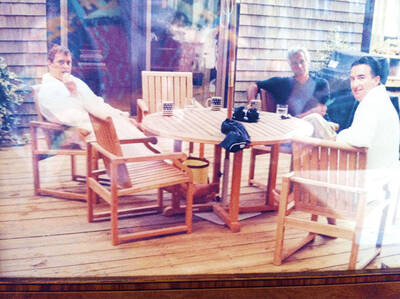
SCANDAL: Other images discovered earlier show Andrew bent over a female and lying across the laps of a number of women, while Mandelson is pictured in his underpants A photograph of former British prince Andrew and veteran politician Peter Mandelson sitting in bathrobes alongside late sex offender Jeffrey Epstein was unearthed on Friday in previously published documents. The image is believed to be the first known photograph of the two men with Epstein. They are currently engulfed in scandal in the UK over their ties to their mutual friend. The undated photograph, first reported by ITV News, shows King Charles III’s disgraced brother and former British ambassador to the US sitting barefoot outside on a wooden deck. They appear to have mugs with a US flag on them
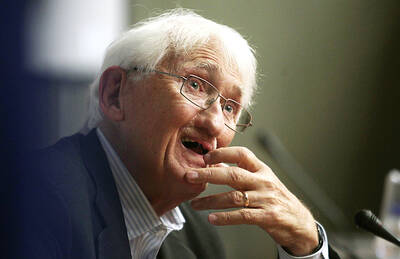
INFLUTENTIAL THEORIST: Habermas was particularly critical of the ‘limited interest’ shown by German politicians in ‘shaping a politically effective Europe Jurgen Habermas, whose work on communication, rationality and sociology made him one of the world’s most influential philosophers and a key intellectual figure in his native Germany, has died. He was 96. Habermas’ publisher, Suhrkamp, said he died on Saturday in Starnberg, near Munich. Habermas frequently weighed in on political matters over several decades. His extensive writing crossed the boundaries of academic and philosophical disciplines, providing a vision of modern society and social interaction. His best-known works included the two-volume Theory of Communicative Action. Habermas, who was 15 at the time of Nazi Germany’s defeat, later recalled the dawn of


 RSS
RSS