


A US monitor with the Organization for Security and Co-operation in Europe (OSCE) died after a mission patrol vehicle hit a landmine in the Russian-backed separatist east Ukraine, eliciting sharp words toward Moscow from US Secretary of State Rex Tillerson on Sunday.
It marked the first loss for the security body’s Special Monitoring Mission (SMM) since the war in Ukraine broke out more than three years ago.
The OSCE’s announcement about the US monitor’s death saw Kiev and the insurgents quickly trade blame over who was at fault for one of the most diplomatically sensitive episodes in a conflict that has claimed more than 10,000 lives.
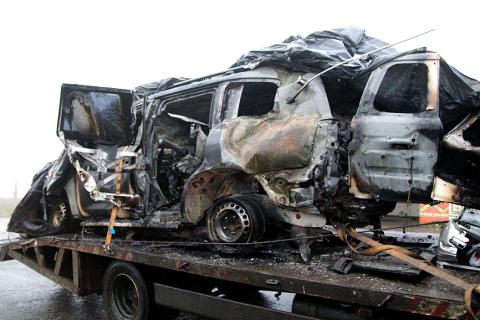
Photo: Reuters
SSM deputy chief monitor Alexander Hug said the patrol consisted of six members who were traveling in two armored vehicles near the village of Pryshyb in a rebel-run region of the separatist fiefdom of Lugansk.
“The explosion resulted in the death of an OSCE patrol member, a citizen of the United States,” Hug told reporters in Kiev.
He said two others — a German and a Czech — were wounded and “undergoing further evaluation” in a Lugasnk hospital.
The OSCE said it would not release the names of the casualties until their families had been notified.
Tillerson said in a telephone conversation on Sunday with Ukrainian President Petro Poroshenko that Moscow’s actions in eastern Ukraine remain an obstacle to improved US-Russian ties, the US Department of State said.
“Secretary Tillerson phoned Ukrainian President Petro Poroshenko today to discuss his recent trip to Moscow and his message to the Russian leadership that, although the United States is interested in improving relations with Russia, Russia’s actions in eastern Ukraine remain an obstacle,” acting US Department of State spokesman Mark Toner said.
Tillerson accepted Poroshenko’s “condolences” for the death of the American, the statement said.
NATO Secretary-General Jens Stoltenberg tweeted his reaction to the incident.
“A thorough investigation is needed of the tragic @OSCE_SMM incident in E #Ukraine. Safety & freedom of movement must be maintained,” he tweeted.
German Chancellor Angela Merkel said the blast underscored the need for the warring sides to “finally respect” a long-ignored ceasefire agreement negotiated by Moscow and Kiev with the help of Paris and Berlin in February 2015.
“The separatists supported by Russia who illegally occupy part of Ukrainian territory by violence have a special responsibility here,” Merkel said in a statement.
EU High Representative for Foreign Affairs and Security Policy Federica Mogherini said the incident was a “reminder of the urgent need for progress on a peaceful resolution of the conflict”
Both Kiev and the West accuse Moscow of plotting and backing the fighting in repr.isal for the February 2014 ouster of Ukraine’s Kremlin-backed leadership.
Russia denies this and in turn accuses the US Department of State of fomenting the 2013 to 2014 street protests that ended up allying ex-Soviet Ukraine with the West.
The OSCE team’s 600 members in eastern Ukraine are the only independent monitoring mission in the devastated industrial war zone.
They provide daily reports on the fighting and have drawn the insurgents’ ire for accusing them of being responsible for most violations of the truce deal.
Lugansk rebel police force spokesman Alexander Mazeikin said that the OSCE vehicle “hit an anti-tank mine.”
The separatists also accused the monitors of veering off the main road and traveling along an unsafe route not agreed with Russian and Ukrainian representatives.
“We know that this patrol team deviated from the main route and was moving along secondary roads, which is prohibited,” the Lugansk rebels said on their news site.
The Ukrainian Ministry of Foreing Affairs branded the incident an attempt by “Moscow and its puppets to scare off OSCE monitors and to nullify efforts by Ukraine and the SMM to stabilize the situation along the front.”
The Russian Ministry of Foreign Affairs responded that it was “deeply outraged” by what it called a bid by undisclosed forces to undermine efforts to bring peace to its western neighbor.

Kouri Richins, a Utah mother who published a children’s book about grief after the death of her husband is to serve a life sentence for his murder without the possibility of parole, a judge ruled on Wednesday. Richins was convicted in March of aggravated murder for lacing a cocktail given to her husband, Eric Richins, with five times the lethal dose of fentanyl at their home near Park City in 2022. A jury also found her guilty of four other felonies, including insurance fraud, forgery and attempted murder for trying to poison her husband weeks earlier on Feb. 14, 2022, with a

‘GROSS NEGLIGENCE?’ Despite a spleen typically being significantly smaller than a liver, the surgeon said he believed Bryan’s spleen was ‘double the size of what is normal’ A Florida surgeon who is facing criminal charges after allegedly removing a patient’s liver instead of his spleen has said he is “forever traumatized” by that person’s death. In a deposition from November last year that was recently obtained by NBC, 44-year-old Thomas Shaknovsky described the death of 70-year-old William Bryan as an “incredibly unfortunate event that I regret deeply.” Bryan died after the botched surgery; and last month, a grand jury in Tallahassee indicted Shaknovsky on a charge of manslaughter. “I’m forever traumatized by it and hurt by it,” Shaknovsky added, also saying that wrong-site surgeries can happen “during

‘PERSONAL MISTAKES’: Eileen Wang has agreed to plead guilty to the felony, which comes with a maximum sentence of 10 years in federal prison A southern California mayor has agreed to plead guilty to acting as an illegal agent for the Chinese government and has resigned from her city position, officials said on Monday. Eileen Wang (王愛琳), mayor of Arcadia, was charged last month with one count of acting in the US as an illegal agent of a foreign government. She was accused of doing the bidding of Chinese officials, such as sharing articles favorable to Beijing, without prior notification to the US government as required by law. The 58-year-old was elected in November 2022 to a five-person city council, from which the mayor is selected

DELA ROSA CASE: The whereabouts of the senator, who is wanted by the ICC, was unclear, while President Marcos faces a political test over the senate situation Philippine authorities yesterday were seeking confirmation of reports that a top politician wanted by the International Criminal Court (ICC) had fled, a day after gunfire rang out at the Philippine Senate where he had taken refuge fearing his arrest. Senator Ronald “Bato” dela Rosa, the former national police chief and top enforcer of former Philippine president Rodrigo Duterte’s “war on drugs,” has been under Senate protection and is wanted for crimes against humanity, the same charges Duterte is accused of. “Several sources confirmed that the senator, Senator Bato, is no longer in the Senate premises, but we are still getting confirmation,” Presidential


 RSS
RSS