


A bloodied Ukraine yesterday marked three years since it launched a campaign against Russian-backed eastern separatists that now looks like an interminable conflict whose terms are dictated by the Kremlin.
More than 10,000 people have died in Europe’s only warzone in that time — a figure unimaginable when Kiev was riding the jubilant high of its February 2014 pro-EU revolution in which a self-enriching pro-Kremlin regime was sent fleeing into Russian exile.
However, warning signs of Moscow refusing to let Ukraine slip out of its orbit and into the West’s arms without a fight emerged almost immediately as Russia swarmed Crimea with troops and then annexed Ukraine’s Black Sea peninsula in March 2014.
Armed men wearing no insignia on their uniforms, but proclaiming pro-Russian slogans, began taking over Ukranian government buildings across the nation’s industrial east the following month.
Russia initially denied sending crack soldiers to Crimea and still calls the separatist conflict a “civil war” in which it has played no part.
However, Kiev and the West say there is overwhelming evidence showing Moscow has sent troops and weapons across the border throughout the unrest and effectively turned the conflict into an undeclared war between the two ex-Soviet neighbors.
One of Europe’s bloodiest crises since the 1990s Balkans wars illustrates how difficult it is for countries once part of the Soviet Union to chart their own course.
More than two years of European efforts to bring peace to the EU’s backyard through talks have produced little beyond periodic truces that have always been followed by more violence and death.
Ukraine was already among Europe’s poorest states in 2014, due to decades of mismanagement and graft.
The war pushed its blighted economy into a two-year recession that now sees Ukrainians’ per capita GDP stand at just one-fifth of the European average.
The three years also did little to shake politics loose of the influence of a few tycoons who still play an outsized role in making big policy decisions.
“Reforms face strong pushback from vested interests,” the IMF said on Tuesday last week after releasing another tranche of its US$17.5 billion Ukrainian rescue package.
Ukranian President Petro Poroshenko’s dream of applying for EU membership by 2020 and one day joining NATO now looks out of reach.
The Ukrainian leader put aside the chocolate empire that made him into a billionaire to emerge as a unifying figure who appeared corruption-free and ready to fulfil the aspirations of the vast crowds of protesters involved in the 2013-2014 street uprising in which more than 100 died.
The political turmoil of early 2014 culminated with his overwhelming victory in a May 25 presidential election.
Poroshenko promised the next afternoon to put an immediate end to a conflict that was then only a month old.
Ukraine’s military campaign “cannot and will not last for two or three months,” Poroshenko said in front of flashing cameras of the global media. “It should last several hours.”
However, Poroshenko’s challenge was taken up immediately by the insurgents. They stormed the main airport in what later became their de facto capital city of Donetsk that same week.
It marked a new and far graver chapter in a war that at its peak saw a dozen or more people killed every day.
There appears to be little chance of peace as a plan hammered out by Russia, Ukraine, Germany and France in February 2015 has stalled.
A Western official said Ukraine’s heavy-handed ground tactics and overall approach to the Russian-speaking region complicated a reconciliation that could make the country whole again.
Kiev “is not making it easy for the east to be part of Ukraine in some meaningful way,” the Western official told reporters on condition of anonymity.
Donetsk city resident Arkady agreed.
“It will be hard for us to be one with Ukraine again,” 50-year-old Arkady told reporters without revealing his last name for safety reasons.
Analysts also doubt that Russian President Vladimir Putin will change his approach.
“As long as the current authorities continue to run Russia, it is hard to see them letting Ukraine go,” Lilia Shevtsova of London-based Chatham House think tank said.

Through the noise of rushing papers and whirring belts at a print factory in Kyoto, two creators watch their photo essay come to life in broadsheet form — part of an effort to win new audiences in the age of artificial intelligence (AI). Despite the decline of the publishing industry, self-publication and handmade “zine” magazines are growing in popularity in Japan, reflecting the nation’s enduring love of paper in the digital era. While speaking to Agence France-Presse at the plant, his hands black with ink, one of the creators, Kazuma Obara, said: “I think [paper] is a medium that engages all five

‘CROSSING THE LINE’: China’s embassy in Seoul criticized US Forces Korea Commander General Xavier Brunson, asking if his ‘hostile’ remarks were authorized by Washington South Korea and the US are in talks over recent public remarks by the commander of US Forces Korea, Seoul’s presidential office said yesterday, after the comments drew sharp criticism from China. In a recent podcast interview, US Forces Korea Commander General Xavier Brunson described South Korea as “the dagger in the heart of Asia” from China’s east coast, prompting the Chinese embassy in Seoul to say that he had “truly crossed the line.” The interview came amid growing speculation that Washington might seek to expand the role of US Forces Korea in countering the growing regional influence of China, a key

Australian researchers have trained lab-grown brain cells on a silicon computer chip to play the 1990s shooter game Doom and said they are just scratching the surface of what the neurons could be capable of doing. It is the science-fiction work of biotech boffins at Cortical Labs, who researched and developed the technology that harnesses the workings of the brain’s networking system. Each so-called “biological computer” contains about 200,000 living human brain cells, grown from stem cells that were harvested from blood donations. Having mastered the simple computer game Pong, where a paddle is moved up and down to send a ball
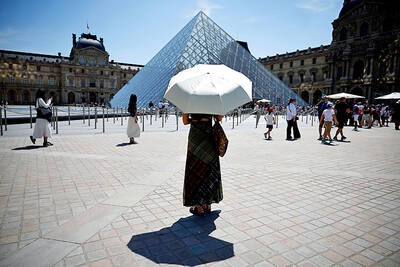
France experienced its hottest spring on record, the French weather service said on Tuesday, after an exceptional early heat wave that also broke highs for the season in England and Wales. Meteo-France said the average nationwide temperature over March to May was 13.8°C — about 1.7°C above the norm, and surpassing records set in 2011 and 2020. “The warmest spring since records began in 1900,” it said in a bulletin. All three months were warmer than average, but the onset of an “unprecedented heatwave” late last month pushed the mercury to highs typically seen at the height of the summer. “Our country had never


 RSS
RSS