


When US President Donald Trump signed an executive order last week to sweep away climate change regulations installed by former US president Barack Obama, he said it would end the US’ “war on coal,” usher in a new era of energy production and put miners back to work.
However, the biggest consumers of US coal — power generating companies — remain unconvinced.
Reuters surveyed 32 utilities with operations in the 26 states that sued Obama’s administration to block its Clean Power Plan, the main target of Trump’s executive order. The bulk of them have no plans to alter their multibillion US dollar, years-long shift away from coal, suggesting that demand for the fuel will keep falling, despite Trump’s efforts.
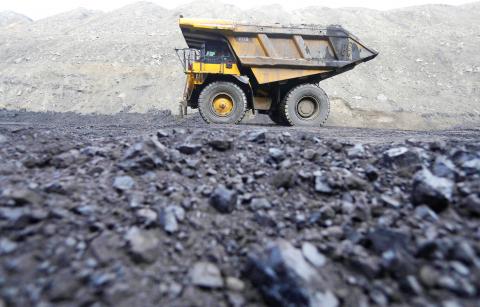
Photo: Reuters
The utilities gave many reasons, mainly economic: Natural gas — coal’s top competitor — is cheap and abundant; solar and wind power costs are falling; state environmental laws remain in place; and Trump’s regulatory rollback might not survive legal challenges.
Meanwhile, big investors aligned with the climate change agenda — such as the Norwegian Sovereign Wealth Fund — have been pressuring US utilities in which they own stakes to cut coal use.
“I’m not going to build new coal plants in today’s environment,” said Ben Fowke, chief executive officer of Xcel Energy, which operates in eight US states and uses coal for about 36 percent of its electricity production. “And if I’m not going to build new ones, eventually there won’t be any.”
Of the 32 utilities contacted by Reuters, 20 said Trump’s order would have no effect on their investment plans; five said they were reviewing the implications of the order; six gave no response.
Just one said it would prolong the life of some of its older coal-fired power units.
North Dakota’s Basin Electric Power Cooperative identified a positive effect of Trump’s order on the outlook for coal.
“We’re in the situation where the executive order takes a lot of pressure off the decisions we had to make in the near term, such as whether to retrofit and retire older coal plants, but Trump can be a one-termer, so the reprieve out there is short,” Basin Electric spokesman Dale Niezwaag said.
Trump’s executive order triggered a review aimed at killing the Clean Power Plan. The Obama-era law would have required states, by 2030, to collectively cut carbon emissions from existing power plants by 30 percent from 2005 levels. It was designed as a primary strategy in US efforts to fight global warming.
The US coal industry, without increases in domestic demand, would need to rely on export markets for growth. Shipments of US metallurgical coal, used in the production of steel, have shown up in China following a two-year hiatus — in part to offset banned shipments from North Korea and temporary delays from cyclone-hit Australian producers.
Coal had been the primary fuel source for US power plants for the past century, but its use has fallen more than one-third since 2008 after advancements in drilling technology unlocked new reserves of natural gas.
Hundreds of aging coal-fired power plants have been retired or retrofitted. Huge coal mining companies such as Peabody Energy Corp and Arch Coal fell into bankruptcy, while production last year hit its lowest point since 1978.
The slide appears likely to continue: US power companies now expect to retire or convert more than 8,000 megawatts of coal-fired plants this year after shutting almost 13,000 megawatts last year, according to US Energy Information Administration and Thomson Reuters data.
Luke Popovich, a spokesman for the US National Mining Association, said that Trump’s efforts would not return the coal industry to its “glory days,” but offered some hope.
“There may not be immediate plans for utilities to bring on more coal, but the future is always uncertain in this market,” he said.
Many of the companies in the Reuters survey said they had been focused on reducing carbon emissions for a decade or more and were hesitant to change direction based on shifting political winds in Washington.
“Utility planning typically takes place over much longer periods than presidential terms of office,” Berkshire Hathaway Inc-owned Pacificorp spokesman Tom Gauntt said.
Several utilities also cited falling costs for wind and solar power, which are subsidized by the US government.
In the meantime, activist investors have increased pressure on US utilities to shun coal.
In the past year, Norway’s sovereign wealth fund, the world’s largest, has excluded more than a dozen US power companies — including Xcel, American Electric Power Co Inc and NRG Energy Inc — from its investments because of their reliance on coal-fired power.
Another eight companies, including Southern Co and NorthWestern Corp, are “under observation” by the fund.
Wyoming-based coal miner Cloud Peak Energy said it does not blame utilities for being lukewarm regarding Trump’s order.
“For eight years, if you were a utility running coal, you got the hell kicked out of you,” said Richard Reavey, a spokesman for the company. “Are you going to turn around tomorrow and say: ‘Let’s buy lots of coal plants’? Pretty unlikely.”

JAN. 1 CLAUSE: As military service is voluntary, applications for permission to stay abroad for over three months for men up to age 45 must, in principle, be granted A little-noticed clause in sweeping changes to Germany’s military service policy has triggered an uproar after it emerged that the law requires men aged up to 45 to get permission from the armed forces before any significant stay abroad, even in peacetime. The legislation, which went into effect on Jan. 1 aims to bolster the military and demands all 18-year-old men fill out a questionnaire to gauge their suitability to serve in the armed forces, but stops short of conscription. If the “modernized” model fails to pull in enough recruits, parliament will be compelled to discuss the reintroduction of compulsory service, German

PHISHING: The con might appear convincing, as the scam e-mails can coincide with genuine messages from Apple saying you have run out of storage For a while you have been getting messages from Apple saying “your iCloud storage is full.” They say you have exceeded your storage plan, so documents are no longer being backed up, and photos you take are not being uploaded. You have been resisting Apple’s efforts to get you to pay a minimum of £0.99 (US$1.33) a month for more storage, but it seems that you cannot keep putting off the inevitable: You have received an e-mail which says your iCloud account has been blocked, and your photos and videos would be deleted very soon. To keep them you need

For two decades, researchers observed members of the Ngogo chimpanzee group of Kibale National Park in Uganda spend their days eating fruits and leaves, resting, traveling and grooming in their tropical rainforest abode, but this stable community then fractured and descended into years of deadly violence. The researchers are now describing the first clearly documented example of a group of wild chimpanzees splitting into two separate factions, with one launching a series of coordinated attacks against the other. Adult males and infants were targeted, with 28 deaths. “Biting, pounding the victim with their hands, dragging them, kicking them — mostly adult males,

Filipino farmers like Romeo Wagayan have been left with little choice but to let their vegetables rot in the field rather than sell them at a loss, as rising oil prices linked to the Iran war drive up the cost of harvesting, labor and transport. “There’s nothing we can do,” said Wagayan, a 57-year old vegetable farmer in the northern Philippine province of Benguet. “If we harvest it, our losses only increase because of labor, transportation and packing costs. We don’t earn anything from it. That’s why we decided not to harvest at all,” he said. Soaring costs caused by the Middle East


 RSS
RSS