


Philippine President Rodrigo Duterte has described European lawmakers as “crazies” in a salty-tongued rebuttal to criticism of his deadly drug war, while vowing again that all traffickers will be killed.
Duterte fired his broadside in a late-night speech on Sunday in Myanmar after the European Parliament issued a resolution last week condemning “the high number of extrajudicial killings” in his drug war.
“I don’t get these crazies. Why are you trying to impose on us? Why don’t you mind your own business/” said Duterte, who frequently uses swear words and other abusive language against his critics.
“Why do you have to fuck with us, God damn it,” he added.
Duterte, who took office in the middle of last year, has overseen a ruthless campaign ostensibly to eradicate illegal drugs that he says are threatening to turn the Philippines into a narco-state.
Police have reported killing more than 2,500 people, while rights groups say there have been more than 5,000 other deaths linked to the drug war.
Amnesty International and Human Rights Watch have said that Duterte might be overseeing crimes against humanity, with police allegedly running anonymous death squads.
Duterte has insisted he has not asked his security forces to break the law, although on other occasions he has called for millions of drug addicts to be killed and vowed to pardon police officers found guilty of murder.
At the speech to a gathering of the Filipino community in Myanmar’s capital, Naypyidaw, Duterte said that many more people would be killed in his drugs crackdown.
“More people will die. I said I will not stop. I will continue until the last drug lord in the Philippines is killed and the pushers [are] out of the streets,” he said.
Reacting to criticism that the operation targeted the poor, Duterte said he must “destroy” small-time street peddlers as well as the big-time drug lords.
In its resolution, European lawmakers also called for the UN Human Rights Council to launch a probe into Duterte’s drug war, and expressed “deep alarm” at Duterte’s plans to bring back the death penalty.
Duterte insisted foreign critics did not understand the Philippines.
To illustrate his theory on the clash of cultures, Duterte referred to a recent Time magazine cover article on gender and sexuality, and compared it with what he insisted was blanket Filipino opposition to same-sex marriage.
“That’s their culture. It does not apply to us. We are Catholics and there is the civil code which says that you can only marry a woman for me [and] for a woman to marry a man,” he said. “You stay where God assigned you. Do not mix us all up.”
In related news, Philippine House of Representatives Speaker Pantaleon Alvarez, a staunch ally of Duterte, yesterday said he was studying whether there was cause to impeach Philippine Vice President Leni Robredo for her criticism of Duterte’s drug war.
Duterte himself is facing an impeachment motion, with Philippine Representative Gary Alejano accusing Duterte of offenses ranging from conflict of interest and assets concealment to drugs-related extrajudicial killings and operating a “death squad” during the 22 years he was Davao City mayor.
Alvarez said in a radio interview he was weighing the possibility of filing an impeachment case against Robredo for “betrayal of public trust.”
Additional reporting by Reuters


Through the noise of rushing papers and whirring belts at a print factory in Kyoto, two creators watch their photo essay come to life in broadsheet form — part of an effort to win new audiences in the age of artificial intelligence (AI). Despite the decline of the publishing industry, self-publication and handmade “zine” magazines are growing in popularity in Japan, reflecting the nation’s enduring love of paper in the digital era. While speaking to Agence France-Presse at the plant, his hands black with ink, one of the creators, Kazuma Obara, said: “I think [paper] is a medium that engages all five
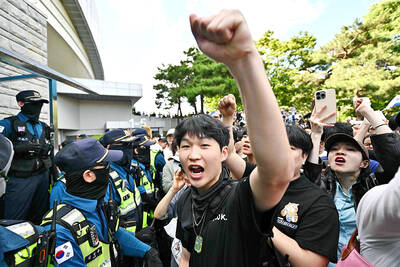
‘ABSURD MISTAKE’: The election commission said that there had been a failure to anticipate turnout after 14 polling stations ran short of ballot papers South Korean riot police yesterday cleared protesters from a Seoul polling station after a 35-hour blockade sparked by a shortage of ballot papers during local elections earlier this week. Wednesday’s election was the first nationwide vote since South Korean President Lee Jae-myung took office following the ouster of Yoon Suk-yeol over his short-lived martial law declaration. Lee’s ruling Democratic Party swept most races, but failed to flip the crucial Seoul mayoral seat. The South Korean National Election Commission apologized, blaming a failure to anticipate turnout after 14 polling stations in Seoul ran short of ballot papers. Some polling stations stayed open until 10pm to

France experienced its hottest spring on record, the French weather service said on Tuesday, after an exceptional early heat wave that also broke highs for the season in England and Wales. Meteo-France said the average nationwide temperature over March to May was 13.8°C — about 1.7°C above the norm, and surpassing records set in 2011 and 2020. “The warmest spring since records began in 1900,” it said in a bulletin. All three months were warmer than average, but the onset of an “unprecedented heatwave” late last month pushed the mercury to highs typically seen at the height of the summer. “Our country had never

A Sherpa guide was found crawling to base camp on Mount Everest a week after he went missing and was reunited with his family, who had given up hope he would return. Dawa Sherpa was last seen on Friday last week descending the mountain, but he did not reach base camp even though his client did. The pair were among the last climbers on the mountain as the climbing season came to an end and the route was dismantled. Dawa was located by a cleaning crew on Thursday morning as he was crawling down the snowy slopes around the Khumbu Icefall, just above


 RSS
RSS