


Olena Gorbatova gave birth to her third child in war-torn eastern Ukraine to the sounds of gunfire and exploding shells in the Kiev-held flashpoint town of Avdiivka.
The 40-year-old Gorbatova calmed herself by thinking the attacks were just a celebration of the baby girl she named Myroslava — which in Russian and Ukrainian means “glory to peace.”
The wartime birth was not unusual.
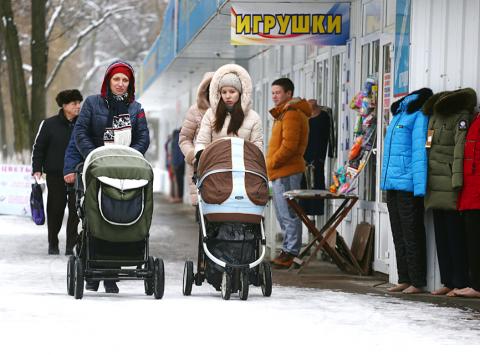
Photo: AFP
The town in which dozens were killed early last month has seen a mini baby boom that doctors attribute to the fact that people want to couple in times of stress and a change in women’s hormonal behavior.
“In recent years, we have managed to deliver babies from older families who are now in their 40s,” gynaecologist Svitlana Khomchenko told reporters in the dilapidated and partially abandoned town of less then 20,000 people.
“They had been trying without success for many years and now families who were considered sterile have children,” Khomchenko said. “It turns out that stress is a factor.”
Gorbatova’s 38-year-old husband, Sergiy, had to make it past a series of road blocks to reach the maternity ward where his wife was resting.
A part of it has been turned into a military hospital. Women about to give birth lie side by side with people wounded in the 34-month revolt in the pro-Russian region that has killed more than 10,000 people and left nearly 25,000 injured.
Sergiy laughed off local jokes that the rising birth rate is down to the large number of Ukrainian soldiers defending the town.
He said that many people tried to convince him not to bring more children into Ukraine’s unsafe world, “but we still decided to do it.”
The fog of war means that no real scientific study can explain why couples have more sex and women appear to be more fertile when disaster strikes.
Khomchenko simply cites the statistics she has.
The year the war broke out in 2014 there were 45 births in Avdiivka compared with 110 babies born last year, despite people fleeing the region for more peaceful parts of the ex-Soviet state.
Khomchenko recalls scenes of horror as women were hidden in basements to shield them from exploding shells that blasted out windows and mortar rounds that landed in the hospital’s garden.
The city’s heating system is periodically not working and the doctor says she has had to take many deliveries by candlelight.
A power generator has been installed and the windows replaced.
The maternity ward stayed open even during the frightening days early last month when constant clashes between rebels and government troops claimed 35 lives.
“We worked while people were dying, but we were forced to move some of the women in labor to neighboring towns because there was no heat or water,” Khomchenko said.
Now the fighting has eased and the hospital is preparing to bring more babies into the world.
“The situation has normalized — if, of course, you call a war a normal situation,” the gynaecologist said.
Gorbatova and Sergiy say they are preparing for tough times, but are still filled with hope for their daughter.
“It will be difficult,” Sergiy said. “We will have to deny ourselves many things.”
“We want her name to give people a signal — enough war and glory to peace,” he added.


HIGH HOPES: The power source is expected to have a future, as it is not dependent on the weather or light, and could be useful for places with large desalination facilities A Japanese water plant is harnessing the natural process of osmosis to generate renewable energy that could one day become a common power source. The possibility of generating power from osmosis — when water molecules pass from a less salty solution to a more salty one — has long been known. However, actually generating energy from that has proved more complicated, in part due the difficulty of designing the membrane through which the molecules pass. Engineers in Fukuoka, Japan, and their private partners think they might have cracked it, and have opened what is only the world’s second osmotic power plant. It generates

When a hiker fell from a 55m waterfall in wild New Zealand bush, rescuers were forced to evacuate the badly hurt woman without her dog, which could not be found. After strangers raised thousands of dollars for a search, border collie Molly was flown to safety by a helicopter pilot who was determined to reunite the pet and the owner. A week earlier, an emergency rescue helicopter found the woman with bruises and lacerations after a fall at a rocky spot at the waterfall on the South Island’s West Coast. She was airlifted on March 24, but they were forced to
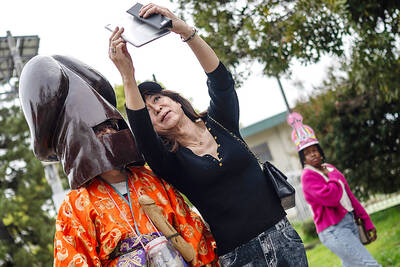
Showcasing phallus-shaped portable shrines and pink penis candies, Japan’s annual fertility festival yesterday teemed with tourists, couples and families elated by its open display of sex. The spring Kanamara Matsuri near Tokyo features colorfully dressed worshipers carrying a trio of giant phallic-shaped objects as they parade through the street with glee. The festival, as legend has it, honors a local blacksmith in the Edo Period (1603-1868) who forged an iron dildo to break the teeth of a sharp-toothed demon inhabiting a woman’s vagina that had been castrating young men on their wedding nights. A 1m black steel phallus sits in the courtyard of

JAN. 1 CLAUSE: As military service is voluntary, applications for permission to stay abroad for over three months for men up to age 45 must, in principle, be granted A little-noticed clause in sweeping changes to Germany’s military service policy has triggered an uproar after it emerged that the law requires men aged up to 45 to get permission from the armed forces before any significant stay abroad, even in peacetime. The legislation, which went into effect on Jan. 1 aims to bolster the military and demands all 18-year-old men fill out a questionnaire to gauge their suitability to serve in the armed forces, but stops short of conscription. If the “modernized” model fails to pull in enough recruits, parliament will be compelled to discuss the reintroduction of compulsory service, German


 RSS
RSS