


A truce between government forces and pro-Russian rebels in eastern Ukraine is to come into force today, Moscow and Kiev said, though some separatists were already labeling it unfeasible.
Saturday’s announcement comes after nearly 30 people lost their lives as violence flared again earlier this month in a conflict that has left more than 10,000 people dead since April 2014.
In another sign that tensions are far from easing up, Moscow on Saturday signed a decree recognizing passports issued by rebel authorities in Ukraine’s separatist regions, triggering a protest from Kiev which called it a “provocation.”
The new ceasefire deal was announced after the foreign ministers of Ukraine, Russia, Germany and France met on the sidelines of a security conference in Munich, Germany, with Russia’s Sergei Lavrov calling it a “positive” development.
However, the warring sides had already agreed on Wednesday last week that they would withdraw heavy weapons from the frontline by today in line with a tattered peace plan, and Lavrov warned that there had been no “major progress” in Munich.
Ukrainian Minister of Foreign Affairs Pavlo Klimkin confirmed the deal, warning that the ceasefire must turn into more than a “political slogan” in practical terms.
“This has to be the real situation — and if that’s not the case, we will have to have fresh negotiations,” he told Ukrainian reporters in Munich.
Pro-Russian separatists on the ground declined to confirm they were planning to respect the new ceasefire, with some saying it was unfeasible for it to come into force as early as today.
“There has been artillery fire all day,” said Eduard Basurin, a senior official in the self-declared Donetsk People’s Republic. “What truce are they talking about? I don’t see the point in declaring a truce.”
He added that “for the moment on the Ukrainian side, we see no withdrawal” of heavy weapons as detailed under the latest plan.
Several ceasefires have already faltered in a bid to end Europe’s only armed conflict, attributed to regular flare-ups in fighting between the pro-Russian rebels — whom Moscow has furiously denied giving financial and military support, despite Western allegations — and Ukrainian troops.
The most recent violence earlier this month saw about 30 soldiers and civilians killed in the flashpoint town of Avdiivka, Ukraine.
“Sometimes we must admit that there is a lack of willingness on the ground,” French Minister of Foreign Affairs Jean-Marc Ayrault said on Saturday.
In Moscow, Russian President Vladimir Putin raised Kiev’s ire again by signing a decree recognizing passports issued by the self-declared Lugansk People’s Republic and the Donetsk People’s Republic.
“Ukrainian citizens and stateless persons who live there” will now be able “to enter Russia and exit Russia without a visa,” the decree said.
Moscow described the move as “temporary” until a “political solution” is found to bring peace to the region.
However, Ukrainian President Petro Poroshenko blasted the decree as “fresh proof of the Russian occupation and violations by Russia of international law,” adding it was “highly symbolic” that it was published while he was meeting in Munich with US Vice-President Mike Pence, who informed him of the move.
“It’s a deliberate provocation by Putin,” Ukrainian minister Ganna Gopko said.
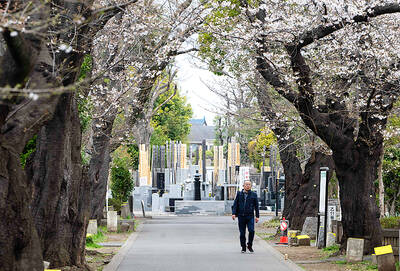
ROCKY RELATIONS: The figures on residents come as Chinese tourist numbers drop following Beijing’s warnings to avoid traveling to Japan The number of Chinese residents in Japan has continued to rise, even as ties between the two countries have become increasingly fractious, data released on Friday showed. As of the end of December last year, the number of Chinese residents had increased by 6.5 percent from the previous year to 930,428. Chinese people accounted for 22.6 percent of all foreign residents in Japan, making them by far the largest group, Japanese Ministry of Justice data showed. Beijing has criticized Tokyo in increasingly strident terms since Japanese Prime Minister Sanae Takaichi last year suggested that a military conflict around Taiwan could
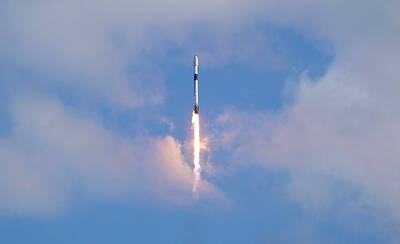
A retired US colonel behind a privately financed rocket launch site in the Dominican Republic sees the project as a response to China’s dominance of the space race in Latin America. Florida-based Launch on Demand is slated to begin building a US$600 million facility in a remote region near the border with Haiti late this year. The project is designed to meet surging demand for the heavy-lift rockets needed to put clusters of satellites into orbit. It is also an answer to China’s growing presence in the region, said CEO Burton Catledge, a former commander of the US Air Force’s 45th Operations

Germany is considering Australia’s Ghost Bat robot fighter as it looks to select a combat drone to modernize its air force, German Minister of Defense Boris Pistorius said yesterday. Germany has said it wants to field hundreds of uncrewed fighter jets by 2029, and would make a decision soon as it considers a range of German, European and US projects developing so-called “collaborative combat aircraft.” Australia has said it will integrate the Ghost Bat, jointly developed by Boeing Australia and the Royal Australian Air Force, into its military after a successful weapons test last year. After inspecting the Ghost Bat in Queensland yesterday,
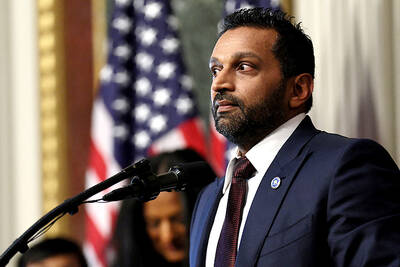
A pro-Iran hacking group claimed to breach FBI Director Kash Patel’s personal e-mail inbox and posted some of the contents online. The e-mails provided by the hacking group include travel details, correspondence with leasing agents in Washington and global entry, and loyalty account numbers. The e-mail address the hackers claim to have compromised has been previously tied to Patel’s personal details, and the leaked e-mails contain photos of Patel and others, in addition to correspondence with family members and colleagues. “The FBI is aware of malicious actors targeting Director Patel’s personal email information,” the agency said in a statement on


 RSS
RSS