


The first ladies of Niger, Burkina Faso and Benin on Monday promised to “end the scourge of female genital mutilation” (FGM) in their countries amid warnings the practice had gone underground in Benin.
“FGM is a barbaric practice,” Niger’s Lalla Malika Issoufou told an international conference in Rome.
She said that Nigerian President Mahamadou Issoufou was fully behind efforts to eradicate the ritual and that the country was looking at bolstering its law.
Worldwide, an estimated 200 million girls and women have been subjected to the ritual, which usually involves the partial or total removal of the external genitalia. It is often carried out by traditional cutters.
The internationally condemned practice is rooted in the wish to control female sexuality, but beliefs around it vary. Some communities see it as a prerequisite for marriage.
Most African countries have introduced laws against the practice, although these are generally poorly enforced.
The first lady of Benin, Claudine Talon, said cutters had found ways around the law.
“The phenomenon has become an underground one,” she said in a statement read out by her adviser, Pounami Doko Toko.
Doko Toko told reporters that the ritual, which was once done openly, was now performed behind closed doors.
Parents were also getting their daughters cut at a much younger age before they had learned to speak — a trend seen in several other African nations.
Some girls in Benin were now cut shortly after birth whereas in the past they would have been cut at about the age of 11, Doko Toko said.
Families were also circumventing the law by crossing into neighboring Burkina Faso or Niger to get their girls cut.
UN statistics show that 9 percent of girls and women have undergone the process in Benin, but Doko Toko said she believed the real figure was two to three times higher.
She said there had been a significant drive to end FGM in Benin up until 2006, but little action since.
Some young women who did not have it done when they were girls are now asking to be cut because they cannot find a man willing to marry them, she said.
Cutters who had previously abandoned the practice have also resumed their work.
Bernice Noudegbessi, an official with the UN population fund (UNFPA) in Benin, said there was a new political will in the nation to tackle the issue.
The prevalence rate in Niger is 2 percent, according to UN data, but the first lady said it was common in some areas.
International campaigners have praised Burkina Faso for its efforts to eradicate the practice.
Although three-quarters of girls and women have had FGM, only 13 percent of under-15s have been cut.
The nation has carried out hundreds of prosecutions and set up a hotline where people can inform the authorities if they hear FGM is about to happen.
The first lady of Burkina Faso, Sika Kabore, said boosting girls’ education, literacy and independence was crucial in fighting FGM and child marriage.
“Great steps have been taken, but there’s a long way to go,” she said in a statement read out at the BanFGM conference.
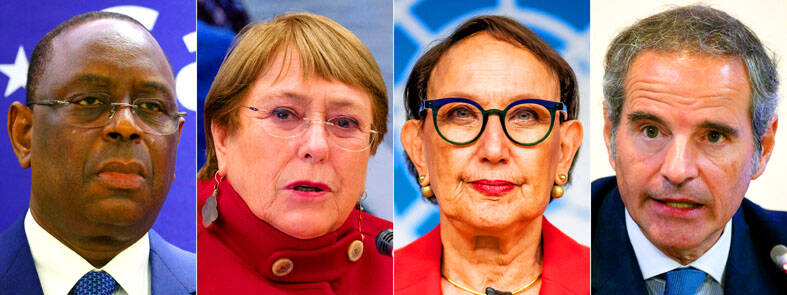
Four contenders are squaring up to succeed Antonio Guterres as secretary-general of the UN, which faces unprecedented global instability, wars and its own crushing budget crisis. Chile’s Michelle Bachelet, Argentina’s Rafael Grossi, Costa Rica’s Rebeca Grynspan and Senegal’s Macky Sall are each to face grillings by 193 member states and non-governmental organizations for three hours today and tomorrow. It is only the second time the UN has held a public question-and-answer, a format created in 2016 to boost transparency. Ultimately the five permanent members of the UN’s top body, the Security Council, hold the power, wielding vetoes over who leads the

South Korea’s air force yesterday apologized for a 2021 midair collision involving two fighter jets, a day after auditors said the pilots were taking selfies and filming during the flight and held them responsible for the accident. “We sincerely apologize to the public for the concern caused by the accident that occurred in 2021,” an air force spokesman told a news conference, adding that one of the pilots involved had been suspended from flying duties, received severe disciplinary action and has since left the military. The apology followed a report released on Wednesday by the South Korean Board of Audit and Inspection,

About 240 Indians claiming descent from a Biblical tribe landed at Tel Aviv airport on Thursday as part of a government operation to relocate them to Israel. The newcomers passed under a balloon arch in blue and white, the colors of the Israeli flag, as dozens of well-wishers welcomed them with a traditional Jewish song. They were the first “bnei Menashe” (“sons of Manasseh”) to arrive in Israel since the government in November last year announced funding for the immigration of about 6,000 members of the community from the states of Manipur and Mizoram in northeast India. The community claims to descend from

Young Chinese, many who fear age discrimination in their workplace after turning 35, are increasingly starting “one-person companies” that have artificial intelligence (AI) do most of the work. Smaller start-ups are already in vogue in Silicon Valley and elsewhere, with rapidly advancing AI tools seen as a welcome teammate even as they threaten layoffs at existing firms. More young people in China are subscribing to the model, as cities pledge millions of dollars in funding and rent subsidies for such ventures, in alignment with Beijing’s political goal of “technological self-reliance.” “The one-person company is a product of the AI era,” said Karen Dai


 RSS
RSS