


Most postcards carry a simple sentiment: Wish you were here.
But the cards Anastasia Taylor-Lind and Alisa Sopova are mailing randomly to people around the globe convey a haunting message: Wish this stranger was still alive.
The pair hopes their postcards — each scribbled with the name of a victim of armed conflict in Ukraine — will put a human face on war.
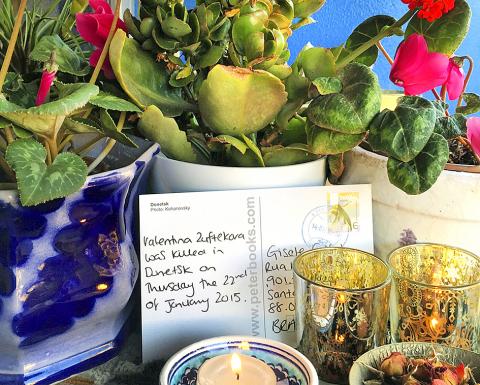
Photo: Gisele Cassol via AP
“I wanted people to have a more personal experience with conflict,” said Taylor-Lind, a photojournalist who was on assignment for National Geographic when inspiration struck in a post office in the middle of the war zone.
Fighting between Ukrainian government troops and Russia-backed separatists has killed more than 9,600 people in eastern Ukraine since it began in 2014. Ukraine filed a case against Russia this month at the UN’s highest court, accusing Moscow of illegally annexing Crimea and illicitly bankrolling rebel groups.
Although the shelling has diminished, Taylor-Lind feels compelled to keep alive the memories of those on all sides who have perished.
At a post office in the embattled city of Slavyansk, she came across postcards with idyllic scenes: a cityscape framed by a river and blossoming trees; lovers embracing at twilight along a moonlit promenade. Printed on them was a cheerful greeting in English: “Welcome to Donetsk,” the capital of the Donbass region and ground zero for the conflict.
In the summer of 2015, Taylor-Lind ordered 1,000 cards and began addressing them to people around the world she had never met. Some were chosen at random; others had responded to her vague offer via social media of a postcard — not knowing what they would get.
That launched a continuing project that gained momentum last year while she was at Harvard University on a fellowship. Each carried a cryptic message with the name of a casualty of war and the date that he or she died.
“The war in Ukraine isn’t something that happened and then just went away. The lives and livelihoods of millions were affected,” she said. “This was very much an experiment. I didn’t know how people would react.”
React they have, with anger, shock, confusion and sadness.
A few recipients initially puzzled over the cards, which are postmarked in Ukraine, worrying whether someone in their household had lost a friend. Eventually, and by the hundreds, they have shared their thoughts using the hashtags #WelcomeToDonetsk and #WarIsPersonal.
Some have carried their cards to a leafy park, a remote beach or a tranquil mountainside, and held a moment of solitary remembrance for a fellow human they never met. Others have posed their cards next to lighted candles and posted photos and videos in somber tribute .
Jochem Lindelauf, of Groningen, Netherlands, was left reeling when he got a card that read: “Artem Gorlenko was killed in Spartak on Tuesday the 13th of October 2015.”
Oct. 13 is Lindelauf’s birthday.
“The crazy coincidence of my birthday brought it even more home for me,” he said in an Instagram post.
Taylor-Lind, an English-Swedish national now at the Carey Institute for Global Good in Rensselaerville, New York, and Sopova, a journalist from Donetsk doing her Nieman Fellowship at Harvard this year, have mailed more than 2,000 postcards to people in 60-plus countries.
Trying to identify those killed has been a challenge. Neither the Ukrainian government nor the UN maintains a comprehensive list, forcing Sopova to spend many hours scouring news reports and gruesome photographs posted online, as well as corresponding with officials and others back in Ukraine.
“It means nobody cares,” Sopova said. “And that makes this project even more important.”

‘CROSSING THE LINE’: China’s embassy in Seoul criticized US Forces Korea Commander General Xavier Brunson, asking if his ‘hostile’ remarks were authorized by Washington South Korea and the US are in talks over recent public remarks by the commander of US Forces Korea, Seoul’s presidential office said yesterday, after the comments drew sharp criticism from China. In a recent podcast interview, US Forces Korea Commander General Xavier Brunson described South Korea as “the dagger in the heart of Asia” from China’s east coast, prompting the Chinese embassy in Seoul to say that he had “truly crossed the line.” The interview came amid growing speculation that Washington might seek to expand the role of US Forces Korea in countering the growing regional influence of China, a key

Through the noise of rushing papers and whirring belts at a print factory in Kyoto, two creators watch their photo essay come to life in broadsheet form — part of an effort to win new audiences in the age of artificial intelligence (AI). Despite the decline of the publishing industry, self-publication and handmade “zine” magazines are growing in popularity in Japan, reflecting the nation’s enduring love of paper in the digital era. While speaking to Agence France-Presse at the plant, his hands black with ink, one of the creators, Kazuma Obara, said: “I think [paper] is a medium that engages all five

Australian researchers have trained lab-grown brain cells on a silicon computer chip to play the 1990s shooter game Doom and said they are just scratching the surface of what the neurons could be capable of doing. It is the science-fiction work of biotech boffins at Cortical Labs, who researched and developed the technology that harnesses the workings of the brain’s networking system. Each so-called “biological computer” contains about 200,000 living human brain cells, grown from stem cells that were harvested from blood donations. Having mastered the simple computer game Pong, where a paddle is moved up and down to send a ball

France experienced its hottest spring on record, the French weather service said on Tuesday, after an exceptional early heat wave that also broke highs for the season in England and Wales. Meteo-France said the average nationwide temperature over March to May was 13.8°C — about 1.7°C above the norm, and surpassing records set in 2011 and 2020. “The warmest spring since records began in 1900,” it said in a bulletin. All three months were warmer than average, but the onset of an “unprecedented heatwave” late last month pushed the mercury to highs typically seen at the height of the summer. “Our country had never


 RSS
RSS