


Ukrainian President Petro Poroshenko’s confectionery company on Friday announced plans to shut down his key asset in Russia, a candy factory, after a barrage of criticism at home for his maintaining business activities on rival ground.
The Western-backed leader’s business empire ranges from car to media holdings, but his most valuable asset is the Roshen confectionery empire, which includes five plants in Ukraine, as well as in Lithuania and Hungary.
Ranked by the Forbes Ukraine Web site as the sixth-richest man in the nation, worth US$858 million, Poroshenko, 51, has garnered the nickname “the chocolate king.”
His most controversial asset is based in the Russian city of Lipetsk, where Poroshenko bought a local confectionary plant in 2002.
Since 2013, the volume of production at the Lipetsk factory has plunged threefold, coinciding with the rupture of ties between Ukraine and Russia.
After an uprising in Kiev ousted a pro-Russian leader, Moscow annexed Ukraine’s strategic Crimean Peninsula on the Black Sea in March 2014 and supported a separatist movement in eastern Ukraine that has since claimed about 10,000 lives.
Poroshenko promised to sell his Roshen empire, but failed to follow through, citing a lack of foreign interest.
He passed his company’s shares to a trust firm for management.
The confectionary giant, whose name is based on Poroshenko’s, said in a statement that it would halt the Lipetsk plant’s operations for political and economic reasons, which include Moscow’s ban on Roshen imports since 2013.
“Roshen corporation halts manufacturing activity of the Lipetsk confectionery plant,” said the company, which is rated among the top 20 companies in the industry and supplies its products to more than 30 countries.
It also accused Moscow of discrediting the Roshen plant’s activity in the Russian media, as well as encouraging the local authorities to put pressure on its shops across the country.
Poroshenko was repeatedly criticized at home for maintaining businesses in Russia, despite his claims that Moscow was an “aggressor.”
Roshen said it was impossible to sell its Lipetsk branch after Russian investigators impounded the factory’s property in April 2015.
The company said it planned to cease production at the site by April.

Crowds in Bangladesh are flocking to snap photographs with an unlikely social media star — an albino buffalo with flowing blond hair nicknamed “Donald Trump” that is due to be sacrificed within days. Owner Zia Uddin Mridha, 38, said his brother named the 700kg bull over its flowing helmet of hair resembling the signature look of the US president. “My younger brother picked this name because of the buffalo’s extraordinary hair,” he said at his farm in Narayanganj, just outside the capital, Dhaka. Mridha said that a constant stream of curious visitors — social media fans, onlookers and children — have come throughout
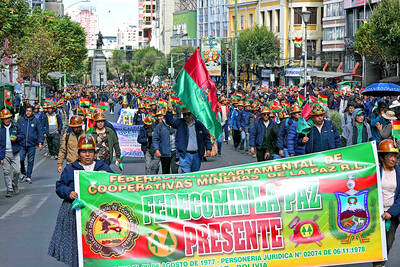
The Bolivian government on Friday struck a deal with protesting miners, but was still grappling with blockades and demonstrations by other workers across La Paz. Other groups are still blocking access roads into the city, which is also the seat of the government. Police on Thursday prevented the miners from entering the main square by using tear gas, while the demonstrators hurled stones and explosives with slingshots. Protests against the policies of Bolivian President Rodrigo Paz have convulsed the Andean nation since early this month, and roadblocks were choking routes into La Paz throughout Friday, the national road authority said. Miners demanded that Paz
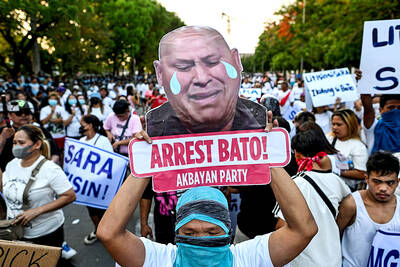
The Philippines said it has asked the country’s Supreme Court to allow it to arrest former Philippine president Rodrigo Duterte’s chief drug war enforcer to stand trial in an international tribunal. The International Criminal Court (ICC) last week unsealed an arrest warrant against Philippine Senator Ronald dela Rosa, accusing him along with Duterte and other “coperpetrators” of the “crime against humanity of murder.” Dela Rosa briefly sought refuge in the Philippine Senate last week while asking the Philippine Supreme Court to stop an ongoing attempt by government agents to arrest him. “By his own conduct, he has placed himself outside the protection of
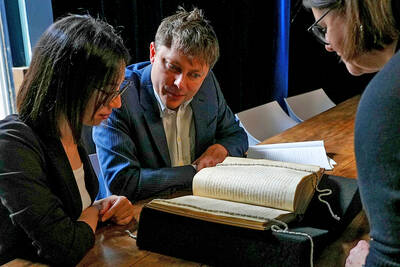
The researchers in Ireland looked at their computer screen, marveling at a medieval book tracked down in a Roman library. They flipped through its digitized pages and found their sought-after treasure: the oldest surviving English poem. “We were extremely surprised. We were speechless. We couldn’t believe our eyes when we first saw that,” said Elisabetta Magnanti, a visiting research fellow at Trinity College Dublin’s school of English. The poem was also within the main body of Latin text, she said, calling it “extraordinary.” Composed in Old English by a Northumbrian agricultural worker in the 7th century, Caedmon’s Hymn appears within some copies of


 RSS
RSS