


Japanese scientists said that silicon is likely the mystery element in the Earth’s inner core, claiming progress on solving one of the planet’s deepest secrets.
The consensus has long been that the center of the planet is composed of about 85 percent iron and 10 percent nickel, with sulfur, oxygen and silicon prime candidates for the other 5 percent.
However, geophysicist Eiji Ohtani at Tohoku University in northern Japan and his research team suggested that silicon is the most likely candidate.
The team conducted experiments on iron-nickel alloys mixed with silicon, subjecting them to the kinds of high temperatures and pressure found in the inner core.
It discovered that the data for the mixed material observed with X-rays matched seismic data — namely, sound velocity, or seismic waves — obtained for the inner core.
“Our latest experiments suggest that the remaining 5 percent of the inner core is composed mostly of silicon,” Ohtani told reporters on Wednesday.
The finding helps understand whether the Earth’s surface was rich in oxygen in its early formation before photosynthesis began, as oxygen has been another potential candidate for the mystery element in the Earth’s inner core, he said.
Ohtani warned that more work needs to be done to confirm his findings on silicon.
Some scientists have said that if the Earth’s inner core contains silicon, then it means the rest of the planet must have been relatively oxygen-rich at the time of its formation, because oxygen that they believe existed when the planet was formed was not confined to the inner core.
However, if the mystery element in the core is oxygen, then the rest of the Earth was oxygen-poor in the beginning.
Ohtani said he does not think oxygen now exists in the inner core, citing the difficulty for silicon and oxygen to coexist in the same place.
“But it doesn’t necessarily mean the rest of the planet was oxygen-rich, because there is a possibility that oxygen did not exist as an element of the Earth at its formation in the first place,” he added.
The Earth is believed to be made up of three main layers: the solid outer layer where creatures, including humans live; the mantle, which is made up of hot magma and other semi-solid materials; and the core at the center.
The core comprises an outer layer of liquid iron and nickel, and an inner layer — a hot dense ball of mostly iron.
Ohtani presented his team’s work at a meeting last month of the American Geophysical Union in San Francisco, and is preparing to submit a research paper to a peer-reviewed scientific journal.
The presentation used a method similar to that applied by his team in a study published in February last year in the peer-reviewed journal Science Advances.

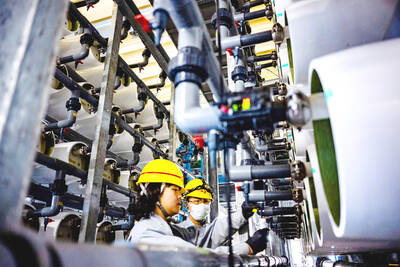
HIGH HOPES: The power source is expected to have a future, as it is not dependent on the weather or light, and could be useful for places with large desalination facilities A Japanese water plant is harnessing the natural process of osmosis to generate renewable energy that could one day become a common power source. The possibility of generating power from osmosis — when water molecules pass from a less salty solution to a more salty one — has long been known. However, actually generating energy from that has proved more complicated, in part due the difficulty of designing the membrane through which the molecules pass. Engineers in Fukuoka, Japan, and their private partners think they might have cracked it, and have opened what is only the world’s second osmotic power plant. It generates

When a hiker fell from a 55m waterfall in wild New Zealand bush, rescuers were forced to evacuate the badly hurt woman without her dog, which could not be found. After strangers raised thousands of dollars for a search, border collie Molly was flown to safety by a helicopter pilot who was determined to reunite the pet and the owner. A week earlier, an emergency rescue helicopter found the woman with bruises and lacerations after a fall at a rocky spot at the waterfall on the South Island’s West Coast. She was airlifted on March 24, but they were forced to
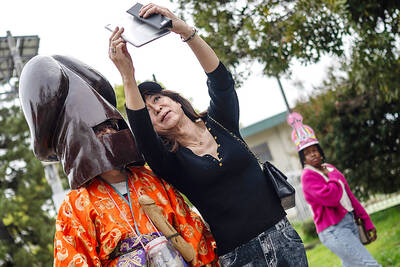
Showcasing phallus-shaped portable shrines and pink penis candies, Japan’s annual fertility festival yesterday teemed with tourists, couples and families elated by its open display of sex. The spring Kanamara Matsuri near Tokyo features colorfully dressed worshipers carrying a trio of giant phallic-shaped objects as they parade through the street with glee. The festival, as legend has it, honors a local blacksmith in the Edo Period (1603-1868) who forged an iron dildo to break the teeth of a sharp-toothed demon inhabiting a woman’s vagina that had been castrating young men on their wedding nights. A 1m black steel phallus sits in the courtyard of

JAN. 1 CLAUSE: As military service is voluntary, applications for permission to stay abroad for over three months for men up to age 45 must, in principle, be granted A little-noticed clause in sweeping changes to Germany’s military service policy has triggered an uproar after it emerged that the law requires men aged up to 45 to get permission from the armed forces before any significant stay abroad, even in peacetime. The legislation, which went into effect on Jan. 1 aims to bolster the military and demands all 18-year-old men fill out a questionnaire to gauge their suitability to serve in the armed forces, but stops short of conscription. If the “modernized” model fails to pull in enough recruits, parliament will be compelled to discuss the reintroduction of compulsory service, German


 RSS
RSS