


Japanese Prime Minister Shinzo Abe said he had frank discussions with Russian President Vladimir Putin yesterday on a territorial row that has blocked a peace treaty between their countries formally ending World War II.
Abe said the talks included the possibility of joint economic activity on disputed isles at the core of their dispute.
Abe hosted Putin in his ancestral city of Nagato in hopes of achieving a breakthrough over the territory off Japan’s northern coast seized by Soviet troops in 1945.
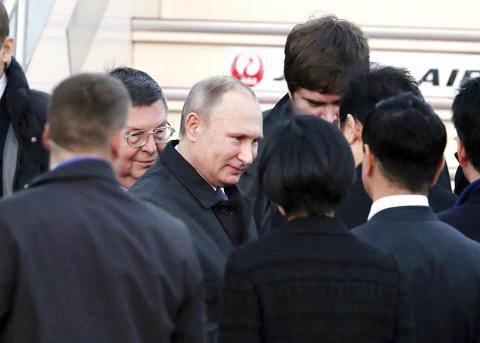
Photo: EPA
The four islands are known as the Southern Kurils in Russia and the Northern Territories in Japan, and the dispute has been a thorn in relations for more than seven decades.
Abe would like to seal a deal as soon as possible as Japanese former residents are aging and dwindling in number.
Despite months of preparation, both sides recently damped down expectations of major progress.
“I want to go into this summit with determination to end the issue in my generation,” Abe told former residents earlier this week, suggesting an agreement remains distant.
Putin, a judo fan who is making his first visit to Japan in more than a decade, said he wanted to end the “anachronism” of the two countries not having a World War II peace treaty.
“But how to do this is a difficult question,” he told Japanese media.
The opening of the two-day meeting was likely to be delayed somewhat as the Japanese government said it was informed Putin’s plane departed from Russia later than expected.
“I hope to spend time to negotiate in a quiet atmosphere at night,” Abe told reporters before departing for the venue.
His comment was an apparent reference to the hot springs in the area in western Japan, where a heavy security presence has been put in place.
For Abe, the issue is also a “legacy” from his late father Shintaro Abe, who took the lead in negotiations with Moscow as a Japanese minister of foreign affairs, but died in 1991 after pushing for talks while suffering from cancer.
The summit is the latest attempt to draw a line under World War II since Japan and the then-Soviet Union began discussions in 1956.
In Nagato, Abe and Putin are expected to focus on territorial and peace treaty issues, a Japanese Ministry of Foreign Affairs official said.
The two leaders are today expected to move to Tokyo for more talks and a joint media appearance before attending an economic forum.
Abe has looked to eke out concessions by dangling the prospect of major Japanese investment in front of Moscow, which is mired in economic crisis.
However, few believe Putin is likely to cave to Japanese demands to hand back at least some control over the islands, especially after Donald Trump’s election as president of the US last month.
The New York real-estate baron has vowed to improve ties with Russia, where the economy has reeled under US sanctions against Moscow over Ukraine and the impact of falling oil prices.

‘CROSSING THE LINE’: China’s embassy in Seoul criticized US Forces Korea Commander General Xavier Brunson, asking if his ‘hostile’ remarks were authorized by Washington South Korea and the US are in talks over recent public remarks by the commander of US Forces Korea, Seoul’s presidential office said yesterday, after the comments drew sharp criticism from China. In a recent podcast interview, US Forces Korea Commander General Xavier Brunson described South Korea as “the dagger in the heart of Asia” from China’s east coast, prompting the Chinese embassy in Seoul to say that he had “truly crossed the line.” The interview came amid growing speculation that Washington might seek to expand the role of US Forces Korea in countering the growing regional influence of China, a key

Through the noise of rushing papers and whirring belts at a print factory in Kyoto, two creators watch their photo essay come to life in broadsheet form — part of an effort to win new audiences in the age of artificial intelligence (AI). Despite the decline of the publishing industry, self-publication and handmade “zine” magazines are growing in popularity in Japan, reflecting the nation’s enduring love of paper in the digital era. While speaking to Agence France-Presse at the plant, his hands black with ink, one of the creators, Kazuma Obara, said: “I think [paper] is a medium that engages all five

Australian researchers have trained lab-grown brain cells on a silicon computer chip to play the 1990s shooter game Doom and said they are just scratching the surface of what the neurons could be capable of doing. It is the science-fiction work of biotech boffins at Cortical Labs, who researched and developed the technology that harnesses the workings of the brain’s networking system. Each so-called “biological computer” contains about 200,000 living human brain cells, grown from stem cells that were harvested from blood donations. Having mastered the simple computer game Pong, where a paddle is moved up and down to send a ball
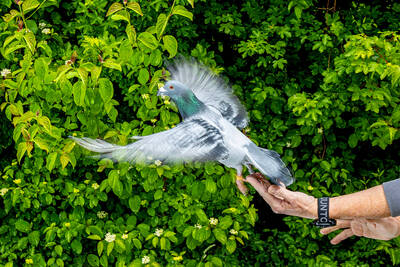
A surprising gut feeling may help pigeons find their way home. Animals use various techniques to navigate, including following the stars and remembering key landmarks. Birds, fish and turtles orient themselves using Earth’s magnetic field as a compass, but it is not yet clear how exactly they do this. Pigeons are a well-known group of frequent flyers that can traverse hundreds of kilometers in a single day. For thousands of years, humans have used them to carry news, notes and military messages. Scientists have long tried to untangle how pigeons travel without getting lost. Some think the birds detect magnetic cues using light-sensitive


 RSS
RSS