


Seventeen years and more than 10 billion euros (US$11 billion) later, Europe’s Galileo satellite navigation system is set to go live tomorrow, promising to outperform US and Russian rivals, while boosting regional self-reliance.
Initial services, free to use worldwide, will be available only on smartphones and navigation boxes already fitted with Galileo-compatible chips.
Some devices might only need a software update to start using the new technology and European Commission spokeswoman Mirna Talko said several smartphone giants are already making chips compatible with it.
“It will be the first time that users around the world will be able to be guided by Galileo satellites,” European Commission spokeswoman for Research, Science and Innovation Lucia Caudet said.
Somewhat fuzzy at first, the signal will be boosted with help from satellites in the US military-run Global Positioning System (GPS), growing stronger over time as orbiters are added to the now 18-strong Galileo network circling 23,222km above the Earth.
The European Commission and European Space Agency (ESA) said Galileo should be fully operational by 2020, providing time and positioning data of unprecedented accuracy.
“GPS allows a train to know which area it is in — Galileo will allow it to identify the track it is on,” said CNES president Jean-Yves Le Gall, head of the French space agency, which is one of the ESA’s 22 member nations.
Such precision would also be invaluable for safer driverless cars and nuclear power plants, as well as better telecommunications.
The civil-controlled service is also of great strategic importance for Europe, which relies on two military-run services — GPS and Russia’s GLONASS — which provide no guarantee of uninterrupted service.
It will be interoperable with these two, but also completely autonomous.
“Having a system that is somewhat independent of the US system that is controlled by the military is probably a good thing,” Rice University senior fellow in space policy George Abbey said in Houston, Texas.
This would be especially pertinent “if there were some conflicts or disagreements ... that would cause the United States to have to limit GPS,” he said.
Named after Italian astronomer Galileo Galilei, the project was first approved with an initial budget of about 3 billion euros and plans to be operational by 2008, but it has suffered several technical and budgetary setbacks, including the launch of two satellites into the wrong orbit in 2014.
COMMERCIAL VENTURE
The European Commission expects the project to ultimately be an important commercial venture.
Almost 10 percent of Europe’s GDP is thought to depend on satellite navigation — a figure projected to grow to about 30 percent by 2030.
By 2020, the global satellite navigation market would be valued at about 244 billion euros, the commission said.
Galileo itself is expected to add about 90 billion euros to the EU economy in its first 20 years.
The system’s groundbreaking accuracy is the result of the best atomic clocks ever flown for navigation — one per satellite — accurate to 1 second in 3 million years.
A mere billionth-of-a-second clock error can mean a positioning error of up to 30cm.
Galileo also has more satellites than either GPS or GLONASS, and better signals which carry more information.
With these features, Galileo’s free Open Service is able to track positions to within a meter, compared with several meters for GPS and GLONASS. Its signal will eventually reach areas where none is possible today — inside traffic tunnels and on roads where high buildings shield radio waves from some satellites.
SEARCH AND RESCUE
A paying service allows clients to track locations even closer, to within centimeters, and governments would have access to an encrypted continued service for use in times of crisis.
Another key feature is a service allowing rescuers to locate people lost at sea or in the mountains much faster than before.
Current satellite navigation technology can take up to three hours to track a person to within a 10km range.
“With Galileo’s Search and Rescue Service, the detection time is reduced to 10 minutes and the localization is reduced to less than 5km,” Caudet said.
Satellite navigation works by ultra-precise clocks in orbit broadcasting their time and position to Earth via radio waves traveling at the speed of light. Anyone with a receiver can combine data from at least three satellites to determine their position, speed and local time on Earth.

SPEAKING OUT: After Siranudh Scott’s allegations surfaced, celebrities and public figures took to social media to share their own experiences of sexual misconduct and abuse A high-profile alleged sexual abuse case within a wealthy Thai beer brewing family has prompted a wave of painful accounts from survivors of unconnected abuse in the conservative nation. Siranudh Scott, a member of the billionaire Thai family that founded the ubiquitous Singha beer brand, posted an emotional video this month accusing his elder brother Sunit of repeatedly abusing him when he was a teenager. Sunit, who is in his 30s, later denied the allegations in a video posted online, but Singha parent Boonrawd dismissed him from his executive role with the company on Tuesday last week. “I felt I needed to speak

SEEKING ORDER: Rodrigo Paz said that ‘anyone who wants to destroy the nation will have to deal with this president and the full force of the constitution’ Bolivian President Rodrigo Paz on Wednesday said that the nation was at a “breaking point” after nearly a month of protests that have caused shortages of food, fuel and medicine. Paz, who took office six months ago amid the worst economic crisis there in four decades, is battling a groundswell of fury over his policies. The political capital, La Paz, has been besieged by low-income workers and members of the indigenous majority calling for his resignation. “The country needs order and is reaching breaking point,” the 58-year-old said at a public event in La Paz, renewing his appeal for dialogue. On Tuesday, the Bolivian
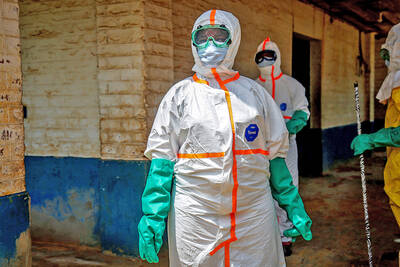
COMMUNITY CONFLICT: Concerns about disease spread from corpses has run up against friends and families’ desire to bury their dead as infection spreads in the area Angry residents of a town at the epicenter of the Ebola outbreak in the Democratic Republic of the Congo (DR Congo) attacked and burned a tent that was part of a health center where people are being treated for the virus, the staff there said Saturday. It was the second such attack in the region in a week. No one was hurt in the attack, according to reports but as patients ran out to escape the fire, 18 people with suspected Ebola infections fled the facility and are unaccounted for, a hospital director said. Angry residents arrived at the clinic in the
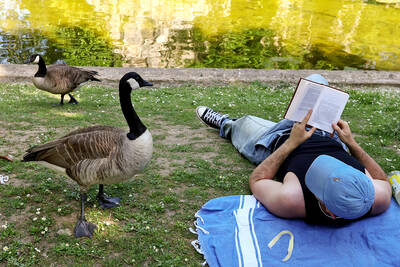
Forecasters in Europe yesterday warned of exceptional heat as record temperatures driven by a “heat dome” push temperatures well above seasonal norms across the continent. The surge follows a record-breaking Monday, with France logging its hottest day in the month of May on record, its weather agency said, and the UK also posting unprecedented highs. A so-called “heat dome” of warm air from northern Africa trapped under a high-pressure system over western Europe is behind the high temperatures not usually seen until high summer. Restrictions on outdoor work were imposed in parts of Italy, beaches in southwest France filled earlier than usual and


 RSS
RSS