


Malaria remains a nagging problem in Africa and efforts to curb the killer disease are “off-track,” the WHO said in a new report issued yesterday.
Despite the billions of US dollars spent on malaria programs, the WHO said too many people are missing out on available resources like medicines and bed nets that protect against mosquitoes that spread the disease.
The UN health agency had set a goal of cutting malaria cases to “near zero” by the end of last year.
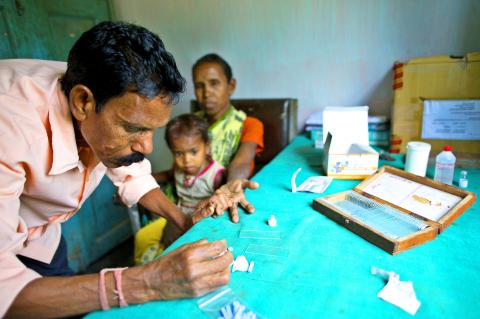
Photo: AP
It fell far short, and now is aiming to reduce malaria cases and deaths by at least 90 percent by 2030.
“We’re far from having completed the job,” the WHO’s malaria department director Pedro Alonso said. “The hardest is yet to come.”
He said gains could be hurt by a lack of funding, which has stagnated in the past six years.
According to yesterday’s report, there were 212 million new cases of malaria and 429,000 deaths last year, a slight drop from the previous year.
However, the figures were based largely on patchy data and modeling; the report said surveillance systems catch fewer than 20 percent of cases.
The vast majority cases are in Africa. About 70 percent of deaths were children under five.
The WHO said children and pregnant women in Africa now have better access to malaria tests and drugs.
However, more than 40 percent of people still do not sleep under an insecticide-treated bed net or have their homes sprayed with insecticides, the main strategies to protect against malaria.
Chris Drakeley, director of the malaria center at the London School of Hygiene and Tropical Medicine, said that even the incremental drop in malaria cases was significant.
He said that new approaches to fighting malaria — like giving out medicines to children during high season to prevent infections— were proving effective.
Other experts said the WHO should rethink its priorities when it comes to malaria spending.
“They’re looking at innovative ideas and investing in new tools like vaccines, but they’re missing the basics,” said Sophie Harman, a public health expert at Queen Mary University in London.
She said more money should be put into bed nets and health services instead.
“Even if you have a new vaccine, how will you even deliver it if there’s no infrastructure?”
Harman questioned whether the WHO’s latest 2030 goal was realistic.
“It has symbolic meaning that WHO is still committed to this,” she said. “But probably nobody in public health thinks this is really achievable.”

An American scientist convicted of lying to US authorities about payments from China while he was at Harvard University has rebuilt his research lab in Shenzhen, China, to pursue technology the Chinese government has identified as a national priority: embedding electronics into the human brain. Charles Lieber, 67, is among the world’s leading researchers in brain-computer interfaces. The technology has shown promise in treating conditions such as amyotrophic lateral sclerosis and restoring movement in paralyzed people. It also has potential military applications: Scientists at the Chinese People’s Liberation Army have investigated brain interfaces as a way to engineer super soldiers by boosting
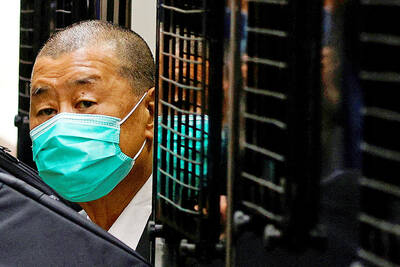
Jailed media entrepreneur Jimmy Lai (黎智英) has been awarded Deutsche Welle’s (DW) freedom of speech award for his contribution to Hong Kong’s pro-democracy movement. The German public broadcaster on Thursday said Lai would be presented in absentia with the 12th iteration of the award on June 23 at the DW Global Media Forum in Bonn. Deutsche Welle director-general Barbara Massing praised the 78-year-old founder of the now-shuttered news outlet Apple Daily for standing “unwaveringly for press freedom in Hong Kong at great personal risk.” “With Apple Daily, he gave journalists a platform for free reporting and a voice to the democracy movement in
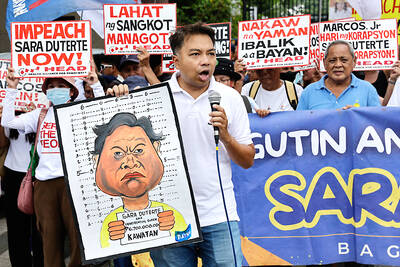
PHILIPPINE COMMITTEE: The head of the committee that made the decision said: ‘If there is nothing to hide, there is no reason to hide, there is no reason to obstruct’ A Philippine congressional committee on Wednesday ruled that there was “probable cause” to impeach Philippine Vice President Sara Duterte after hearing allegations of unexplained wealth, misuse of state funds and threats to have the president assassinated. The unanimous decision of the 53-member committee in the Philippine House of Representatives sends the two impeachment complaints to deliberations and voting by the entire lower chamber, which has more than 300 lawmakers. The complaints centered on Duterte’s alleged illegal use and mishandling of intelligence funds from the vice president’s office, and from her time as education secretary under Philippine President Ferdinand Marcos Jr. Duterte and the

Burmese President Min Aung Hlaing yesterday cut all prisoners’ sentences by one-sixth, a blanket measure that a source close to deposed leader Aung San Suu Kyi said would further shorten her detention. Aung San Suu Kyi has been sequestered since a 2021 military coup, but the senior member of her dissolved National League for Democracy (NLD) party said that while her term had been reduced, her remaining sentence is still unclear. “We also don’t know exactly how many years she has left,” the source told reporters, speaking on condition of anonymity for security reasons. The military toppled Aung San Suu Kyi’s elected government


 RSS
RSS