


German Chancellor Angela Merkel yesterday said “no miracles” were achieved on the Ukraine crisis, but talks with the country’s leader and his Russian and French counterparts did lead to some progress on ending a deadlock in the peace process.
After a five-hour summit billed as “difficult,” Ukrainian President Petro Poroshenko said all sides had agreed to draw up a roadmap for applying the frayed Minsk peace accords following months of impasse.
“Between now and the end of November we have to approve a roadmap. It will be a document on the implementation of all the Minsk accords,” he said at a news conference after the Berlin gathering, according to Russian news agencies.
Merkel said at a separate press conference that the talks “didn’t achieve miracles,” but that progress was made “with the creation of a so-called roadmap.”
“There’s much work left to do,” she said, flanked by French President Francois Hollande.
Russian President Vladimir Putin, on his first visit to Berlin since the conflict erupted, stressed that the Minsk accords remained the best path toward a lasting resolution to war in eastern Ukraine.
The roadmap agreed to in Berlin will be now be further thrashed out and discussed by the countries’ foreign ministers, the leaders said.
“You have to respect the successive steps of the Minsk accords,” Hollande told reporters.
Putin had not visited Berlin since Russia annexed Ukraine’s Crimean Peninsula in 2014, sending relations with the West plunging to their lowest point since the Cold War.
Russia backs a separatist, pro-Moscow insurgency in eastern Ukraine that has claimed nearly 10,000 lives on both sides.
It denies accusations that it has sent troops and weapons across its border with Ukraine.
The Minsk accords, signed in February last year with French and German mediation, call for a ceasefire along with a range of political, economic and social measures to end the conflict between Ukrainian troops and pro-Russian rebels.
While the accords reduced the intensity of fighting, they have failed to stop it.
On a key sticking point — the issue of holding possible local elections in rebel-run regions, Poroshenko said no polls could take place without “the unconditional withdrawal of foreign armed forces.”
Putin for his part wants partial autonomy for rebel-held parts of eastern Ukraine like Donbass and Lugansk, while Kiev wants reassurances that fair and free elections would be held there.
None of the four leaders meeting in Berlin had expected a breakthrough, but Germany and France had argued that it was important to return to the negotiating table more than a year after the Minsk agreements were signed.
Putin, speaking separately to reporters after the talks, confirmed that the four were in favor of widening the role of the European OSCE observer mission.
Poroshenko said that meant an agreement had been reached on deploying an armed OSCE mission to the east.
Putin, who wants to assure the supply of provisions to rebel regions, said the talks had focused heavily on security matters, but on humanitarian issues “we unfortunately didn’t make much progress.”

Through the noise of rushing papers and whirring belts at a print factory in Kyoto, two creators watch their photo essay come to life in broadsheet form — part of an effort to win new audiences in the age of artificial intelligence (AI). Despite the decline of the publishing industry, self-publication and handmade “zine” magazines are growing in popularity in Japan, reflecting the nation’s enduring love of paper in the digital era. While speaking to Agence France-Presse at the plant, his hands black with ink, one of the creators, Kazuma Obara, said: “I think [paper] is a medium that engages all five
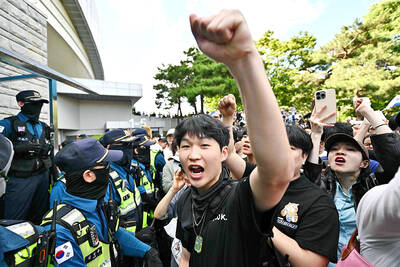
‘ABSURD MISTAKE’: The election commission said that there had been a failure to anticipate turnout after 14 polling stations ran short of ballot papers South Korean riot police yesterday cleared protesters from a Seoul polling station after a 35-hour blockade sparked by a shortage of ballot papers during local elections earlier this week. Wednesday’s election was the first nationwide vote since South Korean President Lee Jae-myung took office following the ouster of Yoon Suk-yeol over his short-lived martial law declaration. Lee’s ruling Democratic Party swept most races, but failed to flip the crucial Seoul mayoral seat. The South Korean National Election Commission apologized, blaming a failure to anticipate turnout after 14 polling stations in Seoul ran short of ballot papers. Some polling stations stayed open until 10pm to

France experienced its hottest spring on record, the French weather service said on Tuesday, after an exceptional early heat wave that also broke highs for the season in England and Wales. Meteo-France said the average nationwide temperature over March to May was 13.8°C — about 1.7°C above the norm, and surpassing records set in 2011 and 2020. “The warmest spring since records began in 1900,” it said in a bulletin. All three months were warmer than average, but the onset of an “unprecedented heatwave” late last month pushed the mercury to highs typically seen at the height of the summer. “Our country had never

A Sherpa guide was found crawling to base camp on Mount Everest a week after he went missing and was reunited with his family, who had given up hope he would return. Dawa Sherpa was last seen on Friday last week descending the mountain, but he did not reach base camp even though his client did. The pair were among the last climbers on the mountain as the climbing season came to an end and the route was dismantled. Dawa was located by a cleaning crew on Thursday morning as he was crawling down the snowy slopes around the Khumbu Icefall, just above


 RSS
RSS