


Philippine President Rodrigo Duterte yesterday said that his bloody anti-drug campaign that has left nearly 1,800 people dead does not amount to genocide, but added that he is ready to go to jail to defend his men from lawsuits.
Duterte drew a line between the widespread killings sparked by his anti-drug war and the brutality under Syrian President Bashar al-Assad and the atrocities committed by the Islamic State.
“Genocide? Who did I kill? I did not kill any child. I did not drop barrel [bombs] just like Assad,” Duterte said in a speech to war veterans, ambassadors and top officials marking the Philippines’ National Heroes’ Day. “I’m fighting ... criminals.”
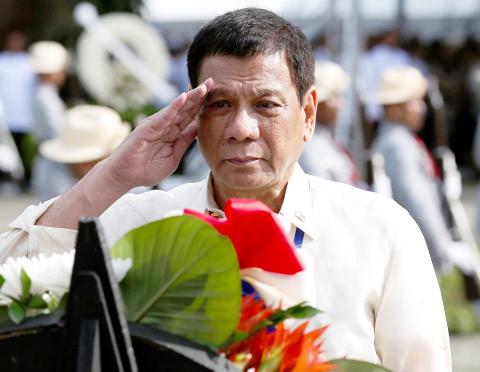
Photo: EPA/Presidential Photographs Division handout
Referring to Islamic State militants, whom he called “idiots,” Duterte said: “I do not burn women because they refuse to have sex.”
At least 1,779 drug suspects have been killed in Duterte’s campaign, including 712 who were gunned down in clashes with police, with the rest being slain in still unclear circumstances, the national police chief told a Philippine Senate inquiry last week.
At least 3.7 million Filipinos have become addicted to methamphetamine, a prohibited stimulant known locally as “shabu,” with about 600,000 drug users and dealers surrendering to authorities, Duterte said.
Human rights groups have expressed alarm over the spate of killings, and UN-appointed human rights experts warned steps should be taken to halt the violence, adding that the government and police could be held responsible.
“Claims to fight the illicit drug trade do not absolve the government from its international legal obligations and do not shield state actors or others from responsibility for illegal killings,” UN Special Rapporteur on summary executions Agnes Callamard said in a statement this month.
Duterte, 71, built a name with his deadly crime-busting style as a long-time mayor of southern Davao city. He described his campaign against drugs as a harsh war that would involve the military, because the problem has worsened into a crisis and claimed the lives of law enforcers.
“We might still end up like the South American countries and their fractured governments. I am declaring war,” he told an audience at a national heroes’ cemetery that included ambassadors, war veterans and security officials.
The drug menace, “has infected every nook and corner of this country involving generals, mayors, governors, barangay [village] captains” and policemen, he said.
Pressing his campaign, Duterte announced bounties of 2 million pesos (US$43,044) for information that would help the government identify any police officer protecting drug syndicates.
He repeated his pledge to defend the police and military, but warned law enforcement against colluding with criminals.
“In the pursuit of law and order, pursuant to my directions, you do not have to worry about criminal liability,” he said. “I will go to the prison for you. I take full legal responsibility, you just do it according to the books.”
“But for those in government, the police, the corrupt police and the corrupt judges and the corrupt prosecutors, there will be a day of comeuppance, there will always be a day of reckoning,” Duterte said.
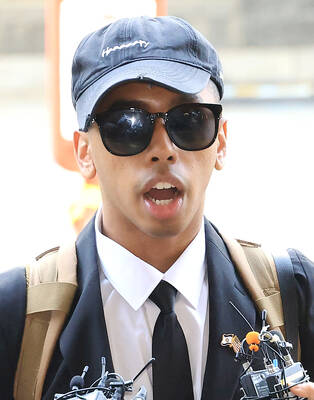
A US YouTuber who caused outrage for filming himself kissing a statue commemorating Korean wartime sex slaves has been sentenced to six months in prison, a court in Seoul said yesterday. Johnny Somali, 25, gained notoriety several years ago for recording himself doing a series of provocative stunts in South Korea and Japan, and streaming them on platforms such as YouTube and Twitch. South Korean authorities indicted Somali — whose real name is Ramsey Khalid Ismael — in 2024 on public order violations and obstruction of business, and banned him from leaving the country. “The court has sentenced him to six months in

Former Lima mayor Rafael Lopez Aliaga, a Peruvian presidential hopeful, gathered hundreds of supporters in Lima on Tuesday and gave authorities 24 hours to annul the first round of the country’s election over allegations of fraud. Lopez Aliaga is locked in a tight three-way race with two other candidates for second place in Sunday’s vote. The election runner-up wins a ticket to June’s presidential run-off against front-runner Keiko Fujimori. “I am giving them 24 hours to declare this electoral fraud null and void,” said Lopez Aliaga, surrounded by a crowd of several hundred supporters. “If it is not declared null and void tomorrow,

PAPAL RETORT: Pope Leo told reporters that he has ‘no fear, neither of the Trump administration nor speaking out loudly about the message of the Gospel’ US President Donald Trump has feuded with Pope Leo XIV over the Iran conflict — setting off an unholy row that could have serious political implications for the Republican leader back in the US. Trump has drawn barbs even from some allies over the attacks on the US-born pontiff, who has criticized the Trump administration over its immigration crackdown, the intervention in Venezuela and the Iran war. The president risks alienating the religious right in November’s crucial US midterm elections. So far the unprecedented clash between the leader of the most powerful military on Earth and the head of the world’s 1.4 billion

A 16-year-old boy has been charged with murder and aggravated sexual abuse in Florida in the death of his 18-year-old stepsister on a Carnival Cruise ship, the US Department of Justice said on Monday. Timothy Hudson was initially charged in February and subsequently indicted on March 10, but the breadth of the case was not known until a seal was lifted on Friday last week, weeks after US District Judge Beth Bloom in Miami said that he would be prosecuted as an adult at the request of the government. Anna Kepner had been traveling on the Carnival Horizon ship in November last


 RSS
RSS