


A former philosophy professor in Minnesota on Monday was fined US$500,000 for smuggling elephant ivory and illegally exporting rhinoceros horns from the US to China, prosecutors said.
Zheng Yiwei (鄭義偉), 43, a former St Cloud State University professor, was also sentenced to three years’ probation and 150 hours of community service by US District Judge John Tunheim in Minneapolis, prosecutors said.
The fine is to be paid to the Lacey Act Reward Fund, which is used by the US Fish and Wildlife Service to reward those who provide information about wildlife crimes and to care for animals held as evidence in ongoing probes.
Zheng’s attorney, Timothy Webb, said the sentence, under which his client will also spend six weekends in jail, was fair.
His employment with St Cloud State University ended in March, said Adam Hammer, a spokesman for the school.
Zheng, a Chinese American also known as Steve Zheng, pleaded guilty in January to smuggling ivory from the US to China in April 2011 and exporting rhino horns in July 2010, in violation of the endangered species act.
“This defendant helped to sustain this illegal market for years, engaging in more than 300 sales and earning more than US$1 million,” Assistant US Attorney Laura Provinzino said in a statement. “His profit was earned at the expense of these threatened and endangered species.”
Zheng operated an online business called Crouching Dragon Antiques in which some of the objects sold were made with ivory and rhino horn, prosecutors said.
The illegal items Zheng smuggled into and out of the US were worth as much as US$1.5 million, prosecutors said.
Rhino horn sells at prices higher than gold in places such as Vietnam, where a belief with no basis in science has recently emerged that it can be used to cure cancer.
South Africa, which has more rhinos than any other country in Africa, saw nearly 1,200 of the animals killed by poachers last yaer, its Environment Ministry said.
There is an arc of illegal animal slaughter on the continent from South Sudan, where conservationists say elephants are being slain by both government forces and rebels, to South Africa.
Trade in rhino horn is banned globally under the terms of the CITES convention.

Through the noise of rushing papers and whirring belts at a print factory in Kyoto, two creators watch their photo essay come to life in broadsheet form — part of an effort to win new audiences in the age of artificial intelligence (AI). Despite the decline of the publishing industry, self-publication and handmade “zine” magazines are growing in popularity in Japan, reflecting the nation’s enduring love of paper in the digital era. While speaking to Agence France-Presse at the plant, his hands black with ink, one of the creators, Kazuma Obara, said: “I think [paper] is a medium that engages all five
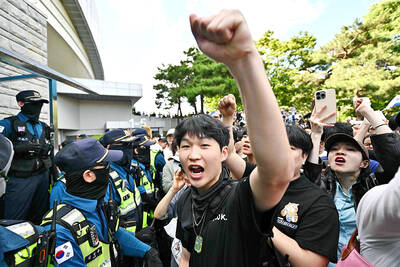
‘ABSURD MISTAKE’: The election commission said that there had been a failure to anticipate turnout after 14 polling stations ran short of ballot papers South Korean riot police yesterday cleared protesters from a Seoul polling station after a 35-hour blockade sparked by a shortage of ballot papers during local elections earlier this week. Wednesday’s election was the first nationwide vote since South Korean President Lee Jae-myung took office following the ouster of Yoon Suk-yeol over his short-lived martial law declaration. Lee’s ruling Democratic Party swept most races, but failed to flip the crucial Seoul mayoral seat. The South Korean National Election Commission apologized, blaming a failure to anticipate turnout after 14 polling stations in Seoul ran short of ballot papers. Some polling stations stayed open until 10pm to

Australian researchers have trained lab-grown brain cells on a silicon computer chip to play the 1990s shooter game Doom and said they are just scratching the surface of what the neurons could be capable of doing. It is the science-fiction work of biotech boffins at Cortical Labs, who researched and developed the technology that harnesses the workings of the brain’s networking system. Each so-called “biological computer” contains about 200,000 living human brain cells, grown from stem cells that were harvested from blood donations. Having mastered the simple computer game Pong, where a paddle is moved up and down to send a ball

France experienced its hottest spring on record, the French weather service said on Tuesday, after an exceptional early heat wave that also broke highs for the season in England and Wales. Meteo-France said the average nationwide temperature over March to May was 13.8°C — about 1.7°C above the norm, and surpassing records set in 2011 and 2020. “The warmest spring since records began in 1900,” it said in a bulletin. All three months were warmer than average, but the onset of an “unprecedented heatwave” late last month pushed the mercury to highs typically seen at the height of the summer. “Our country had never


 RSS
RSS