


Standing next to cages that once housed political prisoners, former Khmer Rouge foot soldier Tho Lon gets a surprisingly sympathetic hearing from a clutch of students, despite his work for a regime that wiped out one-quarter of Cambodia’s population.
“All my life, I’ve been cheated by politicians,” he told them in Anlong Veng, a dirt poor town where Pol Pot and his henchmen are still venerated.
“My heart is pained, but I pretend not to be hurt,” he added.
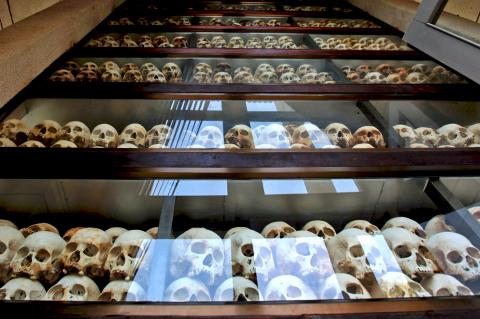
Photo: Reuters
That his complaints get an airing might jar with many Cambodians in a country still piecing together the horrors of the past.
However, his testimony is part of a pioneering reconciliation scheme introducing students to former fighters.
Until now, historians, officials and civil society groups helping Cambodia have struggled to decide on how to approach Anlong Veng, which lies on Cambodia’s remote northern border with Thailand.
It was there and among the surrounding Dangrek Mountains that Pol Pot and senior Khmer Rouge leaders lived on long after their murderous regime was toppled by Vietnam in 1979.
Hidden deep in the jungle, they launched two decades of guerilla attacks that only ended with the region’s final defeat in 1998.
As the students listened intently, Tho Lon explained why he kept on fighting.
“We were living in the mountains,” he said. “We had lost all contact with others, so we believed what we were told, that the Vietnamese would behead us [if we stopped].”
Tho Lon, 57, paid for his loyalty. He lost his sight in one eye and his right arm below the elbow in a mine blast fighting for a Marxist agrarian utopia that never materialized.
The country paid a bigger price — a grisly legacy for Cambodia’s younger generations. Along Veng also hosts the dilapidated grave of Pol Pot, the regime’s “Brother No. 1,” who died about two decades after the Khmer Rouge fell.
“I feel a mixture of excitement and pity,” said Sang Thong, a 25-year-old student from the town of Battambang, as classmates snapped pictures of the grave on their phones. Some of his relatives died under Pol Pot, he said.
“But I don’t come here to take revenge against him, I come here to learn more and understand more deeply about his regime,” he said.
Ly Sok-Kheang, head of the Anlong Veng Peace Program, part of the Documentation Center of Cambodia that researches the country’s genocide, said the meetings “promote historical empathy and understanding.”
However, he admitted it was no easy sell.
When Cambodia’s long civil war finally ended with the fall of Anlong Veng, he said, most of the reconciliation work understandably centered on commemorating the Khmer Rouge’s victims.
The country’s killing fields and notorious detention camps like Tuol Seng have become focal points for those efforts, while Anlong Veng has remained an impoverished backwater.
However, Ly Sok-Kheang said the town should also be remembered, precisely because it was the place where Cambodia finally managed to end decades of violence.
“I think Anlong Veng is the perfect place when we talk about peace in Cambodia,” he said.
Ignoring it, some say, has fed the festering support for Khmer Rouge in the region.
Tho Lon gave his lecture in the grounds of a tumble-down, but once grand villa that was owned by Ta Mok, a senior Khmer Rouge leader nicknamed “The Butcher” for the massacres he perpetrated.
He died in 2006 without ever seeing justice.
Ta Mok rose to No. 3 in the Khmer Rouge hierarchy. However, he eventually turned on Pol Pot as the remnants of the movement imploded and turned on each other.
Pol Pot was arrested and tried by Ta Mok’s faction in 1997.
Ta Mok remains celebrated in the town, primarily for irrigation projects and doling out money and favors.
“I would like to stress that living under Ta Mok, both civilians and troops loved him,” Tho Lon said.
Sieng Sok Heng, chief of Anlong Veng’s tourism office — a wooden shack down a dusty road — agreed.
“A lot of the people here were under Ta Mok,” he said, adding that they instead “hate the regime and its leaders.”
Sieng Sok Heng hopes more tourists will seek out the town. About 2,000 locals and 30 international tourists visit each month.
Many seek out Pol Pot’s grave.
The Khmer Rouge leader died in yet to be fully explained circumstances shortly after his trial by Ta Mok’s henchman.
He was swiftly cremated on a bed of car tires on a hillside overlooking the town, a stone’s throw from the Thai border.
His grave lies in the shadow of a large, newly constructed casino filled with Thai and Chinese tourists, the only clue to its existence a rusty blue sign.
For Chhoeun Chhay Lin, 18, the grave stood as a warning.
“I feel a little bit scared of him as a leader, whether he’s dead or alive, he still has some power over people,” she said.
“But students should know about history. We must learn never to follow the direction of that dark regime again,” she said.
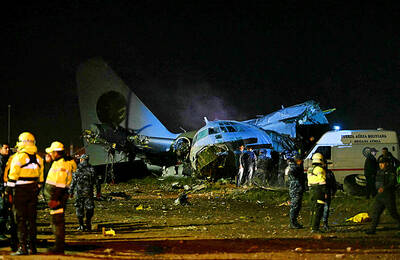
MONEY GRAB: People were rushing to collect bills scattered on the ground after the plane transporting money crashed, which an official said hindered rescue efforts A cargo plane carrying money on Friday crashed near Bolivia’s capital, damaging about a dozen vehicles on highway, scattering bills on the ground and leaving at least 15 people dead and others injured, an official said. Bolivian Minister of Defense Marcelo Salinas said the Hercules C-130 plane was transporting newly printed Bolivian currency when it “landed and veered off the runway” at an airport in El Alto, a city adjacent to La Paz, before ending up in a nearby field. Firefighters managed to put out the flames that engulfed the aircraft. Fire chief Pavel Tovar said at least 15 people died, but
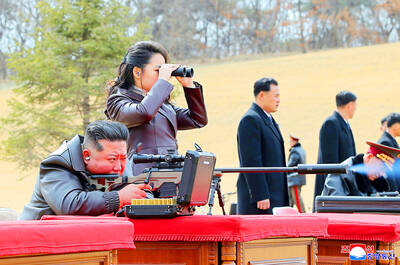
LIKE FATHER, LIKE DAUGHTER: By showing Ju-ae’s ability to handle a weapon, the photos ‘suggest she is indeed receiving training as a successor,’ an academic said North Korea on Saturday released a rare image of leader Kim Jong-un’s teenage daughter firing a rifle at a shooting range, adding to speculation that she is being groomed as his successor. Kim’s daughter, Ju-ae, has long been seen as the next in line to rule the secretive, nuclear-armed state, and took part in a string of recent high-profile outings, including last week’s military parade marking the closing stages of North Korea’s key party congress. Pyongyang’s official Korean Central News Agency (KCNA) released a photo of Ju-ae shooting a rifle at an outdoor shooting range, peering through a rifle scope
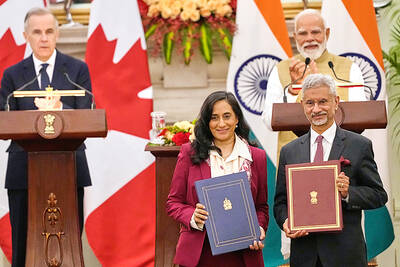
India and Canada yesterday reached a string of agreements, including on critical mineral cooperation and a “landmark” uranium supply deal for nuclear power, the countries’ leaders said in New Delhi. The pacts, which also covered technology and promoting the use of renewable energy, were announced after Indian Prime Minister Narendra Modi and Canadian Prime Minister Mark Carney hailed a fresh start in the relationship between their nations. “Our ties have seen a new energy, mutual trust and positivity,” Modi said. Carney’s visit is a key step forward in ties that effectively collapsed in 2023 after Ottawa accused New Delhi
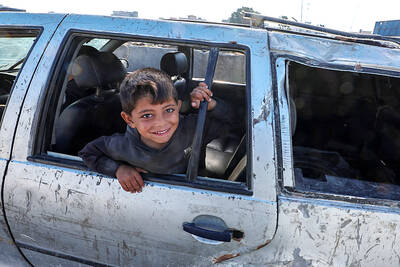
Gaza is rapidly running out of its limited fuel supply and stocks of food staples might become tight, officials said, after Israel blocked the entry of fuel and goods into the war-shattered territory, citing fighting with Iran. The Israeli military closed all Gaza border crossings on Saturday after announcing airstrikes on Iran carried out jointly with the US. Israeli authorities late on Monday night said that they would reopen the Kerem Shalom crossing from Israel to Gaza yesterday, for “gradual entry of humanitarian aid” into the strip, without saying how much. Israeli authorities previously said the crossings could not be operated safely during


 RSS
RSS