


A migrant worker was pulled out alive yesterday after he was buried for more than 60 hours in a massive landslide that swept through part of a major manufacturing city in southern China.
Shenzhen Emergency Response Office official Rao Liangzhong said that the man, Tian Zeming (田澤明), was rescued at about dawn yesterday. He said Tian was from Chongqing in southwestern China.
“The survivor had a very feeble voice and pulse when he was found alive buried under debris, and now he is undergoing further checks,” Wang Yiguo (王以國) told a news conference in Shenzhen, according to a transcript posted by the district government that covers the area.
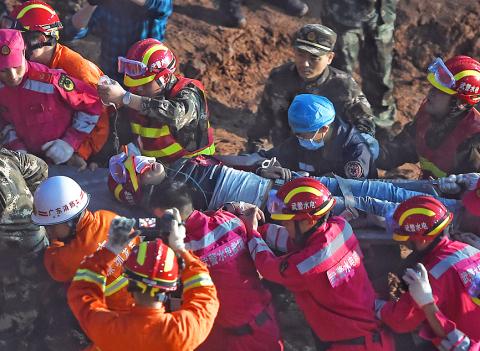
Photo: AP
State broadcaster CCTV reported that Tian later underwent surgery for a broken hand and on his foot, which had been wedged against a door panel. It said he had been trying to get out of his room when the building collapsed, and the door panel created a space for him to survive.
When they found him, Tian told rescuers his name and that there was another person buried near him, according to the transcript. Another neurosurgeon, Dai Limeng (戴黎萌), told the news conference that he had gone into the rubble and confirmed that the second person had not survived.
More than 70 people are still missing from the landslide that happened on Sunday when a mountain of construction waste material and mud collapsed and flowed into an industrial park in Shenzhen.
The Chinese Ministry of Land and Resources has said a steep mountain of dirt, cement chunks and other construction waste had been piled up against a 100m-high hill over the past two years.
Heavy rain saturated the soil, making it unstable, and ultimately causing it to collapse with massive force in and around an industrial park.
State media reported that the New Guangming District Government identified problems with the mountain of soil months earlier.
The Legal Evening News said a district government report in January found that the dump had received 1 million cubic meters of waste and warned of a “catastrophe.”
Under pressure from the media, officials allowed about 30 journalists, mostly from foreign outlets, to approach an edge of the disaster area. Flanked by police officers, reporters could observe military posts with computers and disease control stations set up for the rescue workers.
Shenzhen is a major manufacturing center, making everything from cellphones to cars, and it attracts workers from all parts of China.
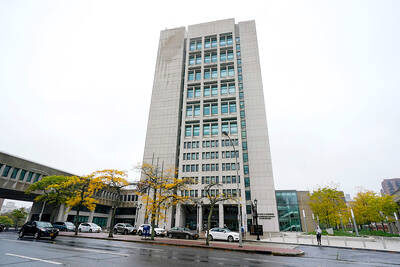
A coalition of civil rights groups on Tuesday asked a New York State judge to order one of its largest suburban counties to stop its deployment of nearly 600 license plate readers, calling it a warrantless and “indiscriminate surveillance system” that violates the state constitution. The class action lawsuit also alleged that Westchester County never got proper authorization to launch the program, which has amassed a database of 1.6 billion plate scans that has been shared with more than 50 outside law enforcement agencies. The complaint said the network “records the long-term travel patterns, daily habits, and intimate information of millions of

Pope Leo XIV on Wednesday blessed a giant new tower at Barcelona’s famed Sagrada Familia Basilica after celebrating mass inside what is now the world’s tallest church. A fireworks and light show illuminated the exterior of the temple at the end of the ceremony, bathing the unfinished basilica in shifting colours that highlighted its towering spires. A choir of 600 singers performed at the service which lasted around 90 minutes and was attended by Spanish Prime Minister Pedro Sanchez as well as King Felipe VI and Queen Letizia. The stained-glass windows in various colours shone brightly in between the tree-like

Voters in Switzerland yesterday cast their ballots on an initiative championed by the top right-wing party to cap the Alpine country’s population at 10 million. As of press time last night, early results showed that Swiss voters were leaning against it. The populist Swiss People’s Party, which has the most seats in parliament, has stirred up and fostered anti-migration sentiment over the years, notably about an influx of workers from the neighboring EU. Critics called the bid a self-inflicted wound, saying the boom in migration over the past generation has brought foreign labor and skills to sectors such as healthcare, finance, pharmaceuticals
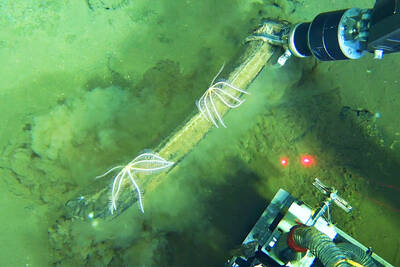
Scientists have discovered communities of marine life — including jellyfish, tubeworms and brittle stars — thriving on a whale graveyard. The graveyards form when whale carcasses fall to the sea floor, becoming a sustaining snack for nearby critters. This one, which is up to 7km below the surface of the southeastern Indian Ocean, spans the largest area, and is so far the deepest found. A whale’s sheer size and the unique chemistry of its bones are the keys to forming these unique underwater neighborhoods, said Song Xikun (宋希坤), a biologist with the Chinese Academy of Sciences’ Institute of Deep-sea Science and Engineering


 RSS
RSS