


Fires raging across huge areas of Indonesia are spewing more greenhouse gases into the atmosphere every day than the US economy, according to estimates from global environment watchdogs.
For nearly two months, thousands of fires caused by slash-and-burn farming have suffocated vast expanses of Southeast Asia with smog, causing respiratory illnesses to soar, schools to close, and scores of flights and some international events to be canceled.
Much of the burning is in tropical peatlands rich in carbon, but which are being drained and cleared at a rapid rate to make way for agriculture, particularly fast-expanding palm oil plantations.
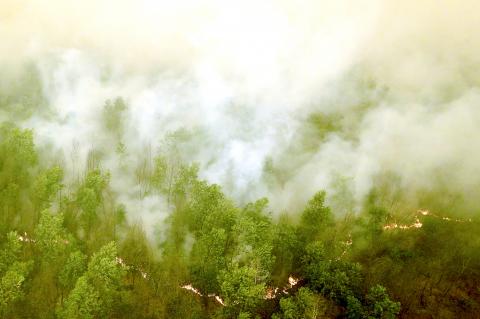
Photo: Reuters / Nova Wahyudi /Antara Foto
The World Resources Institute (WRI), using findings from the Global Fire Emissions Database, said in a recent report that, since early last month, carbon emissions from the fires had exceeded average US daily output on 26 out of 44 days.
The US is the world’s second-largest greenhouse gas source after China.
“The burning of tropical peatlands is so significant for greenhouse gas emissions because these areas store some of the highest quantities of carbon on Earth, accumulated over thousands of years,” the WRI said. “Draining and burning these lands for agricultural expansion, such as conversion to oil palm or pulpwood plantations, leads to huge spikes in greenhouse gas emissions.”
The fires and resulting region-wide blanket of smoke occur to varying degrees each year during the dry season as land is illegally cleared by burning, regularly angering Indonesia’s smog-hit neighbors Malaysia and Singapore.
However, experts have said the current outbreak is on track to become the worst ever, exacerbated by bone-dry conditions caused by the El Nino weather phenomenon.
The fires on Sumatra and Borneo are typically only brought under control by the onset of the rainy season, due to start next month.
However, Herry Purnomo, a scientist at the Indonesia-based Center for International Forestry Research, this week said that climatology data indicated the rainy season might be delayed and that the fires could last until the end of the year.
Indonesia earlier this month agreed to accept international help after failing to douse the fires manually and last week launched its biggest fire-fighting push yet.
Thirty-two planes and helicopters — including six aircraft from Singapore, Malaysia and Australia — were deployed to back up more than 22,000 ground personnel.
Malaysia, which in recent weeks has repeatedly ordered school closures across several states as a health precaution, did so again yesterday for the third straight day as pollution levels climbed.
Air quality was in the “very unhealthy” range near the capital, Kuala Lumpur, under the government’s rating system.

ACTIONABLE ADVICE: The majority of chatbots tested provided guidance on weapons, tactics and target selections, with Perplexity and Meta AI deemed to be the least safe From school shootings to synagogue bombings, leading artificial intelligence (AI) chatbots helped researchers plot violent attacks, according to a study published on Wednesday that highlighted the technology’s potential for real-world harm. Researchers from the nonprofit watchdog Center for Countering Digital Hate and CNN posed as 13-year-old boys in the US and Ireland to test 10 chatbots, including ChatGPT, Google Gemini, Perplexity, Deepseek and Meta AI. Eight of the chatbots assisted the make-believe attackers in more than half the responses, providing advice on “locations to target” and “weapons to use” in an attack, the study said. The chatbots had become a “powerful accelerant for

Australians were downloading virtual private networks (VPNs) in droves, while one of the world’s largest porn distributors said it was blocking users from its platforms as the country yesterday rolled out sweeping online age restriction. Australia in December became the first country to impose a nationwide ban on teenagers using social media. A separate law now requires artificial intelligence (AI)-powered chatbot services to keep certain content — including pornography, extreme violence and self-harm and eating disorder material — from minors or face fines of up to A$49.5 million (US$34.6 million). The country also joined Britain, France and dozens of US states requiring
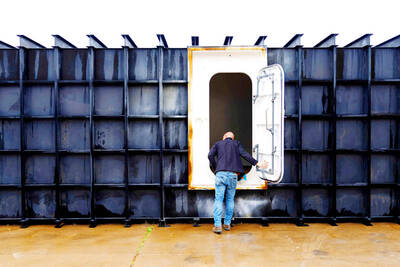
Since the war in the Middle East began nearly two weeks ago, the telephone at Ron Hubbard’s bomb shelter company in Texas has not stopped ringing. Foreign and US clients are rushing to buy his bunkers, seeking refuge in case of air raids, nuclear fallout or apocalypse. With the US and Israel pounding Iran, and Tehran retaliating with strikes across the region, Hubbard has seen demand for his product soar, mostly from Gulf nation customers in Bahrain, Qatar, Kuwait and the United Arab Emirates. “You can imagine how many people are thinking: ‘I wish I had a bomb shelter,’” Hubbard, 63, said in
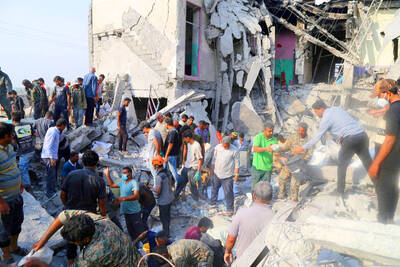
STILL IN POWER: US intelligence reports showed that the Iranian regime is not in danger of collapse and retains control of the public, casting doubt on Trump’s exit Nearly every US Senate Democrat on Wednesday signed a letter sent to US Secretary of Defense Pete Hegseth requesting a “swift investigation” of airstrikes on a girls’ school in Iran that killed scores of children and any other potential US military actions causing civilian harm. Reuters reported on Thursday last week that US military investigators believe it is likely that US forces were responsible for the Feb. 28 strike on the school, as US and Israeli forces launched attacks on Iran. “The results of this school attack are horrific. The majority of those killed in the strikes were girls between the ages


 RSS
RSS