


The US nuclear-powered aircraft carrier USS Ronald Reagan yesterday docked at its new home in Japan’s Yokosuka naval port just as Tokyo tries to deepen defense ties with the US under new security laws that expand the role of Japan’s military.
The warship’s arrival received a warm welcome from Japanese officials because of its role in disaster relief after the March 2011 earthquake and tsunami disaster as part of the US government’s tomodachi, or “friends,” project.
At a welcoming ceremony, US Secretary of the Navy Ray Mabus said the arrival and the welcome the vessel received are “visible symbols of our shared commitment to one another and regional stability.”

Photo: AP
However, outside the port, a small group of citizens protested the aircraft carrier’s deployment as a move to step up Japan’s military cooperation with the US.
Japanese Prime Minister Shinzo Abe’s government enacted new laws that would allow the country’s troops to also defend their allies, mainly the US, overseas, in a chaotic parliamentary session last month disrupted by opposition lawmakers’ vote-delaying attempts.
Abe says Japan needs the laws to increase its deterrence capabilities amid China’s growing assertiveness, North Korea’s missile and nuclear ambitions and other security concerns.
However, many Japanese worry the new laws increase the risk of Japan being embroiled in US-led wars.
The carrier, which came with about 5,000 crewmembers, replaces the USS George Washington, which was the first US nuclear-powered warship based in Japan, where atomic weapons are a sensitive issue.
Three destroyers are set to be deployed later this year to Yokosuka, near Tokyo, bringing the number of Yokosuka-based US warships to 14, the largest since Japan’s World War II defeat in 1945, Kyodo News reported.

An American scientist convicted of lying to US authorities about payments from China while he was at Harvard University has rebuilt his research lab in Shenzhen, China, to pursue technology the Chinese government has identified as a national priority: embedding electronics into the human brain. Charles Lieber, 67, is among the world’s leading researchers in brain-computer interfaces. The technology has shown promise in treating conditions such as amyotrophic lateral sclerosis and restoring movement in paralyzed people. It also has potential military applications: Scientists at the Chinese People’s Liberation Army have investigated brain interfaces as a way to engineer super soldiers by boosting
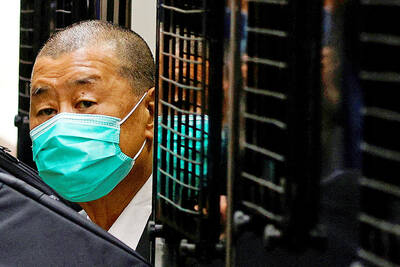
Jailed media entrepreneur Jimmy Lai (黎智英) has been awarded Deutsche Welle’s (DW) freedom of speech award for his contribution to Hong Kong’s pro-democracy movement. The German public broadcaster on Thursday said Lai would be presented in absentia with the 12th iteration of the award on June 23 at the DW Global Media Forum in Bonn. Deutsche Welle director-general Barbara Massing praised the 78-year-old founder of the now-shuttered news outlet Apple Daily for standing “unwaveringly for press freedom in Hong Kong at great personal risk.” “With Apple Daily, he gave journalists a platform for free reporting and a voice to the democracy movement in

PHILIPPINE COMMITTEE: The head of the committee that made the decision said: ‘If there is nothing to hide, there is no reason to hide, there is no reason to obstruct’ A Philippine congressional committee on Wednesday ruled that there was “probable cause” to impeach Philippine Vice President Sara Duterte after hearing allegations of unexplained wealth, misuse of state funds and threats to have the president assassinated. The unanimous decision of the 53-member committee in the Philippine House of Representatives sends the two impeachment complaints to deliberations and voting by the entire lower chamber, which has more than 300 lawmakers. The complaints centered on Duterte’s alleged illegal use and mishandling of intelligence funds from the vice president’s office, and from her time as education secretary under Philippine President Ferdinand Marcos Jr. Duterte and the
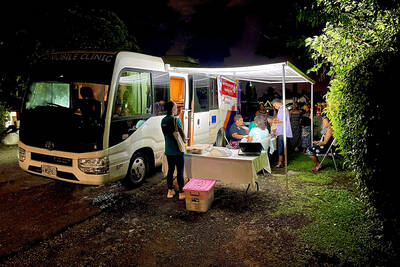
As evening falls in Fiji’s capital, a steady stream of people approaches a makeshift clinic that is a first line of defense against one of the world’s fastest-growing HIV epidemics. In the South Pacific nation — a popular tourist destination of just under a million people — more than 2,000 new HIV cases were recorded last year, a 26 percent increase from 2024. The government has declared an HIV outbreak and described it as a national crisis. “It’s spreading like wildfire,” said Siteri Dinawai, 46, who came to be tested. The Moonlight Clinic, a converted minibus parked in a suburban cul-de-sac in Suva, is


 RSS
RSS