


A brain-to-computer technology that can translate thoughts into leg movements has enabled a man paralyzed from the waist down due to a spinal cord injury to become the first such patient to walk without the use of robotics, doctors in Southern California reported on Wednesday.
The slow, halting first steps of the 28-year-old paraplegic were documented in a preliminary study published in the UK-based Journal of NeuroEngineering and Rehabilitation, along with a YouTube video.
The feat was accomplished using a system that allows the brain to bypass the injured spinal cord and instead send messages through a computer algorithm to electrodes placed around the patient’s knees to trigger controlled leg muscle movements.
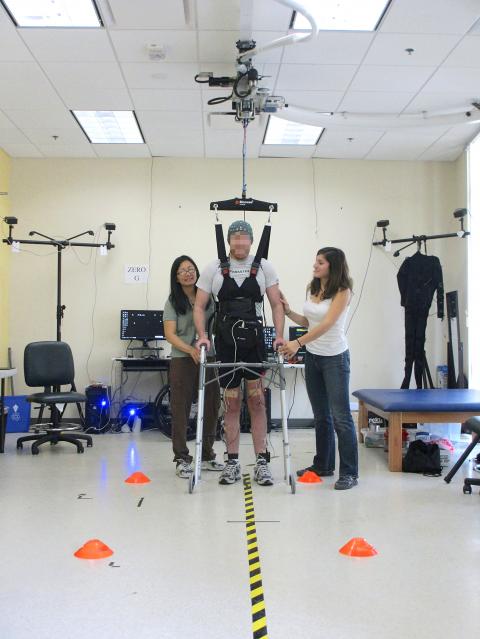
Photo: Reuters
Researchers at the University of California said the outcome marks a promising, but incremental achievement in the development of brain-computer interfaces that might one day help stroke and spinal injury victims regain some mobility.
Study co-author An Do said clinical applications were many years away. Results of the research still need to be replicated in other patients and greatly refined.
Nevertheless, the study proved it possible “to restore intuitive, brain-controlled walking after a complete spinal cord injury,” said biomedical engineer Zoran Nenadic, who led the research.
The steps were taken a year ago by the experiment’s subject, former graduate student Adam Fritz, who injured his back in a motorcycle accident.
Fritz propelled himself over a distance of 3.6 meters across the floor of UC Irvine’s iMove Lab, though his weight was partially supported by an overhead suspension harness and a walker he grasped to keep his body upright, researchers said.
The weight support was necessary because the patient lacked any sensation in his legs or feet, Do explained.
Still, the experiment built on earlier UC Irvine studies in which brain signals were transmitted to a robotic prosthesis attached to the patient’s legs to produce movement, Do said.
The latest study, which began about five years after Fritz became paralyzed, involved months of mental training in which he practiced thinking about walking to produce necessary leg-moving brain waves.
Those signals were then picked up by an electroencephalogram (EEG) he wore as a cap and were transmitted to a computer for processing by a special algorithm that could isolate the messages related only to leg motion and convert them to signals that would stimulate the patient’s muscles to walk.
Researchers hope to refine the technology by miniaturizing the EEG component enough to be implanted inside the patient’s skull or brain, allowing for clearer reception of the neural messages and perhaps the delivery of pressure sensation from sensors in the foot back to the brain.

‘CROSSING THE LINE’: China’s embassy in Seoul criticized US Forces Korea Commander General Xavier Brunson, asking if his ‘hostile’ remarks were authorized by Washington South Korea and the US are in talks over recent public remarks by the commander of US Forces Korea, Seoul’s presidential office said yesterday, after the comments drew sharp criticism from China. In a recent podcast interview, US Forces Korea Commander General Xavier Brunson described South Korea as “the dagger in the heart of Asia” from China’s east coast, prompting the Chinese embassy in Seoul to say that he had “truly crossed the line.” The interview came amid growing speculation that Washington might seek to expand the role of US Forces Korea in countering the growing regional influence of China, a key

SEEKING ORDER: Rodrigo Paz said that ‘anyone who wants to destroy the nation will have to deal with this president and the full force of the constitution’ Bolivian President Rodrigo Paz on Wednesday said that the nation was at a “breaking point” after nearly a month of protests that have caused shortages of food, fuel and medicine. Paz, who took office six months ago amid the worst economic crisis there in four decades, is battling a groundswell of fury over his policies. The political capital, La Paz, has been besieged by low-income workers and members of the indigenous majority calling for his resignation. “The country needs order and is reaching breaking point,” the 58-year-old said at a public event in La Paz, renewing his appeal for dialogue. On Tuesday, the Bolivian

Forecasters in Europe yesterday warned of exceptional heat as record temperatures driven by a “heat dome” push temperatures well above seasonal norms across the continent. The surge follows a record-breaking Monday, with France logging its hottest day in the month of May on record, its weather agency said, and the UK also posting unprecedented highs. A so-called “heat dome” of warm air from northern Africa trapped under a high-pressure system over western Europe is behind the high temperatures not usually seen until high summer. Restrictions on outdoor work were imposed in parts of Italy, beaches in southwest France filled earlier than usual and

Australian researchers have trained lab-grown brain cells on a silicon computer chip to play the 1990s shooter game Doom and said they are just scratching the surface of what the neurons could be capable of doing. It is the science-fiction work of biotech boffins at Cortical Labs, who researched and developed the technology that harnesses the workings of the brain’s networking system. Each so-called “biological computer” contains about 200,000 living human brain cells, grown from stem cells that were harvested from blood donations. Having mastered the simple computer game Pong, where a paddle is moved up and down to send a ball


 RSS
RSS