


Despite new surveillance footage that might offer a possible clue to the bombing in central Bangkok on Monday last week that killed 20 people, Thai police yesterday said that the perpetrators might have already fled the nation.
Surveillance footage leaked to Thai media shows a man in a blue shirt placing a bag on a riverside walkway, then kicking it into the water shortly after the explosion several kilometers away at the Erawan Shrine.
About 18 hours later, at 1pm on Tuesday, an explosion took place at the same spot near a busy pier, causing no casualties.
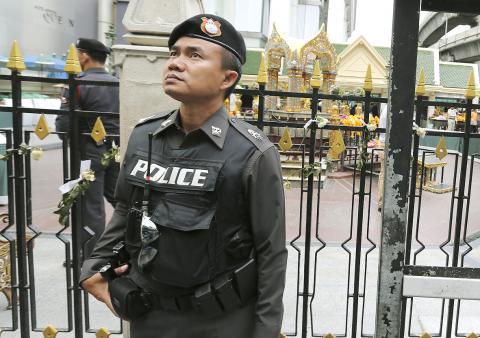
Photo: EPA
Colonel Winthai Suvaree, a spokesman for Thailand’s ruling junta, also said that closed-circuit television footage showing the main bombing suspect was used to trace the route he took to and from the site of Monday evening’s rush-hour attack.
He said that a police sketch of the suspect had been distributed to border posts.
Police spokesman Prawut Thawornsiri said he believes the perpetrator would have timed an escape carefully and “would not have much time to stay around.”
“I suspect that he may have left, but we will keep searching, in case we can find others who may be in the country or find clues, evidence and witnesses who may have seen him,” he told Channel 3 TV network.
Police have offered a reward that on Friday was raised to 3 million baht (US$85,000). On a police arrest warrant, the suspect is described as a “foreign man,” although a military spokesman said a connection to international terrorism seemed unlikely.
Thai police chief Somyot Poompanmoung said investigators would need some luck to catch those behind the attack.
“I have to say we need some luck. If the police have good fortune we might be able to make an arrest, but ... if the perpetrator has good fortune maybe they can get away,” he told reporters yesterday after a ceremonial show of security strength meant in part to reassure the public over safety.
So far, the operation to find who carried out the attack appears to have made little headway, with apparently contradictory statements coming from the military-backed government and the police.
Theories abound as to who was responsible for the attack.
They include ethnic Uighurs unhappy that Thailand repatriated to China more than 100 of their countrymen who had fled from there; Islamic separatists who have been carrying out an insurgency in southern Thailand for a decade; frustrated supporters of former prime minister Thaksin Shinawatra angry at the military government that opposes his return to politics; and rival factions within the army contending for power.

Crowds in Bangladesh are flocking to snap photographs with an unlikely social media star — an albino buffalo with flowing blond hair nicknamed “Donald Trump” that is due to be sacrificed within days. Owner Zia Uddin Mridha, 38, said his brother named the 700kg bull over its flowing helmet of hair resembling the signature look of the US president. “My younger brother picked this name because of the buffalo’s extraordinary hair,” he said at his farm in Narayanganj, just outside the capital, Dhaka. Mridha said that a constant stream of curious visitors — social media fans, onlookers and children — have come throughout

It began as a satirical online project. Now millions of young people in India are flocking to it as an outlet for their frustration. A parody political party called the Cockroach Janta Party, with the insect as its symbol, has exploded across India’s social media by turning absurdist humor into protest. Memes and short videos mocking corruption, joblessness and political dysfunction have flooded social media sites, where millions of users are embracing the cockroach — known for its ability to survive harsh conditions — as a tongue-in-cheek symbol of endurance. The online movement’s rise has been unusually rapid. The Cockroach Janta Party (CJP)
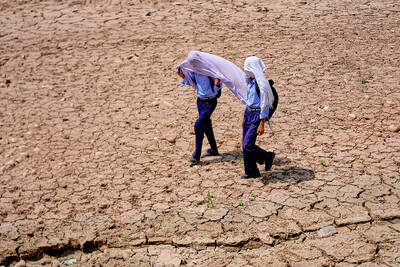
HOTTER: While Indians are accustomed to summer heat, climate change has caused northwestern India to warm faster than other parts of the country, an academic said Roads and markets have emptied during afternoons and some farmers have switched to nighttime work to avoid scorching temperatures as a heat wave grips large parts of India. The India Meteorological Department forecast maximum temperatures for yesterday of about 45°C in the capital, New Delhi, where authorities have opened temporary “cooling zones” to help people cope. The weather department warned that conditions would likely persist across several northern regions in the coming days, with temperatures staying well above seasonal averages. Authorities urged people to stay indoors during the hottest hours and take precautions against heat-related illnesses. India declares a heat wave whenever maximum temperatures
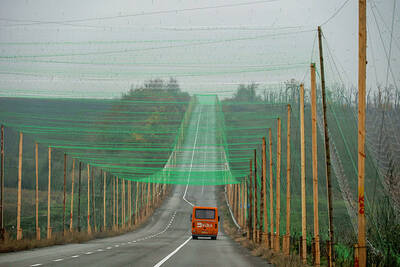
BIGGER ROLE: Beijing has said it maintains an impartial stance on the war in Ukraine, but by training Russian troops, China is far more involved than previously known China’s armed forces secretly trained about 200 Russian military personnel in China late last year, and some have since returned to fight in Ukraine, according to three European intelligence agencies and documents seen by Reuters. While China and Russia have held a number of joint military exercises since Moscow’s full-scale invasion of Ukraine in 2022, Beijing has repeatedly said that it is neutral in the conflict and presents itself as a peace mediator. The covert training sessions, which predominantly focused on the use of drones, were outlined in a dual-language Russian-Chinese agreement signed by senior Russian and Chinese officers in Beijing on


 RSS
RSS